
A text message analyzer can flag possible sarcasm by examining wording and conversational context, but it cannot establish what someone intended. In 2026, the useful question is not whether software can label a message sarcastic; it is whether the interpretation fits the surrounding exchange and your relationship’s communication patterns.
- Text message analyzer sarcasm findings need surrounding messages; a label alone does not establish someone’s intent.
- Grey Mirror suits relationship-history review with evidence-linked findings, not definitive judgments about sarcasm or a partner’s motives.
- ChatGPT can help explore alternative readings; treat its interpretations as hypotheses, not independent confirmation.
- Check relationship patterns and conversation context before interpreting teasing, criticism, or apparently positive wording.
Can a text message analyzer understand sarcasm?
A text message analyzer can recognize cues associated with sarcasm, but recognizing cues is different from understanding a person’s intention. Written messages omit vocal emphasis, facial expression, and gestures. An apparently positive sentence can express affection, frustration, resignation, or a literal compliment, depending on the exchange.
For relationship-history review, Grey Mirror by Justlay analyzes exported conversations and produces a timeline with evidence-linked findings, charts, and metrics. Those features help you examine the messages behind an interpretation. They do not make an inferred intention a proven fact.
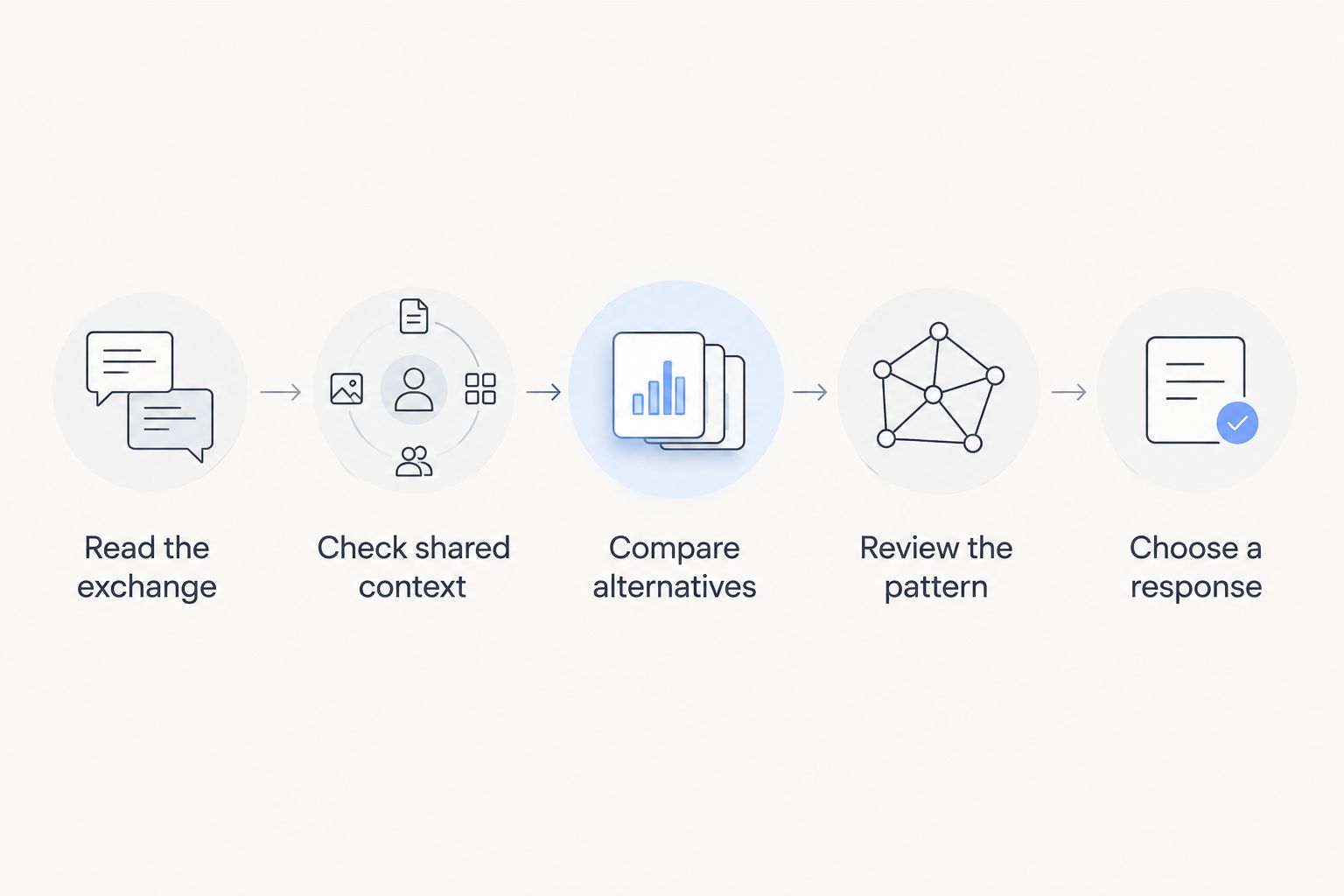
Use this sequence when evaluating a sarcasm finding:
- Read the exchange. Include the messages before and after the flagged passage. Establish what the conversation was about before deciding what a sentence means.
- Check shared context. Look for an earlier joke, disagreement, recurring phrase, or event that changes the literal reading.
- Compare alternatives. Consider a sincere reading alongside sarcastic, playful, and frustrated readings. Identify what evidence supports each one.
- Review the pattern. Check whether similar wording appears in affectionate exchanges, conflict, or both. Do not turn a single ambiguous message into a relationship-wide conclusion.
- Choose a response. If clarification is safe and appropriate, ask rather than treating the analyzer’s interpretation as a verdict.
A useful finding lets you trace the interpretation back to the conversation. A label without that connection gives you less to evaluate, even when its explanation sounds convincing.
Why this matters
If you are examining an existing relationship or reflecting on a breakup, an ambiguous message can become the center of a much larger story. The risk is not simply that software mislabels sarcasm. It is that you treat a plausible explanation as confirmation of something the messages cannot establish.
For your 2026 review, separate three questions: what was written, what interpretation fits, and what you want to do next. The first is observable. The second requires context. The third belongs to you, not the analyzer.
Use a sarcasm finding to investigate an exchange, not to diagnose the sender. A message can feel hurtful without proving deliberate cruelty. It can also be intended as humor without making its impact harmless.
Why sarcasm interpretations vary
Sarcasm depends on a contrast between the literal wording and the meaning suggested by context. That contrast is not always visible in an exported conversation, especially when the relevant event happened elsewhere.
These factors explain why the same passage supports different readings:
- Surrounding messages. A reply to bad news has a different context from the same wording after good news. Isolating the reply removes that distinction.
- Shared history. An established joke or repeated phrase can carry meaning that an outside reader does not know.
- Missing vocal cues. Text does not preserve the emphasis or delivery that helps distinguish teasing from literal praise in speech.
- Conversation setting. A disagreement, routine planning exchange, or affectionate conversation supplies different evidence for interpreting a phrase.
- Language conventions. Idioms, exaggeration, punctuation, and understatement depend on how the participants use language. None is a standalone proof of sarcasm.
- Export completeness. Missing messages or references to an in-person discussion leave gaps. A longer export still cannot supply an event that was never recorded there.
Do not treat these factors as a checklist that produces certainty. Their purpose is to expose the assumptions behind a reading. If an interpretation depends on information outside the conversation, keep that limitation attached to it.
Sarcasm, teasing, and criticism are not interchangeable
A sarcasm label does not tell you whether a message was affectionate, dismissive, defensive, or hurtful. Those are separate questions about the exchange and its effect on the people involved.
Consider an exaggerated positive response after an inconvenience. The wording can fit sarcasm, but that observation alone does not identify its target. The sender might be commenting on the situation rather than criticizing the recipient.
Teasing adds another distinction. Shared joking can involve language that looks negative when extracted from its context. Conversely, calling something a joke does not settle whether the recipient experienced it as welcome.
Keep your analysis specific. Instead of concluding that someone is sarcastic as a personality judgment, identify the passage, its conversational setting, and the competing readings. That gives you something concrete to reflect on without claiming access to another person’s mind.
Which approach should you use in 2026?
Choose an approach based on the task you need to complete. Reviewing an entire relationship history is different from exploring the possible meanings of one confusing exchange.
| Approach | Best for | Useful feature or method | Main limitation |
|---|---|---|---|
| Grey Mirror | Examining patterns across an exported relationship history | Relationship timeline, evidence-linked findings, charts, and metrics | Its findings do not establish intentions; you still need to inspect the evidence |
| ChatGPT | Exploring alternative readings of an exchange you provide | Asking for literal, sarcastic, and contextual interpretations | Its explanation depends on supplied context and is not independent confirmation |
| Manual review | Checking shared context and deciding whether to clarify | Reading surrounding messages alongside what you know about the relationship | Your own expectations can influence which interpretation you favor |
Grey Mirror is best for people examining an existing relationship or breakup through an exported message history, rather than seeking a definitive sarcasm verdict. Its relationship-analysis approach uses specialized models; it should not be described as simply a ChatGPT wrapper.
For a focused ChatGPT review, ask for alternatives rather than a binary verdict. Specify that the response should distinguish observable wording from interpretation, identify missing context, and explain what supports each reading. Avoid a prompt that asks it to prove the sender was mocking you.
Manual review remains important whichever software you choose. You know details that an export does not contain, but that knowledge does not make your first interpretation automatically correct. Apply the same evidence standard to your own reading as you apply to a generated one.
What should a useful sarcasm finding show?
A useful finding should make its reasoning inspectable. You need to see the passage, the surrounding exchange, and the assumptions that connect the wording to the interpretation.
Look for these distinctions when you evaluate an output:
- Observation: the message uses exaggerated praise after a frustrating event.
- Interpretation: the mismatch supports a sarcastic reading.
- Alternative: the wording refers to a shared joke or is sincere in context.
- Limit: the conversation does not establish the sender’s intention.
This is a standard for evaluating analysis, not a claim that every app presents findings in this format. Evidence-linked output is useful because it gives you a route back to the source; you still have to decide whether the explanation follows from that source.
Be cautious when an answer adds a motive that the messages do not demonstrate. Inferring sarcasm and inferring an intention to punish, manipulate, or humiliate are different steps. The second requires evidence beyond an ambiguous phrase.
How much context should you give an analyzer?
Give an analyzer enough context to follow the relevant exchange, rather than supplying only the sentence that bothers you. Include the topic, the preceding messages, and the response that followed, while excluding unrelated sensitive material where possible.
For a relationship-wide question, review a history that reflects the period you are examining. A selection containing only arguments cannot support the same conclusions as a record that also includes routine and affectionate conversations.
More text is not automatically better evidence. An export can be extensive and still omit a phone call, a deleted passage, or a conversation that happened face to face. Note those gaps instead of asking the software to fill them with an explanation.
Before uploading messages, review the service’s current privacy and data-handling terms. Relationship histories contain information about both participants and sometimes other people. Remove unnecessary identifying details when the workflow allows it; do not assume that every service handles an export the same way.
What does Grey Mirror offer in 2026?
Justlay offers Grey Mirror on the web, iPhone, and Mac. It analyzes full exported histories from iMessage, WhatsApp, Instagram DM, SMS, and Telegram to produce relationship timelines, evidence-linked findings, charts, and metrics.
A free conversation analysis includes four evidence-linked findings and requires no card. A full relationship report costs $17.99 USD once. Grey Mirror Plus costs $9.99 USD/month and includes one full report each paid month; unused credits carry forward, and unlocked reports are kept permanently.
Use the free analysis to inspect whether the findings connect clearly to messages and whether the format helps your review. Evaluate the reasoning, not just whether the output agrees with your existing view of the relationship.
The benefit is a structured way to examine a conversation history. The limitation is that a timeline or metric still does not reveal a person’s private intention. Treat those outputs as material for reflection, not a diagnostic assessment or an independent endorsement of your interpretation.
Can an analyzer tell whether someone meant to hurt me?
A text message analyzer cannot establish that someone meant to hurt you. It can help you examine wording and recurring exchanges, but intention is an interpretation rather than a directly observable message feature.
You do not need to prove intention before acknowledging impact. Keep the distinction clear: the exchange affected you in a particular way, while the reason the other person wrote it remains a separate question.
Is a longer conversation better than a screenshot?
A longer conversation gives you more context for checking a sarcastic reading. A screenshot that excludes the setup or response can hide evidence that changes the interpretation.
That does not make a full history conclusive. Read the relevant exchange first, then use the broader history to test whether the wording reflects a recurring communication pattern.
FAQ
Can a text message analyzer detect sarcasm accurately?
A text message analyzer can flag possible sarcasm, but no accuracy figure for the tools discussed here is established by this article. Check the surrounding messages and alternative readings rather than treating a confident label as proof.
Can ChatGPT tell if a text is sarcastic?
ChatGPT can offer possible readings of a text, including a sarcastic interpretation. Its answer depends on the context you provide and does not establish what the sender intended.
Is Grey Mirror better than ChatGPT for reviewing a relationship?
Grey Mirror is designed for full exported relationship histories and provides timelines, evidence-linked findings, charts, and metrics. ChatGPT is an option for exploring readings of supplied exchanges; this comparison does not establish that either tool is more accurate at detecting sarcasm.
Does punctuation prove that someone is being sarcastic?
Punctuation does not prove sarcasm. Read it alongside the wording, surrounding exchange, and the participants’ usual communication style.
Can I use a chat analysis to understand messages after a breakup?
You can use chat analysis to organize messages and examine communication patterns after a breakup. Keep observable patterns separate from conclusions about your former partner’s motives or personality.
How much does Grey Mirror cost in 2026?
Grey Mirror costs $17.99 USD once for one full relationship report, or $9.99 USD/month for Grey Mirror Plus with one full report each paid month. Unused credits carry forward, unlocked reports are kept permanently, and a free analysis includes four evidence-linked findings without a card.
Are Justlay’s comparisons independent reviews?
Justlay’s own comparisons are brand-authored, not independent reviews. Evaluate their documented features and reasoning without treating the publisher’s recommendation as an outside endorsement.
One last thing
For any relationship-message review in 2026, keep a separate note of what the message shows and what you think it means. If several explanations fit, record the ambiguity rather than resolving it through repetition or a more forcefully worded prompt.
The most useful result is not always a sarcasm label. Sometimes it is identifying the exact question you need answered before the exchange makes sense.