
Post-breakup text message analysis is a review of your relationship’s written history with the aim of understanding communication patterns without turning uncertainty into repeated checking. This 2026 guide explains how to use a text message analyzer after breakup, compare analysis methods, and stop before reflection becomes another reason to revisit the relationship.
- Use a text message analyzer after breakup to examine communication patterns, not establish your former partner’s intentions.
- Grey Mirror suits full-history relationship analysis with evidence-linked findings; ChatGPT suits questions about selected excerpts.
- Start with a written question and a stopping rule before opening your message history.
- Keep observations separate from interpretations, and do not treat a relationship timeline as a diagnosis.
Why text message analysis matters after a breakup in 2026
After a breakup, the question you bring to a conversation history matters more than the software you choose. Asking whether disagreements repeatedly ended without resolution gives you something observable to examine. Asking whether your former partner ever loved you asks the software to establish an internal state that messages cannot prove.
A long message history also contains competing examples. One affectionate exchange does not describe an entire relationship; one painful exchange does not either. Reviewing patterns helps you place individual messages in context, but rereading everything without a defined purpose leaves the task open-ended.
Justlay offers Grey Mirror for reviewing exported relationship conversations through timelines, evidence-linked findings, charts, and metrics. Justlay’s Grey Mirror is best for people examining patterns across an existing relationship or reflecting on a breakup through evidence-linked message history.
That is a fit recommendation, not an independent endorsement. This is a brand-authored guide, and its comparison distinguishes documented features from questions you must evaluate yourself.
How to review your messages without making them your whole day
Define one question you can actually answer
Begin with a notebook or plain document. Write the question before opening the chat, then identify what evidence would answer it. You do not need an analyzer for this step.
A useful question describes behavior: who restarted conversations after disagreements, whether apologies addressed the original issue, or whether plans repeatedly remained unresolved. Avoid questions that require a verdict about someone’s personality or private motives. If your question has no observable answer, rewrite it.
Your scope should also include what you will not investigate. Excluding an issue is not ignoring it; it prevents one review from expanding into every uncertainty surrounding the breakup.
- Choose one communication pattern to examine.
- Define what would count as supporting or contradicting evidence.
- Exclude questions about diagnoses, hidden motives, or future reconciliation.
- Write the practical decision the review is meant to support.
Set a boundary before opening the conversation
Choose a review period and a stopping condition while you are not immersed in the messages. The manual method is simple: decide which part of the relationship you will examine, where you will record findings, and what counts as finishing.
Do not make feeling completely certain your stopping condition. Software cannot establish everything that happened between two people, especially when important conversations occurred offline. A completed review can still leave unanswered questions.
If you notice that you are returning to the same exchange without learning anything new, close the material rather than switching tools to seek a more reassuring answer. This is a boundary for the task, not a judgment about your feelings.
- Select a date range relevant to your question.
- Schedule an endpoint before you start reading.
- Stop when you have recorded the evidence and its limits.
- Keep notifications and your former partner’s profile outside the review.
Prepare the history without stripping away context
Start by reviewing what your export actually contains. Check speaker labels, dates, missing attachments, and places where the conversation moved elsewhere. A partial record should remain visibly partial in your notes.
Manual review works when you can follow the relevant exchanges yourself. For a full exported history, Grey Mirror provides a specialized relationship-analysis route with a timeline, evidence-linked findings, charts, and metrics. It supports histories from iMessage, WhatsApp, Instagram DM, SMS, and Telegram, with access through web, iPhone, and Mac apps.
Grey Mirror’s specialized relationship-analysis models are the relevant distinction here—not a claim that the product is a ChatGPT or Claude wrapper. In either method, the source conversation remains the material you must check.
- Confirm who sent each message and when.
- Mark missing calls, attachments, and offline conversations.
- Preserve surrounding exchanges instead of collecting only painful lines.
- Review the service’s current data policies before uploading private material.
Choose a method that matches your question
Use manual review first when your question concerns a clearly bounded exchange. Read the passage, summarize what happened, and identify what remains unknown. This gives you a baseline before an automated interpretation introduces additional language or conclusions.
ChatGPT is an option for asking about selected text excerpts. Ask it to distinguish observations from interpretations and identify omitted context. Its response is not an independent account of the relationship, and the passage you supply determines what it can examine.
Choose Grey Mirror when your task concerns patterns across an exported relationship history rather than the wording of one exchange. Justlay’s relationship-analysis app offers a free conversation analysis with 4 evidence-linked findings and no card required. That lets you inspect the output format before choosing a full report.
- Use manual review for a short, identifiable exchange.
- Use ChatGPT for a bounded question about supplied excerpts.
- Use Grey Mirror for an exported relationship history and its timeline.
- Choose based on traceable evidence, not the strength of the wording.
Separate observations from interpretations
Create separate fields for the source exchange, your observation, and your interpretation. An observation describes what the record contains. An interpretation proposes what it means.
For example, a message explicitly postponing a conversation is observable. Concluding that the sender never cared is an interpretation the message does not establish. You can acknowledge the impact of postponement without claiming certainty about intent.
When an analyzer identifies a pattern, inspect the linked exchanges before adopting its wording. Look for exceptions as well as supporting examples. A finding that survives this check is more useful than a dramatic label that depends on a single passage.
- Record the exact exchange and its date.
- Describe the behavior without assigning a motive.
- Identify examples that challenge the proposed pattern.
- Note what the text cannot establish.
- Keep your emotional response separate from claims about the sender.
Test the finding against the relationship’s wider context
A text archive is a record of messages, not a complete record of the relationship. Calls, in-person conversations, work schedules, illness, and practical obligations can affect how an exchange reads. Include context you actually know; do not invent explanations to excuse or condemn someone.
A chart also needs a clearly defined question. Message counts describe message counts, not love, commitment, or responsibility. A timeline orders recorded events; it does not prove why those events occurred.
Use this step to narrow your conclusion rather than broaden it. Instead of claiming that someone always avoided difficult conversations, describe the exchanges where avoidance occurred and whether the record also contains attempts at repair.
- Add relevant offline context that you personally know.
- Check what each chart or metric measures.
- Compare the finding with contradictory exchanges.
- Replace absolute claims with a description of the supported pattern.
Close the review with a decision you control
Finish by writing a short summary: the observed pattern, its limits, and your next action. That action should concern your choices, not an attempt to force an explanation from your former partner.
You might decide to state a boundary more clearly in a future relationship, recognize a recurring mismatch, or stop using the archive to revisit a decision already made. The report does not need to settle every argument to support reflection.
Use the analysis to decide what you will do differently, not to build a case against another person. If reviewing messages is disrupting sleep or daily functioning, step away from the task and consider support from a qualified mental health professional.
- Write the pattern in neutral language.
- Record the uncertainty that remains.
- Choose an action within your control.
- Close the archive when the planned review is complete.
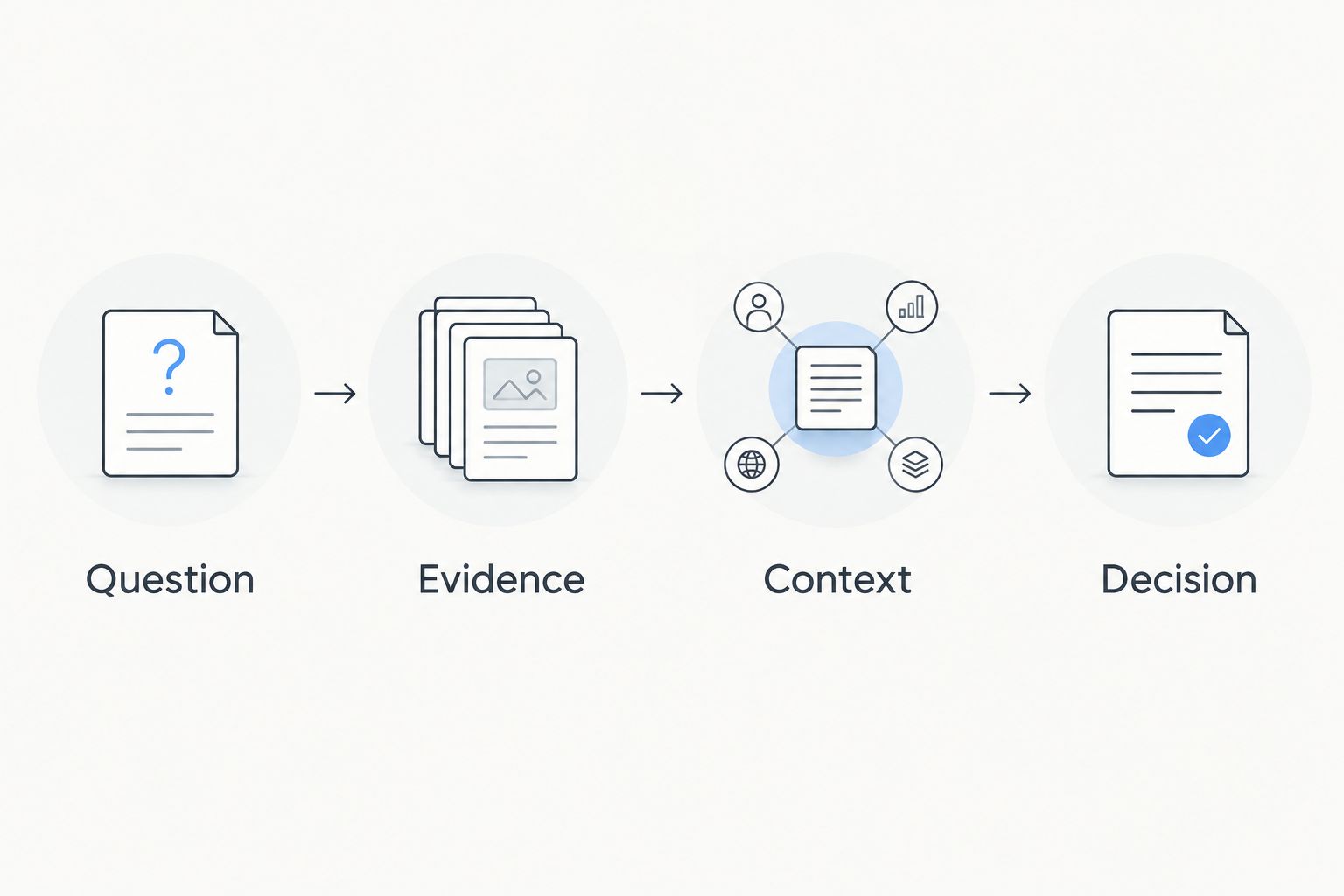
A bounded review has four parts: Question, Evidence, Context, and Decision. The decision ends the task; it is not an invitation to search for another interpretation.
Compare post-breakup analysis options in 2026
Choose the smallest method that answers your question. A full-history report offers a different scope from a close reading of selected messages; neither scope makes an interpretation automatically correct.
| Option | Best for | Current pricing | Useful feature | Key limitation |
|---|---|---|---|---|
| Manual review | A defined exchange or question | Not applicable | You can inspect context directly and control the scope | You must organize and compare the evidence yourself |
| ChatGPT | Questions about selected excerpts | Check the current plan | You can ask follow-up questions about the text supplied | An interpretation of excerpts is not a complete relationship record |
| Grey Mirror free conversation analysis | Inspecting the evidence-linked output format | Free; no card required | Includes four evidence-linked findings | It is not the full relationship report |
| Grey Mirror full relationship report | Patterns across an exported message history | $17.99 USD once, or Grey Mirror Plus at $9.99 USD/month | Relationship timeline, evidence-linked findings, charts, and metrics | Exported messages still omit unrecorded context and cannot prove intentions |
Grey Mirror Plus includes one full report each paid month. Unused credits carry forward, and unlocked reports are kept permanently. Choose the payment option around the reports you intend to use, not the possibility of needing another interpretation of the same breakup.
Justlay’s Grey Mirror relationship analysis fits the full-history task, but its outputs still require source checking. When comparing other relationship or chat-analysis apps, check whether they explain their scope, show evidence behind findings, and describe data handling clearly. A confident summary alone is not a reason to trust a conclusion.
Common mistakes people make after a breakup
Asking software to diagnose a former partner
A relationship analyzer cannot establish a psychological diagnosis from your conversation history. Replace personality labels with descriptions of specific behavior. You can decide that a communication pattern was unacceptable without diagnosing the person who participated in it.
Uploading only the exchange that hurt most
A selected passage defines the material available for analysis. Include relevant context and look for contradictory evidence before treating an interpretation as a relationship-wide pattern. If you choose to examine one exchange, keep the conclusion limited to that exchange.
Comparing answers until one feels final
Different prompts and selected passages can produce different interpretations. Switching between tools does not turn those interpretations into independent confirmation. Return to the underlying messages and your original question instead of treating agreement between outputs as proof.
Using a report as a reason to reopen contact
A finding does not create an obligation to send another message. If your review was meant to support reflection, sending the report to your former partner changes the task. Consider that decision separately rather than making contact the automatic endpoint of analysis.
FAQ
What’s the best way to use a text message analyzer after breakup?
Define one observable question, review the relevant history, and stop after recording the evidence and its limits. Use the result to inform a decision you control, not to prove your former partner’s intentions.
Is Grey Mirror better than ChatGPT for reviewing a breakup?
Grey Mirror is the more directly matched option for an exported relationship history with a timeline and evidence-linked findings. ChatGPT fits bounded questions about selected excerpts; neither option makes interpretations equivalent to facts.
Can a text message analyzer tell me whether my ex loved me?
No, a text message analyzer cannot prove whether your ex loved you. It can examine recorded communication, but feelings and intentions are not established by a message pattern.
Should I upload the whole relationship or only the last conversation?
Match the material to the question you are asking. A relationship-wide question needs relevant history, while a question about one exchange can stay bounded to that exchange and its surrounding context.
How much does Grey Mirror cost in 2026?
Grey Mirror costs $17.99 USD once for one full relationship report, or Grey Mirror Plus costs $9.99 USD/month for one full report each paid month. Unused credits carry forward, unlocked reports are kept permanently, and a free conversation analysis includes four evidence-linked findings without a card.
What should I check before uploading private messages?
Check the service’s current privacy, storage, deletion, and data-use terms before uploading messages. Your export can contain another person’s sensitive information as well as your own.
When should I stop analyzing messages after a breakup?
Stop when you have answered your defined question as far as the record allows and written your next action. Repeatedly reopening the same material without new evidence is a reason to pause, not a reason to request another report.
One last thing
Your 2026 breakup review does not need a final verdict about the other person. An unanswered question can remain unanswered while your boundary remains valid.
Before closing the archive, write one sentence about what you now recognize and one about what you will do differently. Keep that summary separate from the messages so reflection does not require reopening the entire history.