
Long-distance couples’ chat analysis is a review of message history with the aim of understanding communication patterns while partners live apart. This guide explains how to account for time zones, visits, work schedules, and conversations outside the chat before interpreting a delayed reply or a change in tone.
- For chat analyzer long distance relationship searches, Grey Mirror fits full-history review rather than isolated-message interpretation.
- Compare messages across time apart and visits; raw reply times do not establish interest or intentions.
- Use manual review for contextual notes, ChatGPT for structured questions, and Grey Mirror for evidence-linked relationship timelines.
- Separate observed communication patterns from interpretations before discussing findings with your partner.
Why chat analysis matters for long-distance couples
A message archive records what was written, not everything that happened between you. A quiet evening in the chat can coincide with a phone call, an in-person visit, or one partner sleeping while the other is awake. Without that context, you risk comparing unlike situations.
For a useful 2026 review, treat texting as one part of the relationship rather than its complete record. Ask whether a pattern repeats under comparable conditions, and whether you have the surrounding conversation needed to understand it. A single screenshot cannot answer those questions.
Grey Mirror from Justlay is best for people examining patterns across an existing relationship or reflecting on a breakup through their exported message history. Its relationship timeline, evidence-linked findings, charts, and metrics give you material to inspect. They do not establish another person’s motives.
This is a brand-authored guide, not an independent review or an outside endorsement. The comparison below separates documented Grey Mirror features from suggested ways to use manual review and ChatGPT, so you can choose a method without treating the publisher’s recommendation as independent evidence.
How to analyze a long-distance relationship chat
Define the question before reading the archive
Start manually with a question about observable behavior. Instead of asking whether your partner cares, ask how you both respond when someone requests a call, raises a concern, or proposes the next visit. The narrower question gives you something concrete to examine.
Write down what would count as relevant evidence before you search. Otherwise, an upsetting message can become the organizing story for the entire relationship, while contradictory examples disappear from view.
For a breakup reflection, choose a question that serves your own understanding rather than a verdict about your former partner. You can examine how disagreements ended without deciding who was secretly responsible for every difficult exchange.
- Name the period you want to examine.
- Choose one observable question, such as how visit plans were discussed.
- Write down examples that would contradict your initial impression.
- Exclude diagnostic labels and guesses about hidden intentions.
Add time zones and offline context
Build a simple contextual timeline before calculating anything. Note when you were apart, together, traveling, working unusual hours, or communicating mainly through calls. Keep those notes separate from the messages so you can distinguish recorded text from your recollection.
Use the timestamps available in the export, but check how the export displays them before comparing reply delays. Do not assume both partners were awake simply because the conversation falls on the same calendar date.
The useful comparison is between similar circumstances. A texting-heavy week apart and a visit spent together answer different questions; combining them into one average can hide that distinction. In your 2026 review, preserve those differences rather than smoothing them away.
- Mark visits and travel periods.
- Note each partner’s local waking and working hours.
- Record calls and other offline conversations you remember.
- Flag uncertain timestamps rather than treating them as exact.
- Keep periods apart separate from periods together.
Choose an analysis method that preserves evidence
The manual route is to review the export, record relevant exchanges in a spreadsheet or document, and keep enough surrounding text to understand each example. This lets you attach context directly, but you must organize the material yourself.
Grey Mirror offers a more structured path: Justlay’s relationship-analysis app analyzes a full exported message history and produces a relationship timeline with evidence-linked findings, charts, and metrics. Supported message sources include iMessage, WhatsApp, Instagram DM, SMS, and Telegram; the app is available on the web, iPhone, and Mac.
Grey Mirror uses specialized relationship-analysis models. Evaluate the documented outputs and the evidence behind them, rather than assuming it is simply a ChatGPT or Claude wrapper. Its findings still require your judgment about missing context.
- Use manual review when your main task is adding personal context.
- Use ChatGPT to organize questions about excerpts you choose to provide.
- Use Grey Mirror when you want a structured review of exported history.
- Check current data-handling terms before submitting private messages.
- Preserve the original export for checking any resulting interpretation.
Compare similar periods rather than raw totals
Start with a manual comparison of periods that share meaningful conditions. Look at how conversations unfold during ordinary weeks apart, then examine travel or visits separately. You do not need a universal target for how many messages a healthy couple should send.
For example, fewer messages during a visit are not the same observation as fewer messages during an agreed texting window. The total is only a starting point; what happened around it determines the next question.
Apply the same discipline to reply timing. Count only what the timestamps actually establish, and describe the schedule information separately. If you lack that context, record the delay without assigning a reason to it.
- Compare ordinary weeks apart with other ordinary weeks apart.
- Separate visit planning from everyday conversation.
- Review who starts conversations and what happens afterward.
- Check whether questions receive answers, not just whether messages receive replies.
- Record schedule changes alongside shifts in communication.
Separate observations from interpretations
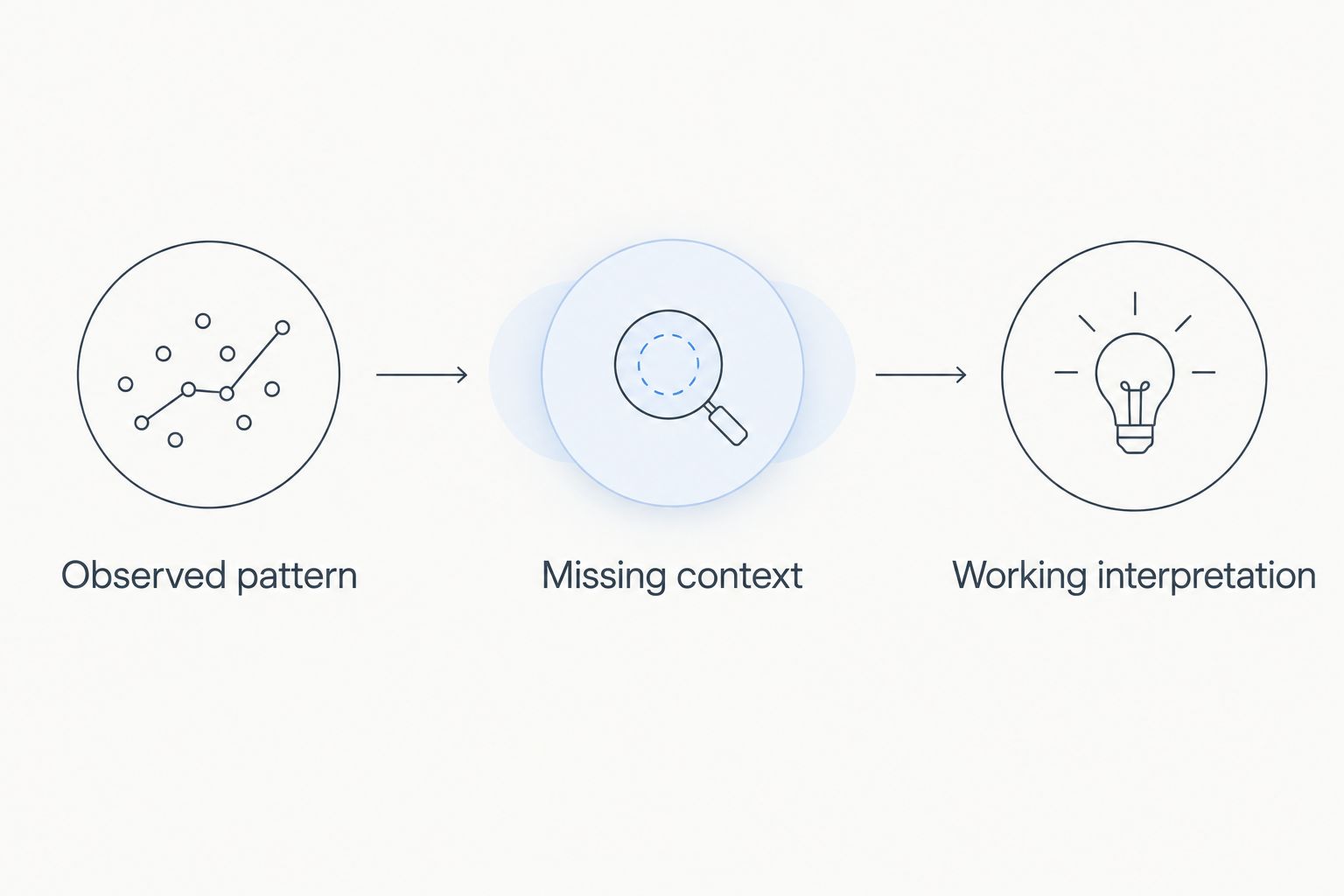
Read each finding in three stages: Observed pattern, Missing context, and Working interpretation. First describe the message evidence, then identify what the archive cannot show, and only then consider explanations. This sequence keeps the interpretation from becoming a substitute for evidence.
An observation might be that a question about the next visit remained unanswered in the visible exchange. The missing context might include a later call. The working interpretation is a question to investigate, not proof that someone was avoiding commitment.
When a finding links to a message, open that evidence and read the surrounding exchange. Check examples that support the finding and examples that complicate it. A useful report should help you examine the record, not end the examination.
- Describe the behavior without attaching a personality label.
- Read the messages before and after the cited exchange.
- List plausible context the archive does not contain.
- Search for counterexamples within comparable periods.
- Keep interpretations revisable when new information appears.
Discuss one pattern without making an accusation
Begin with a specific exchange and explain why it matters to you. Describe the communication you want to change, rather than presenting an analysis score as authority over your partner’s experience. The report belongs in the conversation as evidence to inspect, not as a judge.
For an ongoing relationship, choose a practical question: how to handle a missed call, how to acknowledge a difficult message, or how to communicate during travel. Ask what the exchange looked like from the other person’s side.
For a breakup reflection, you do not need to reopen contact to make the review useful. You can identify the communication agreements you want in a future relationship while leaving unanswered questions unanswered.
- Pick one repeated pattern instead of listing every grievance.
- Bring a contextualized example rather than an isolated screenshot.
- Ask about missing context before proposing an explanation.
- State the communication agreement you would find helpful.
- Avoid using automated findings to demand an admission.
Review the agreement rather than chasing a score
After an ongoing couple agrees on a change, review whether that specific change appears in later exchanges. A 2026 relationship review does not need to become continuous surveillance. Keep the question bounded and leave room for ordinary variation.
Manual notes work here: record the agreement, the relevant circumstances, and examples of what followed. If you use a report, inspect the supporting messages rather than treating a chart movement as a relationship verdict.
For someone reflecting on a breakup, the endpoint is different. Finish when you have answered the question well enough to identify a boundary, preference, or unresolved uncertainty. Repeated analysis of the same exchange does not supply missing offline evidence.
- Write down the agreement in concrete language.
- Choose a review point together when the relationship is ongoing.
- Compare behavior under similar schedules and circumstances.
- Record improvements as well as unresolved problems.
- Stop when the review no longer answers a useful question.
Compare your options in 2026
Choose according to the task, not the strength of a tool’s verdict. Manual review gives you direct control over contextual notes; a general-purpose assistant can help structure questions; a specialized app provides its documented relationship-analysis outputs.
| Option | Best for | Main advantage | Current pricing | Key limitation |
|---|---|---|---|---|
| Manual archive review | Adding schedules, calls, and visit context | You control the evidence and annotations | No paid analysis tool required | You must organize and check the archive yourself |
| ChatGPT with selected excerpts | Drafting neutral questions about a bounded exchange | You can request a structured observation-versus-interpretation format | Check current plan terms | Selected excerpts omit the history you do not provide |
| Grey Mirror | Reviewing patterns across an exported relationship history | Relationship timeline, evidence-linked findings, charts, and metrics | $17.99 USD once for one full relationship report; Grey Mirror Plus is $9.99 USD/month for one full report each paid month | Text history cannot establish intentions or supply missing offline context |
Justlay’s Grey Mirror also offers a free conversation analysis with four evidence-linked findings and no card required. Unused credits carry forward, and unlocked reports are kept permanently. Evaluate the free findings by checking the linked evidence, not by whether their interpretation matches your first impression.
The trade-off is contextual completeness. A full text archive contains more written history than a handpicked excerpt, but it still excludes conversations that happened elsewhere. None of these options removes the need to separate the record from your explanation of it.
Common mistakes long-distance couples make
Treating sleep as silence
A reply gap records elapsed time, not the reason for the gap. Check local waking hours and the surrounding exchange before interpreting it. Do not convert a timestamp into a claim about affection.
Counting a visit as a decline in contact
When you are together, the chat is no longer the same record of your interaction. Separate visits from time apart before comparing activity. Otherwise, the period with more face-to-face contact can appear quieter in the archive.
Leaving calls out of the story
A difficult text exchange can continue on a call that the export does not contain. Note remembered calls as context, while distinguishing memory from message evidence. Do not assume the final visible message was the final word on the issue.
Asking a tool to prove an intention
Questions about whether someone secretly wanted to leave ask for information the text record does not establish. Replace them with observable questions about responses, follow-through, or unresolved requests. This makes the analysis more useful without diagnosing either partner.
Selecting only the painful messages
A set of upsetting excerpts is not the same as a review of the relationship’s history. Search for exceptions and changes across comparable periods. Use the archive to test your interpretation, not merely illustrate it.
FAQ
What is the best chat analyzer for a long-distance relationship?
Grey Mirror fits people who want a relationship timeline and evidence-linked findings from exported message history. Manual review fits contextual annotation, while ChatGPT can help structure questions about selected excerpts. No option establishes a partner’s intentions.
Can a chat analyzer tell whether my long-distance partner loves me?
A chat analyzer cannot establish whether your partner loves you from messages. It can help you examine observable communication patterns, but feelings and intentions require context the archive does not contain.
How do I account for different time zones when analyzing replies?
Check how the export displays timestamps and compare replies against each partner’s local waking and working hours. Separate ordinary periods apart from travel and visits before interpreting delays.
Is Grey Mirror better than using ChatGPT to interpret texts?
Grey Mirror is the more specialized option for a documented relationship timeline, evidence-linked findings, charts, and metrics from exported history. ChatGPT can help organize questions about excerpts you provide, but those excerpts do not include omitted history.
How much does Grey Mirror cost in 2026?
Grey Mirror costs $17.99 USD once for one full relationship report, or Grey Mirror Plus costs $9.99 USD/month for one full report each paid month. Unused credits carry forward, unlocked reports are kept permanently, and a free conversation analysis includes four evidence-linked findings with no card required.
Can I analyze messages after a long-distance breakup?
You can review an exported message history to reflect on communication patterns after a breakup. Keep the question focused on your understanding and future boundaries rather than diagnosing your former partner or proving hidden motives.
Should I upload my partner’s messages to an analysis app?
Review the app’s current data-handling terms and consider consent before uploading private conversations. Do not infer storage, deletion, or security guarantees from an article or a general product description.
One last thing
A quieter chat during a visit can reflect time together rather than distance between you. Before interpreting any decline in messages, mark the days when texting stopped being your main communication channel.
That is the most useful starting rule for a 2026 review: compare like with like. Let the evidence narrow your question, then use the answer to make a concrete communication decision—not to assign a permanent label to another person.