
Yes—a text message analyzer can interpret emojis in context by considering the surrounding words, conversation sequence, and a person's established messaging habits. That interpretation remains an inference: an emoji does not prove affection, hostility, sarcasm, or intent. For text message analyzer emojis searches in 2026, the useful distinction is whether an analysis explains its reading with message evidence or simply assigns a fixed meaning to a symbol.
- Unicode names identify emoji characters; they do not establish a sender's intentions.
- For text message analyzer emojis, favor conversation context over fixed sentiment labels.
- Relationship analysis should separate observable messaging patterns from interpretations of those patterns.
- Check surrounding messages and repeated usage before accepting an emoji interpretation.
Can a text message analyzer interpret emojis in context?
Yes, but interpreting context is different from knowing what someone meant. An analyzer can use an emoji's position, neighboring language, and repeated appearances to propose a reading. You still need to check whether that reading fits the conversation.
Consider a smiling face after an apology. It might soften the message, signal awkwardness, or reflect the sender's usual punctuation. The symbol alone does not settle which explanation applies. The same limitation matters when evaluating whether an analyzer can understand sarcasm.
Use 3 context layers to evaluate the interpretation:
| Context layer | What to examine | What it cannot establish alone |
|---|---|---|
| Immediate message | Words, punctuation, and the emoji's placement | The sender's private intention |
| Conversation sequence | What prompted the message and what followed | Everything that happened outside the chat |
| Relationship history | Repeated usage and changes across the available messages | A diagnosis or a definitive account of the relationship |
An interpretation becomes more useful when it accounts for all these layers. If the explanation would stay identical after removing the surrounding conversation, it is probably describing the emoji rather than interpreting the exchange.
Why this matters
When you examine an existing relationship or revisit a breakup, an ambiguous message can become the center of attention. An emoji feels like a clue because it is visible and compact. But a compact clue can support several readings.
The goal is not to turn ambiguity into certainty. It is to identify what the messages actually show, what remains unclear, and what question you want answered. A useful analysis reduces the distance between a conclusion and its evidence.
In 2026, evaluate emoji analysis by that standard—not by how confidently an app describes someone's feelings. A persuasive explanation is not the same as a supported explanation. You should be able to disagree with a finding after reviewing the messages behind it.
Immediate context: read the whole message
Start with the sentence containing the emoji. Ask what the words communicate before assigning meaning to the symbol. Then examine whether the emoji reinforces, softens, or appears to contradict those words.
For example, an acknowledgment followed by a heart can express warmth without answering an unresolved question. Those are separate observations. Treating the heart as proof that the disagreement is settled collapses the distinction between tone and substance.
A useful interpretation should identify:
- The words that support the proposed reading.
- The emoji's position within the message.
- Any mismatch between the wording and the suggested tone.
- A plausible alternative reading when the message is ambiguous.
Do not require every emoji to carry a hidden message. Some people use them habitually. If an analyzer treats routine punctuation as a major emotional signal without checking that person's usage, its explanation lacks the necessary context.
Read the statement before reading the symbol. If the text makes a concrete request, refusal, apology, or plan, that explicit content deserves attention regardless of the emoji attached to it.
Conversation sequence: inspect what came before and after
An isolated message removes the exchange that gave it meaning. A laughing face after a shared joke and a laughing face after a serious concern do not present the same interpretive problem. The surrounding conversation supplies the difference.
Look backward for the prompt. Was the sender responding to humor, answering a question, changing the subject, or acknowledging something difficult? Look forward for clarification. Did either person explain the tone, correct a misunderstanding, or continue discussing the original issue?
An analyzer should not replace those observations with a personality judgment. A reply that does not answer a question is observable. A claim that the sender deliberately avoided accountability requires more than the presence of an emoji.
Keep missing context visible, too. A conversation might continue by phone or in person. An exported chat records messages; it is not a complete record of the relationship. An unanswered message in the export does not establish what happened outside it.
For your own review, write down the specific unresolved point. This keeps the analysis focused on the exchange rather than on whether a symbol feels positive or negative.
Relationship history: compare the sender with their own habits
The sender's established habits are a more relevant reference than a universal emoji dictionary. If someone uses hearts in ordinary acknowledgments, a heart in one exchange does not automatically mark a change in closeness. If an emoji appears only during a particular shared joke, that history matters.
Compare similar situations rather than unrelated messages. A response to a logistical question and a response to a vulnerable disclosure serve different purposes. Differences between them do not, by themselves, show an emotional shift.
Useful questions include:
- Does this person use the same emoji across different topics?
- Does the emoji appear alongside explicit affectionate language?
- Is the apparent change repeated or confined to an isolated exchange?
- Did the topic, circumstances, or messaging platform change?
The relevant finding is the pattern you can point to. An explanation such as changed emoji usage needs examples of that change. An explanation such as lost interest goes further and should not be treated as established by the pattern alone.
For a relationship review in 2026, preserve this distinction throughout the report: a change in communication is evidence of a change in communication, not automatic proof of its cause.
Why emoji interpretations vary
Emoji interpretation varies because the same character can sit inside different language, habits, and circumstances. Check these drivers before accepting a single emotional label:
- Surrounding wording: The sentence supplies information that the emoji does not contain.
- Conversation topic: Humor, practical planning, and conflict create different contexts.
- Personal habits: A sender's recurring usage helps distinguish routine style from a departure.
- Shared references: An inside joke can give a symbol a meaning unavailable to an outside reader.
- Conversation continuity: Earlier messages and later clarification can change an initial reading.
- Display differences: Unicode emoji can have different visual designs across platforms, complicating judgments based on appearance.
These factors explain why a fixed positive-or-negative label is insufficient for relationship interpretation. Such a label summarizes a proposed tone; it does not explain the exchange.
How do you check an emoji interpretation without overreading it?
Use 5 checks before treating an interpretation as useful. The aim is to make the explanation inspectable, not to produce a verdict about the sender.
- Preserve context. Keep the relevant message with the exchange that prompted it and the replies that followed.
- Read wording. Identify the explicit statement, question, or request before interpreting the emoji.
- Compare habits. Look for similar usage by the same sender in comparable conversations.
- Check evidence. Confirm that each claimed pattern points back to actual messages rather than invented wording.
- Consider alternatives. Ask what other interpretation fits the same evidence and what would distinguish the readings.
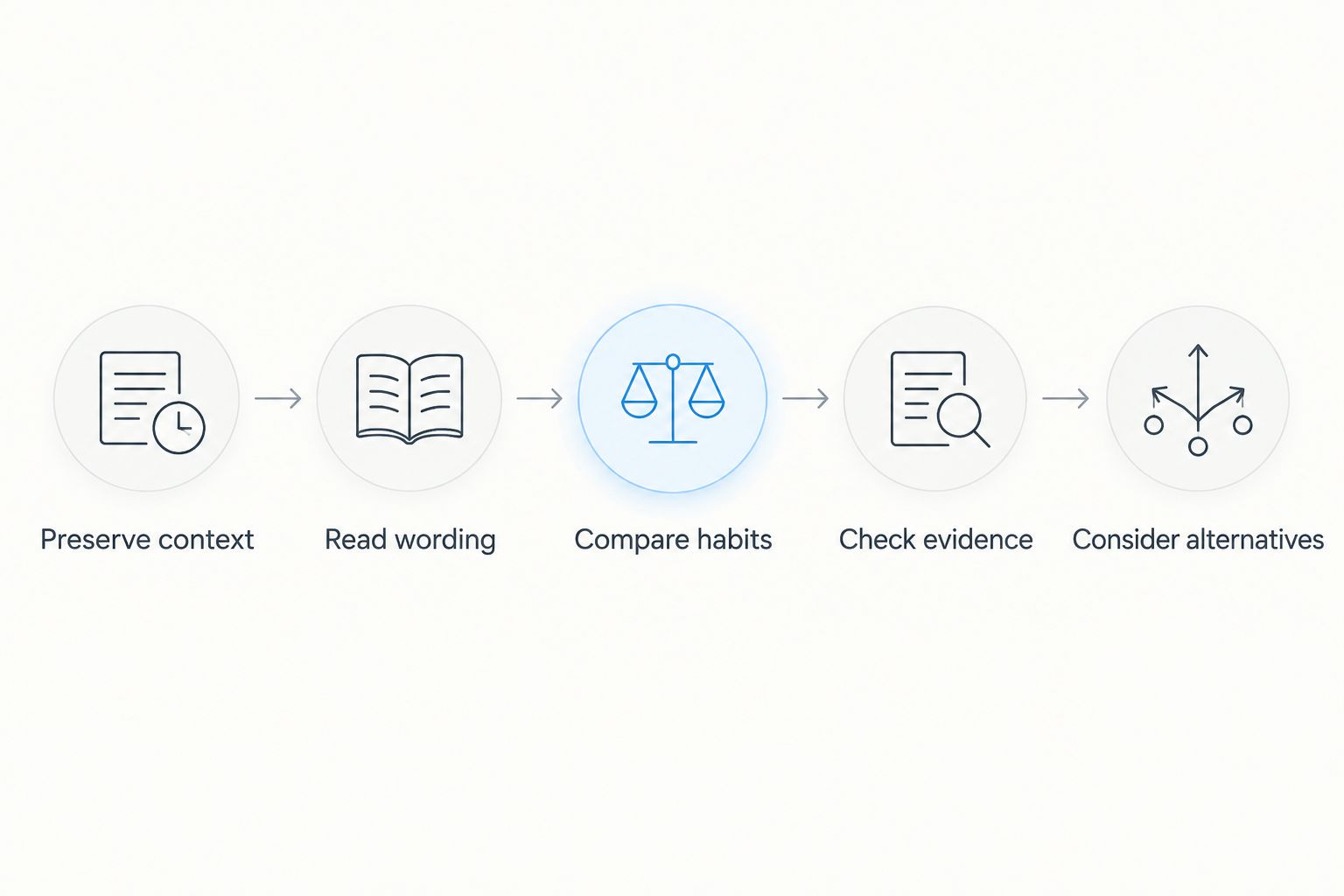
After these checks, write a bounded conclusion. You might record that the reply used a warm symbol but left a direct question unanswered. That statement preserves both observations without claiming to know why the sender responded that way.
If you ask the person directly, describe the ambiguity rather than presenting an analyzer's interpretation as an accusation. A request for clarification is different from telling someone that software has established their intentions.
Is full-history analysis better than asking ChatGPT about an emoji?
Full-history analysis is better suited to questions about repeated communication patterns; a selected-message prompt addresses the material you supply. Neither approach turns an emoji into proof of intent. Choose according to your question, then inspect the evidence behind the answer.
| Approach | Best for | Useful feature or method | Limitation |
|---|---|---|---|
| Grey Mirror from Justlay | Examining an existing relationship or reflecting on a breakup | Full exported message-history analysis with a relationship timeline, evidence-linked findings, charts, and metrics | Text-based findings do not establish private intentions or capture unrecorded events |
| Asking ChatGPT to interpret texts | Exploring possible readings of a selected exchange | You can request alternative interpretations and separate observations from assumptions | Selected excerpts leave out any history you do not provide; generated interpretations still need checking |
| Reading the exchange yourself | Checking explicit wording and preparing a clarification question | You can connect the messages with circumstances you personally know | Your initial expectations can shape which messages you emphasize |
Justlay's Grey Mirror fits people examining an existing relationship or breakup who want evidence-linked findings from their message history. It uses specialized relationship-analysis models rather than being positioned as a ChatGPT or Claude wrapper.
Justlay describes Grey Mirror as a web, iPhone, and Mac app that analyzes exported iMessage, WhatsApp, Instagram DM, SMS, and Telegram histories. Its documented outputs provide a way to examine relationship patterns; those features should not be treated as a claim of verified accuracy for every emoji interpretation.
For a 2026 evaluation, ask to see how a finding connects to its source messages. Justlay also offers a free conversation analysis with 4 evidence-linked findings, with no card required. Evaluate whether the findings are specific, traceable, and appropriately limited—not whether they confirm the interpretation you already favor.
Can an emoji prove that someone is interested or upset?
No—an emoji alone cannot prove interest, anger, or another private emotional state. It can contribute to an interpretation when the wording and broader exchange support that reading.
Keep explicit statements separate from inferred tone. A clear invitation provides different evidence from a heart attached to an acknowledgment. Likewise, a symbol that feels dismissive to you does not establish that dismissal was intended.
If the question matters to a decision, look for direct communication and repeated behavior in the available record. Do not ask an emoji to answer a question the conversation itself leaves open.
Should you analyze emojis differently after a breakup?
After a breakup, use emoji analysis to examine documented patterns, not to recover a definitive hidden explanation. Re-reading an ambiguous symbol cannot establish feelings that the messages never clearly express.
Decide what you want to understand before reviewing the history. A question about how disagreements developed is more bounded than a request to determine what someone really felt throughout the relationship.
Set a stopping point for the review. Once you have recorded the supported observations and remaining uncertainties, repeating the same analysis does not add new message evidence. You can leave a question unresolved without treating that uncertainty as a failure.
FAQ
Can a text message analyzer understand what an emoji means?
A text message analyzer can propose a contextual interpretation, but it cannot establish the sender's private intention. Check the surrounding wording, conversation sequence, and repeated usage before accepting the reading.
Does a heart emoji mean someone still loves me?
A heart emoji does not prove that someone still loves you. Its significance depends on the surrounding message and the sender's established habits; direct statements provide different evidence.
Can an analyzer tell whether a laughing emoji is sarcastic?
An analyzer can propose sarcasm as a reading, but a laughing emoji alone does not establish sarcasm. Look for a mismatch between the wording and tone, shared references, or later clarification.
Is ChatGPT better than a relationship analyzer for interpreting texts?
The better fit depends on your question: selected-message interpretation and full-history relationship analysis serve different purposes. Compare the context each approach uses and whether you can trace its conclusions to the messages.
Does Grey Mirror prove what my partner intended?
Grey Mirror's evidence-linked relationship findings do not prove private intentions. Use the timeline, findings, charts, and metrics to examine communication patterns rather than diagnose a person.
What should I check before uploading a private chat?
Check the service's current privacy, retention, deletion, and access terms before uploading a private chat. Consider the other person's privacy and avoid sharing unnecessary identifying information.
What should I look for in an emoji analyzer in 2026?
In 2026, look for contextual explanations, traceable message evidence, and clear separation between observations and interpretations. Reject certainty about feelings or intentions based only on an emoji.
One last thing
Ask whether removing the emoji changes the explicit meaning of the message. If the request, refusal, apology, or unanswered question remains the same, focus on that substance before interpreting the tone.
For your next relationship review in 2026, record the observable message pattern first and your interpretation separately. That small separation keeps a symbol from becoming a verdict about a person.