
Couples preparing for therapy use chat analysis to organize relationship messages into evidence-linked notes, with the aim of making difficult conversations more specific. A chat analyzer before couples therapy should help you identify examples and questions—not diagnose either partner, prove intentions, or decide who is right.
- Use a chat analyzer before couples therapy to prepare questions, not verdicts about either partner.
- Grey Mirror suits people reviewing an existing relationship who want evidence-linked findings across an exported message history.
- Read original exchanges before bringing any relationship timeline or communication-pattern summary into a session.
- Manual review, ChatGPT, and specialized analysis serve different purposes; none replaces your therapist’s assessment.
Why chat analysis matters for couples preparing for therapy
Preparing for couples therapy is different from asking whether a single text sounds rude. You need examples that both people can examine, context that a transcript leaves out, and questions that allow more than one explanation. An accusation disguised as a report does not meet those needs.
Justlay’s Grey Mirror relationship analysis is best for people examining an existing relationship who want evidence-linked findings from their exported messages. It creates a relationship timeline, charts, and metrics from a full exported text history. Those outputs organize material; they do not establish what either person intended.
For your 2026 preparation, start with the purpose of the first session rather than the most upsetting message. The Justlay app is one option for reviewing the record, but a handwritten note can also give your therapist a clear starting point.
The practical distinction is between recollection and evidence. You can bring a remembered experience, a message showing part of that experience, and your interpretation of it. Keep those separate so your partner and therapist can discuss each without treating them as interchangeable.
Prepare useful notes before your first session
Define the question you want therapy to address
Start manually by writing one question in ordinary language. For example: What happens when we try to make plans? That question invites examination of requests, responses, and follow-through without assigning blame in advance.
Avoid questions that already contain a diagnosis or conclusion. Asking why your partner manipulates you assumes an answer before you have examined the exchanges. Asking how disagreements about plans develop gives you something concrete to discuss.
Your preparation should serve the session, not become a separate investigation. Decide what you want help understanding and what you are willing to reconsider. If you are reflecting on a breakup, distinguish questions about your own patterns from a search for certainty about your former partner.
Close this step with a small scope you can actually review:
- Write one central question about a recurring interaction.
- State what a useful therapy conversation would clarify.
- Identify your own contribution to the interaction.
- List relevant events that happened outside messages.
- Leave conclusions about motives out of the question.
Select a message record with enough context
Begin with your existing conversation history and read the exchanges around the issue. Save the opening request, the response, and the later clarification together. A screenshot of the sharpest sentence leaves out how the conversation started and whether someone repaired the misunderstanding afterward.
Choose a period that contains the interaction you want to understand. Explain why you selected it. If you select only arguments, the resulting notes describe those arguments—not the whole relationship.
Grey Mirror offers a faster route for reviewing a full exported message history rather than assembling isolated screenshots. It supports histories from iMessage, WhatsApp, Instagram DM, SMS, and Telegram through its web, iPhone, and Mac app. Confirm export requirements and data-handling terms before submitting sensitive material.
Use these checks before reviewing your record:
- Include messages before and after the disputed exchange.
- Mark gaps, missing channels, and unavailable conversations.
- Note calls or in-person discussions that changed the context.
- Preserve dates and speaker attribution in your working notes.
- Avoid accessing accounts or devices without permission.
Separate observations from interpretations
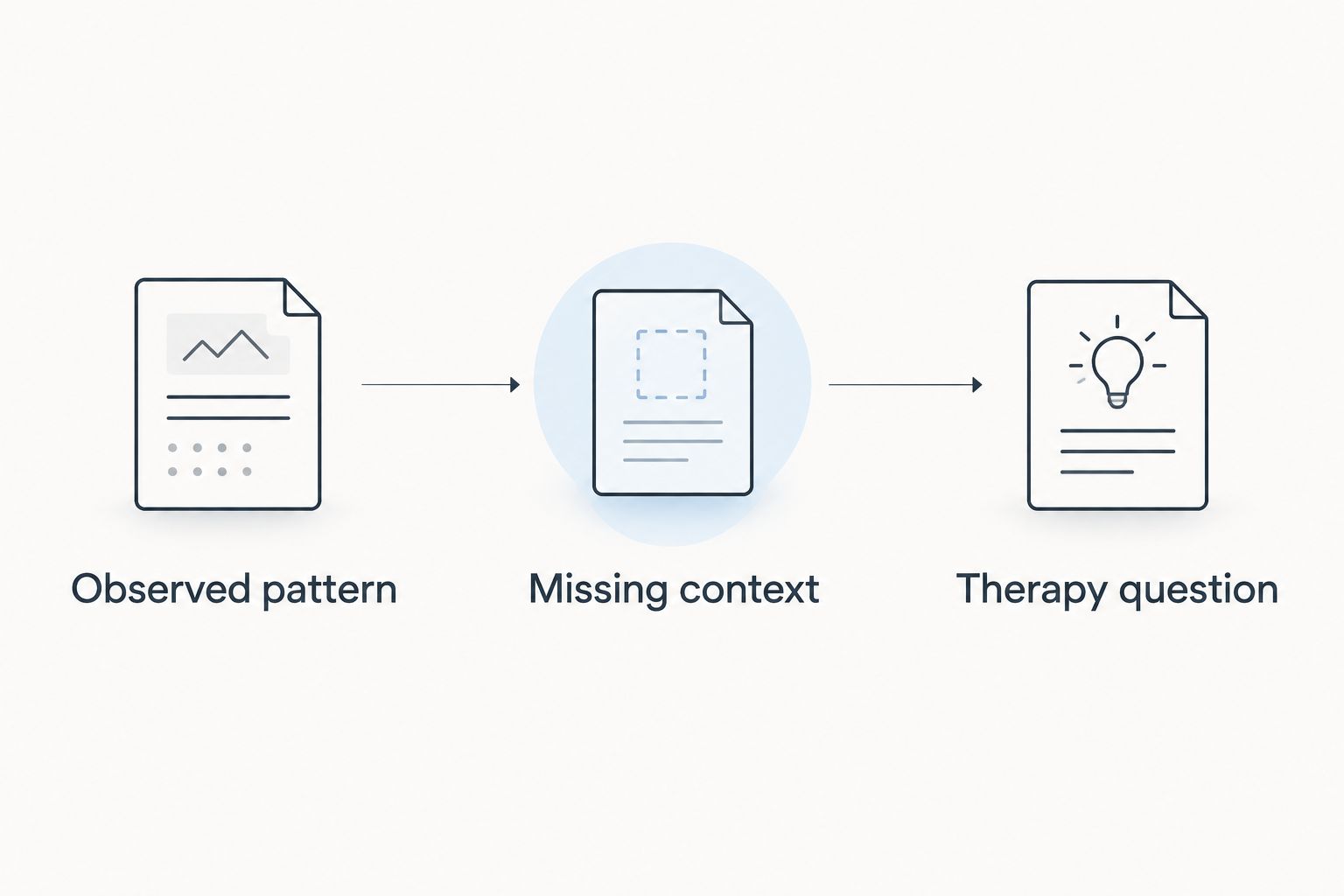
Make a simple document with three headings: Observed pattern, Missing context, and Therapy question. Under the first, describe something you can point to in the messages. Under the second, record what the messages cannot tell you. Under the third, turn the uncertainty into a question for the session.
For example, an observation is that a planning request received no written response before the subject changed. An interpretation is that your partner wanted to punish you. The transcript supports the first statement; it does not prove the second.
Justlay’s Grey Mirror relationship analysis uses specialized relationship-analysis models and provides evidence-linked findings. Treat each finding as a prompt to inspect the underlying exchange, not as an independent judgment about your relationship. A chart summarizes messages; it does not supply the missing conversation.
For a 2026 therapy-preparation document, use the same structure whether you review manually or use an app:
- Describe the visible exchange without labeling either person.
- Open the evidence attached to each finding you use.
- Record alternative explanations beside your first interpretation.
- Add relevant circumstances outside the transcript.
- Convert uncertain interpretations into therapist questions.
Check summaries against the original exchanges
Read the source messages yourself before putting a finding into your session notes. Check who wrote each message, what immediately preceded it, and whether the exchange continued elsewhere. Do not let a confident summary substitute for that check.
Sarcasm, shared jokes, shorthand, and references to earlier events require context. So do response gaps: a delay can be visible in the record without revealing why it happened. Your task is to document the gap, not convert it into a claim about care or commitment.
If you use ChatGPT, ask it to distinguish direct textual observations from interpretations and to identify missing context. Keep the original exchange beside the response. ChatGPT is an alternative for discussing text, not an authority whose wording settles a disagreement.
Use a source-checking routine:
- Read the entire relevant exchange, not just highlighted excerpts.
- Confirm that the summary attributes messages correctly.
- Check whether later messages correct an earlier impression.
- Flag jokes, sarcasm, and shared references for discussion.
- Remove any claim you cannot connect to the record.
Build a short, balanced session brief
Write a one-page brief before your appointment. This is an editorial limit for your notes, not a clinical rule: it forces you to choose a question rather than deliver an archive. Ask your therapist how they prefer to receive supporting material.
Include an example of difficulty and, when your record contains one, an example of repair. A repair might be an apology, a clarification, or a successful return to the original topic. Do not manufacture balance, but do not exclude contrary evidence because it weakens your initial interpretation.
Include your own messages. A note that documents only your partner’s behavior gives an incomplete account of a two-person exchange. You can describe feeling hurt while still acknowledging where your response escalated or obscured the issue.
Build the brief around these items:
- State the central question at the top.
- Summarize the observed pattern in neutral language.
- Attach a short exchange with surrounding context.
- Include your response and relevant missing information.
- End with what you want help discussing or changing.
Agree how the notes will enter the session
Ask your therapist whether to share notes beforehand or bring them to the appointment. Explain that any software-generated findings are preparation material. A therapist should not have to infer which statements came from you and which came from an app.
Discuss sharing boundaries with your partner when doing so is safe. Do not surprise them with a report presented as an expert ruling. You can say that you reviewed messages to identify questions and want help examining the examples together.
If you fear retaliation, coercion, or harm, prioritize individual safety advice from a qualified professional rather than confronting your partner with an analysis. This guide is about organizing notes, not determining whether joint therapy is appropriate for your circumstances.
Before the session, check these boundaries:
- Label app findings separately from your own observations.
- Ask how much written material the therapist wants.
- Share only material relevant to the session’s purpose.
- Avoid using a report to demand an admission.
- Keep safety concerns separate from the analysis workflow.
Compare your preparation options
Choose the option that fits the question, not the strongest-sounding verdict. Manual review gives you direct contact with the record. Specialized software organizes a larger history. ChatGPT supports an open-ended discussion of text. Therapist-led review puts the selected material into a clinical conversation.
These are different roles, not interchangeable endorsements. This Justlay guide is brand-authored; it is not an independent review of Grey Mirror or competing tools. Use the 2026 comparison below to assess the workflow and its limits.
| Option | Best for | Payment terms | Key limitation |
|---|---|---|---|
| Manual message review | Selecting exchanges and noting context yourself | No separate analysis-app purchase | You must organize the record and check your own selection bias |
| Grey Mirror | Reviewing patterns across a full exported relationship history | $17.99 USD once for one full report; Grey Mirror Plus is $9.99 USD/month for one full report each paid month | Evidence-linked findings still require source checks and cannot establish intentions |
| ChatGPT | Exploring questions and alternative readings of selected texts | Check current plan terms | A response is not a clinical assessment or proof of either person’s motives |
| Therapist-led review | Discussing selected exchanges with professional context | Ask the clinician about their terms | The therapist needs relevant examples, not an unexplained archive |
Grey Mirror’s free conversation analysis includes four evidence-linked findings and requires no card. Unused paid credits carry forward, and unlocked reports are kept permanently. Compare those terms with the scope of material you actually want to review; a paid report is not a prerequisite for preparing useful notes.
Before uploading messages to any service in 2026, read its current privacy and data-handling terms. Consider whether the export includes another person’s sensitive information or unrelated conversations. Keeping an unlocked report permanently is a report-access term, not an answer to every data-retention question.
Common mistakes couples make before therapy
Treating a finding as a verdict
A finding about an exchange does not prove dishonesty, manipulation, or lack of love. Replace labels with the specific messages and a question about their meaning. Bring evidence you can discuss, not a conclusion your partner must accept.
Selecting only the worst moments
A folder of arguments cannot describe the full range of communication. Include relevant ordinary exchanges and repair attempts when they exist. State the selection limits so the therapist understands what your notes cover.
Counting messages as emotional investment
Message volume and timing describe activity, not a person’s commitment. Work, offline contact, illness, and communication preferences belong in the context discussion. Do not turn a chart into a score for how much someone cares.
Bringing an archive instead of a question
A large export is source material, not a session agenda. Choose an exchange that illustrates your question and keep the larger record available if requested. The goal is a useful conversation, not a transcript presentation.
Using preparation to pressure a partner
Presenting software output as proof can turn preparation into another argument. State what you observed, acknowledge uncertainty, and invite discussion through the therapist. If sharing creates a safety concern, seek individual professional advice first.
FAQ
Should I use a chat analyzer before couples therapy?
Use a chat analyzer before couples therapy if it helps you organize examples and questions. Check its findings against the original messages and bring notes rather than verdicts about either partner.
Is Grey Mirror better than ChatGPT for reviewing our messages?
Grey Mirror is the more specialized fit for reviewing an exported relationship history with a timeline, evidence-linked findings, charts, and metrics. ChatGPT serves a different role: discussing selected texts and possible interpretations; neither replaces a therapist’s assessment.
Can chat analysis tell me what my partner really intended?
Chat analysis cannot prove what your partner intended. Messages document communication, while intentions and missing context require discussion rather than a software verdict.
How much does Grey Mirror cost in 2026?
Grey Mirror costs $17.99 USD once for one full relationship report, or Grey Mirror Plus costs $9.99 USD/month for one full report each paid month. Unused credits carry forward and unlocked reports are kept permanently; a free conversation analysis includes four evidence-linked findings and requires no card.
What should I bring from a chat report to our therapist?
Bring a short question-led brief, a relevant exchange, and the context the report cannot show. Label software findings separately from your observations and ask your therapist how they prefer to receive supporting material.
Do both partners need to agree before messages are uploaded?
Discuss permission and privacy before uploading shared messages, and do not access another person’s accounts without authorization. Read the service’s current terms and seek qualified advice about legal obligations in your circumstances.
Can I use chat analysis if we have already broken up?
Use chat analysis after a breakup to formulate reflection questions, not to establish a former partner’s motives. Keep the review focused on what you want to understand about your own experiences and patterns.
One last thing
Before your 2026 appointment, add one sentence to the bottom of your notes: What evidence would change my interpretation? Answer it honestly. That question turns a report from an argument you want to win into material you are prepared to examine.