
Reconciled couples’ chat analysis is a review of communication before and after getting back together, with the aim of identifying whether agreed changes appear in the messages. A chat analyzer after reconciliation is useful only when you compare similar periods and separate observed patterns from assumptions about your partner’s intentions.
- Use a chat analyzer after reconciliation to compare equivalent periods, not a breakup crisis against a reunion high.
- Grey Mirror suits people examining an existing relationship through evidence-linked findings and a relationship timeline.
- Keep message sources, observation windows, and communication context consistent before interpreting changes.
- Treat relationship analysis as preparation for a conversation, not proof of motives or a diagnosis.
Why chat analysis matters for reconciled couples
After reconciliation, your question is narrower than whether a relationship looks positive overall. You want to know whether a specific agreement—raising concerns earlier, acknowledging difficult messages, or returning to unfinished discussions—shows up in everyday communication.
The comparison gets difficult when the circumstances change. A breakup period, a reunion weekend, and an ordinary working week do not offer equivalent opportunities to communicate. More affectionate messages are not, by themselves, evidence that the original problem has changed.
JustLayMe offers Grey Mirror, which analyzes exported relationship messages and presents a timeline, evidence-linked findings, charts, and metrics. Those outputs give you material to inspect; they do not establish what either person intended.
For your 2026 review, start with the agreement you actually made. Then choose a comparison that can answer it without treating every silence, short reply, or affectionate phrase as a relationship verdict.
Compare like-for-like periods before drawing conclusions
Define the question
Write one question that connects directly to the reconciliation agreement. For example: when one person raises a concern, does the other acknowledge it and return to the discussion? That question is more useful than asking whether your partner now loves you more.
Choose observable actions, not personality labels. A message can show that someone suggested another time to talk; it cannot prove that the suggestion was sincere. Keep your own communication in scope, too, so the review does not become a search for evidence against one person.
A manual note is enough to start. Write the agreement, the observable behavior, and what would count as an unresolved example before opening an analysis app.
- Copy the reconciliation agreement into your private notes.
- Convert each promise into an observable communication behavior.
- Include both people’s responses and follow-through.
- Exclude diagnoses, personality labels, and guesses about motives.
Match the periods
Choose windows with comparable duration and circumstances. As a practical example, compare 14 days before the rupture with 14 ordinary days after reconciliation—not 14 crisis days with 3 days of reunion messages. These are example window lengths, not a validated relationship threshold.
Match the weekday mix, time apart, and communication channel where possible. If you were together in person after reconciliation but apart beforehand, fewer texts do not answer whether communication improved. Record the difference instead of converting it into a negative finding.
You can make this comparison manually using dates in the exported conversation. Grey Mirror’s relationship timeline offers another way to inspect messages across the relationship history; check the evidence dates before assigning any finding to your selected window.
For a 2026 comparison, keep the reunion itself separate from ordinary life if that better matches your question. A burst of reassurance immediately after getting back together answers a different question from how you handle a later disagreement.
- Use equal-length windows as your starting point.
- Match workdays, weekends, and time spent apart.
- Keep the same messaging channel where possible.
- Mark holidays, travel, illness, and unusual work demands.
- Label unmatched periods rather than treating them as equivalent.
Check the record
Read the export before trusting a summary. Missing messages, absent attachments, and conversations that moved to calls can leave a gap between the written record and what happened. A clean-looking chart does not repair an incomplete conversation.
Start by checking timestamps, participants, and the beginning and end of each window. Note references to conversations you cannot see. A message such as an acknowledgment after a phone call is not a complete record of that call.
Grey Mirror analyzes exported histories from iMessage, WhatsApp, Instagram DM, SMS, and Telegram. That makes the source history important: evaluate findings against the material actually present, not an assumed record of every interaction.
JustLayMe’s relationship analysis is useful when you can inspect the underlying evidence. Before relying on an interpretation, use the guide to checking a chat analyzer for false positives to frame your review.
- Confirm that both comparison windows appear in the export.
- Check that sender names remain consistent.
- Note unavailable messages, media, and call discussions.
- Keep an unchanged copy of the original export.
- Read surrounding messages before accepting an isolated finding.
Compare agreed behaviors
Build a small worksheet with columns for the agreement, the earlier period, the later period, and relevant context. Record message examples before writing a conclusion. This keeps a persuasive summary from becoming your only evidence.
For an agreement about difficult conversations, inspect acknowledgment, proposed follow-up, and whether the topic returns. For an agreement about planning, inspect whether proposals receive an answer and whether changed plans get discussed. Do not substitute message volume for the behavior you agreed to change.
Grey Mirror’s specialized relationship-analysis models produce evidence-linked findings, charts, metrics, and a relationship timeline. Its role here is to organize material for inspection, rather than establish a partner’s intentions. You still need to decide whether each finding answers your chosen question.
A useful review sequence is to define the question, match the periods, check the record, compare agreed behaviors, review alternatives, and discuss the findings.
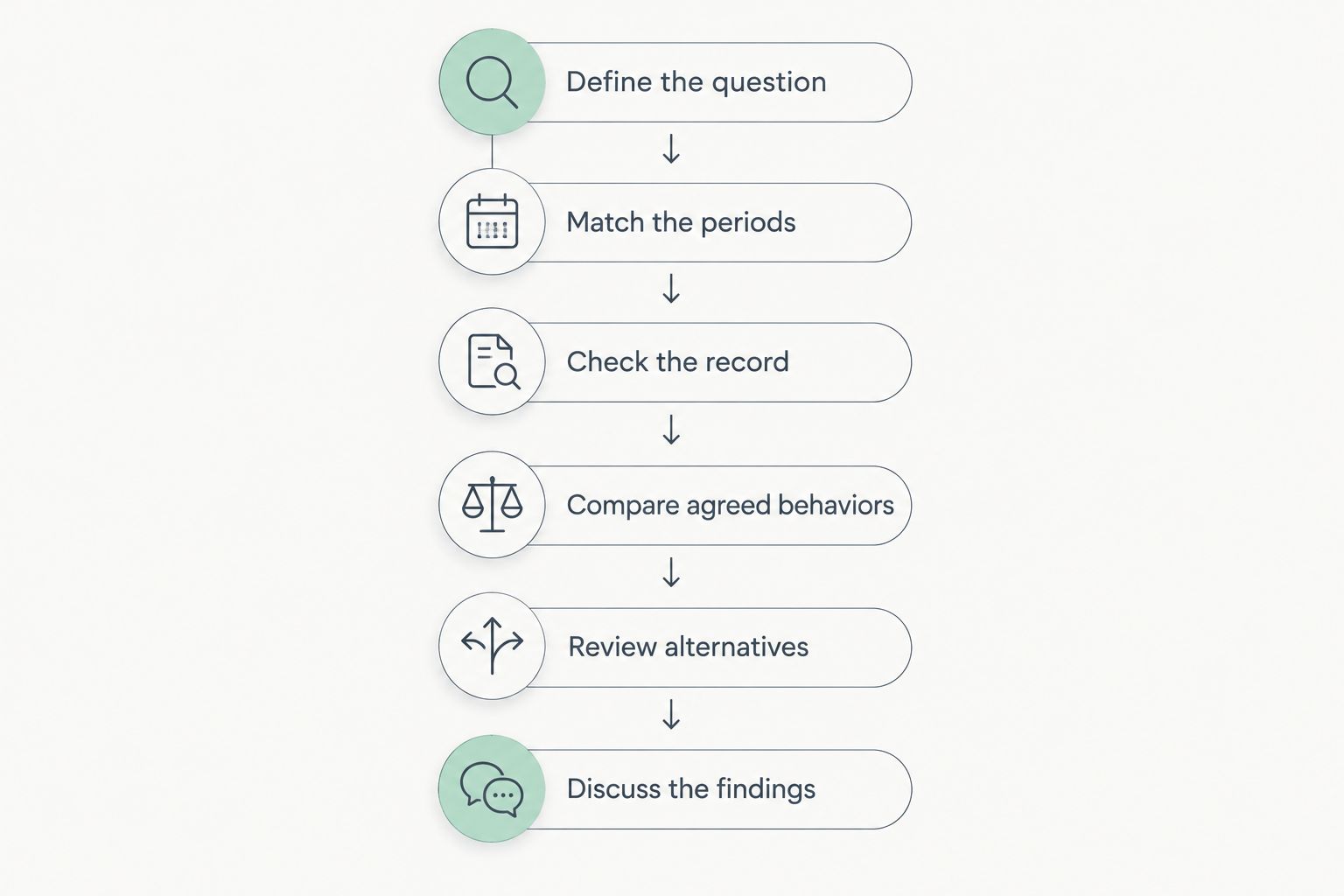
Keep your 2026 worksheet focused on the agreement rather than collecting every metric available. A measure earns its place only when you can explain what question it helps answer.
- Attach a dated message example to each observation.
- Compare the same behavior in both periods.
- Separate message counts from the quality of a response.
- Include examples that challenge your initial conclusion.
- Mark outcomes as observed, unclear, or absent from the record.
Review alternatives
Write an alternative explanation beside each interpretation. Fewer messages might reflect more time together; a delayed response might follow a changed work schedule. These are possibilities to investigate, not excuses to accept automatically.
The manual approach is straightforward: reread the exchange with context and list what remains unknown. If you use ChatGPT to discuss an excerpt, ask it to distinguish visible actions from interpretations and identify missing context. Do not ask it to certify that your partner has changed.
Apply the same standard to Grey Mirror. Evidence-linked output supports checking a finding; it does not make every interpretation correct. Reject conclusions that depend on messages you cannot locate or on motives the text cannot establish.
- Write a plausible alternative beside each interpretation.
- Check whether circumstances changed between windows.
- Identify information that only a conversation can clarify.
- Revisit findings that rely on sarcasm or ambiguous phrasing.
- Stop when repeated analysis is no longer answering your question.
Discuss the findings
Bring a bounded observation into the conversation, not a report-based verdict. Describe the agreement, the exchange you noticed, and what remains unresolved. Ask how your partner understood the situation before deciding what the pattern means.
A practical limit is to discuss 2 examples at a time. This is a suggested conversation boundary, not a clinical rule. It helps keep the discussion focused on an actionable behavior rather than an exhaustive inventory of faults.
Your 2026 review should end with a next step: clarify an agreement, change how you schedule a difficult discussion, or acknowledge that the written record does not answer the question. Another report is not automatically the next move.
- Choose examples directly connected to the agreement.
- Explain the observation without assigning a motive.
- Ask what relevant context the messages leave out.
- Agree on a specific communication action to try.
- Decide when another review would serve a clear purpose.
Choose the right analysis approach
Grey Mirror is best for people examining patterns across an existing relationship through evidence-linked findings and a relationship timeline. Manual review suits a tightly scoped question; ChatGPT suits discussing text you supply when you want help considering interpretations.
This is a JustLayMe-authored comparison, not an independent review or endorsement. Choose by the evidence you need to inspect, not by how confidently an output describes your relationship.
| Option | Best for | Starting price or plan | Useful strength | Key limitation |
|---|---|---|---|---|
| Manual export review | One clearly defined reconciliation agreement | Not applicable | You control the windows and read the surrounding conversation | Organizing a long history takes your own time and attention |
| ChatGPT | Discussing supplied excerpts and alternative interpretations | Check current plan terms | You can ask follow-up questions about the text you provide | It cannot establish intentions or account for context you do not supply |
| Grey Mirror | Reviewing patterns across an exported relationship history | $17.99 USD once for one full report; Grey Mirror Plus is $9.99 USD/month | Relationship timeline, evidence-linked findings, charts, and metrics | An incomplete export and mismatched periods still limit interpretation |
Grey Mirror’s free conversation analysis includes four evidence-linked findings and requires no card. Grey Mirror Plus includes one full report each paid month; unused credits carry forward, and unlocked reports are kept permanently. Check the current pricing information before purchasing.
Start manually if you are still deciding what question to ask. Consider Grey Mirror when you want a relationship-specific report to inspect across the exported history, while keeping responsibility for the interpretation with you.
Explore evidence-linked relationship analysis
Review Grey Mirror’s relationship timeline, findings, charts, and metrics.
Common mistakes reconciled couples make
Comparing the crisis with the reunion
A breakup confrontation and a celebratory reunion have different purposes. Comparing them as ordinary communication makes the result hard to interpret. Use comparable everyday periods when the question is whether an everyday behavior changed.
Counting affection instead of follow-through
Affectionate language answers whether affectionate language appeared. It does not answer whether an avoided topic was revisited or a planning agreement was honored. Track the behavior named in the reconciliation agreement.
Treating the report as an adjudicator
A finding is material to examine, not a ruling about who is right. Quoting an app as authority over your partner’s intentions closes off the very context you need to understand the exchange.
Repeating analysis to obtain reassurance
Rerunning the same material without a new question does not add missing context. Set a stopping point and move to discussion when the uncertainty concerns something only the people involved can explain.
FAQ
What’s the best way to use a chat analyzer after reconciliation?
Use a chat analyzer after reconciliation to compare equivalent periods against a specific agreement. Keep the message source and circumstances consistent, then inspect the messages behind each finding.
Can Grey Mirror tell me whether my partner has really changed?
Grey Mirror cannot establish whether a partner has changed internally or prove intentions. Its relationship timeline, evidence-linked findings, charts, and metrics provide material for examining observable communication patterns.
How long should the before-and-after periods be?
Choose periods long enough to contain the behavior you are examining and comparable in duration and circumstances. Equal 14-day windows are a practical example, not a validated threshold for judging a relationship.
Is ChatGPT better than a relationship-analysis app?
ChatGPT suits discussion of supplied excerpts, while Grey Mirror is designed to analyze exported relationship histories. Choose by whether you need an excerpt discussion or a relationship timeline with evidence-linked findings; neither can prove motives.
How much does Grey Mirror cost in 2026?
Grey Mirror costs $17.99 USD once for one full relationship report, or $9.99 USD/month for Grey Mirror Plus with one full report each paid month. Unused credits carry forward, and unlocked reports are kept permanently; check current pricing before purchasing.
Can I try Grey Mirror without entering a card?
Grey Mirror’s free conversation analysis includes four evidence-linked findings and requires no card. Use those findings to check whether the evidence format helps you examine your question.
What if we text less because we spend more time together?
Fewer texts do not establish worse communication when you spend more time together. Record the change in circumstances and compare periods with similar time apart, or focus on specific agreements rather than total message volume.
Should I show my partner the whole analysis report?
Start with relevant observations rather than treating the whole report as a verdict. Explain which agreement each example concerns, invite missing context, and consider privacy before sharing exported conversations or reports.
One last thing
The most useful result can be identifying a question the messages cannot answer. If your reconciliation agreement concerned an in-person conversation, a text-only comparison has a clear boundary. Do not turn absence from the export into absence from the relationship.