
Couples’ shift-work chat analysis is a review of relationship messages alongside work and sleep schedules, with the aim of separating communication problems from periods when neither partner can reasonably reply. This guide explains how to examine an existing relationship—or reflect on a breakup—without treating a night shift, a sleeping phone, or a missing message as evidence of someone’s intentions.
- For chat analyzer shift work searches, Grey Mirror suits relationship-wide reviews; work and sleep schedules remain essential context.
- Compare response patterns during shared availability, not across every hour of the day.
- Justlay’s Grey Mirror is best for reviewing relationship-wide text patterns, not proving a partner’s intentions.
- Use evidence-linked findings to prepare questions, not diagnoses or accusations.
Why chat analysis matters for couples working different shifts
Different shifts create a specific interpretation problem: the timestamp records when a message arrived, not whether the recipient was available. A message sent during your lunch break can arrive during your partner’s sleep. The delay is visible; the reason is not necessarily in the conversation.
The useful question is therefore not whether someone replies slowly. It is whether communication changes when both people have a realistic opportunity to connect. Compare like-for-like availability before interpreting response gaps.
Justlay offers Grey Mirror for reviewing exported relationship conversations through timelines, evidence-linked findings, charts, and metrics. Those outputs can organize a long history, but you still need to supply the schedule context that gives a gap meaning.
For a 2026 relationship review, keep the purpose narrow: identify a recurring difficulty you can discuss, or understand a pattern after a breakup. A report is not a way to establish motives, assign a diagnosis, or decide which partner cared more.
How to review messages without confusing shifts with distance
Choose a question you can actually answer
Start manually with a question about observable behavior. For example, ask whether plans receive acknowledgment when both partners are awake, rather than whether someone secretly wants to leave. The first question has evidence you can examine; the second asks a message archive to read a mind.
Separate practical coordination from emotional connection. A conversation about collecting groceries serves a different purpose from a conversation about feeling disconnected. Combining them into a single responsiveness score hides that distinction.
If you are reviewing a breakup, choose a question that helps you understand your own experience. Repeatedly searching for a final explanation can turn the same archive into an argument with someone who is no longer participating.
Finish by defining what would count as an observation, what would remain uncertain, and what action the answer would support. Stop when the question is answered rather than expanding the review indefinitely.
- Write down the communication difficulty in neutral language.
- Separate planning messages from requests for emotional support.
- Choose a conversation period that includes the relevant shifts.
- Define a stopping point before reading the archive.
Map work, sleep, and shared availability
Use a calendar or a plain note before opening an analysis app. Mark the work and sleep periods you know, including schedule changes within the conversation period. Do not reconstruct an exact schedule from messaging activity alone: sending a message does not establish that someone was free for a sustained conversation.
Identify shared availability separately. A partner can have time to send a brief acknowledgment without having time for a difficult discussion. Distinguish those expectations instead of treating every reply as evidence of equal availability.
For exports you review in 2026, check how timestamps appear before comparing them with your calendar. If the displayed times do not match your known schedule, resolve the discrepancy before interpreting delays. Preserve uncertainty where you cannot verify the relevant hours.
This manual context map is useful regardless of which tool you choose. Do not assume that an app has correctly inferred a work rota, sleep period, or change in routine from the chat itself.
- Mark known work periods and sleep periods.
- Label shared availability separately from brief phone access.
- Record changes in shifts during the selected period.
- Check the displayed timestamps against known events.
- Leave uncertain availability explicitly unresolved.
Separate observation, context, and interpretation
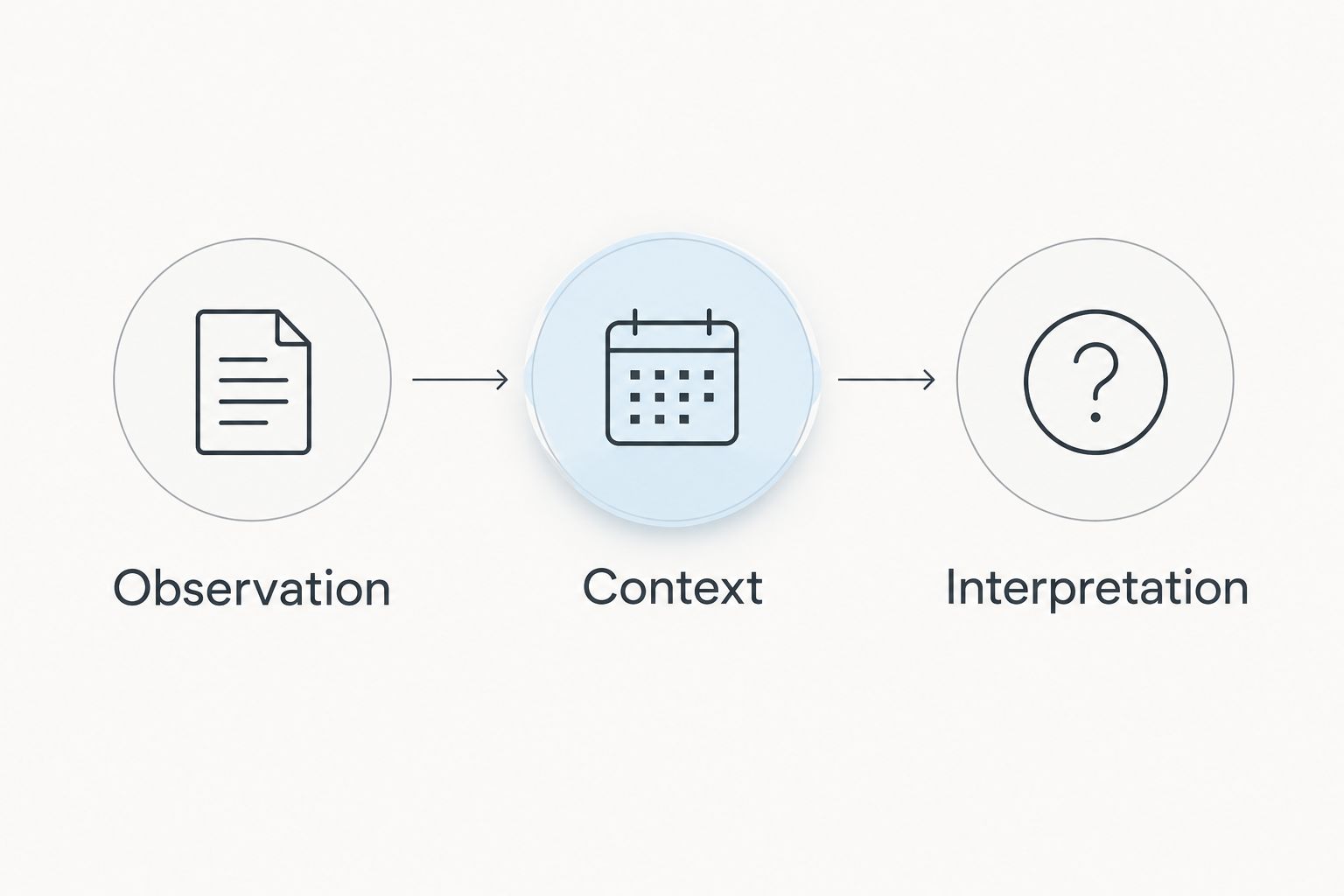
Create a simple note with three headings: Observation, Context, and Interpretation. Copy the relevant message sequence under Observation, add the known schedule under Context, and reserve Interpretation for possible explanations. Keeping those layers separate prevents an explanation from becoming a supposed fact through repetition.
For example, a request received no acknowledgment before the sender went to sleep. That is an observation. The recipient was working during that period, if you know this independently, is context. Whether the recipient dismissed the request remains an interpretation unless the conversation establishes it.
Also look for evidence that challenges your initial reading. A later acknowledgment, a previously agreed arrangement, or an explanation elsewhere in the thread belongs in the same note. A useful finding survives a check of the surrounding conversation.
- Record the exact message sequence under Observation.
- Add verified availability under Context.
- Keep explanations and unanswered questions under Interpretation.
- Include messages that challenge your first impression.
Choose a tool that preserves the evidence
The manual route is to read the exported conversation and build your own timeline. This keeps selection decisions visible, but it requires you to find relevant exchanges and check your own summaries against the original messages.
Grey Mirror is the faster organizational path for examining a full exported relationship history. It uses specialized relationship-analysis models and produces a relationship timeline with evidence-linked findings, charts, and metrics. It is available on the web, iPhone, and Mac and analyzes exports from iMessage, WhatsApp, Instagram DM, SMS, and Telegram.
Justlay’s Grey Mirror relationship analysis includes a free conversation analysis with four evidence-linked findings and no card required. Use that entry point to assess whether the findings are understandable and traceable, not to assume the interpretation is settled.
For your 2026 tool choice, evaluate a finding by opening its supporting messages and checking the context. The guide to checking a chat analyzer for false positives addresses that review task.
- Start with the original export, not isolated screenshots.
- Check whether each finding points to supporting messages.
- Read the exchanges before and after the cited passage.
- Confirm whether the finding accounts for known availability.
- Reject interpretations that exceed the evidence.
Compare equivalent opportunities to connect
Once your context notes are ready, compare situations in which both partners had a similar opportunity to communicate. Do not compare a work period with a quiet evening and call the difference a relationship trend. Describe the availability difference first.
Examine what happens after missed contact. Does the conversation resume? Is an unanswered practical question resolved? Does either person acknowledge a request to reconnect? These are narrower, more useful observations than a single average response time.
Compare similar kinds of requests, too. A message that needs a decision is different from a casual update, and a difficult conversation requires more attention than an acknowledgment. Keep those distinctions visible in your notes rather than forcing every message into the same standard.
If you use a metric from a report, return to the messages that explain it. The metric summarizes a pattern; it does not establish whether the pattern was acceptable under the couple’s actual agreements.
- Compare exchanges during similar availability conditions.
- Separate practical decisions from casual updates.
- Check whether missed conversations resume later.
- Look for acknowledgment of requests to reconnect.
- Read source messages before acting on a summary metric.
Turn findings into a workable agreement
Bring an observation and a request to the conversation, not a verdict about your partner. Explain the message pattern, acknowledge the shift constraint, and ask what arrangement would work for both people. The useful outcome is a clearer expectation, not agreement with every line of a report.
Distinguish an acknowledgment from a full reply. You can discuss whether a brief confirmation is realistic during a break, while reserving difficult conversations for shared availability. Neither expectation should be assumed simply because a phone is accessible.
For a relationship agreement made in 2026, write down what counts as urgent, what can wait, and how you will reconnect after missed contact. Revisit it when shifts change. If you are reflecting on a breakup, translate the same exercise into expectations you want to communicate in a future relationship.
- Describe the specific exchange without assigning motives.
- Ask when brief acknowledgments are realistic.
- Agree on a way to flag genuinely urgent messages.
- Set expectations for reconnecting after missed contact.
- Update the agreement when work or sleep schedules change.
Compare your options for a 2026 review
Choose by the task: organizing a full relationship history is different from interpreting a selected exchange. Manual review, ChatGPT, and Grey Mirror each have a role, but none removes the need to verify context.
| Option | Best for | Current payment terms | Useful strength | Key limitation |
|---|---|---|---|---|
| Manual export review | A focused question about a limited conversation period | No analysis-app purchase required | You control the context notes and can inspect every passage | You must organize the history and check your own selections |
| ChatGPT | Discussing possible readings of passages you choose to provide | Check the current terms for the service you use | You can ask for alternative interpretations and clearer discussion questions | A selected passage does not provide the full relationship history or schedule context |
| Grey Mirror | Reviewing patterns across a full exported relationship history | $17.99 USD once for one full relationship report | Timeline, evidence-linked findings, charts, and metrics | Supporting messages still need checking against work, sleep, and missing context |
| Grey Mirror Plus | Reviewing a full report each paid month | $9.99 USD/month for one full report each paid month | Unused credits carry forward; unlocked reports are kept permanently | Regular reporting does not replace a clear review question or a stopping point |
Grey Mirror’s free conversation analysis provides four evidence-linked findings without requiring a card. The paid options above are the current terms specified for this guide; refer to the brand’s pricing information rather than older homepage wording.
Justlay’s comparison here is brand-authored, not an independent review or an endorsement from a separate reviewer. Evaluate the options by their outputs and limits. In particular, do not treat a polished explanation from any app as stronger evidence than the messages supporting it.
Common mistakes couples working different shifts make
Treating every delay as rejection
A delay during known sleep or work time cannot, by itself, establish rejection. Review what happens when contact becomes realistic, including whether the conversation resumes and whether an unresolved request gets attention. Keep the delay and your emotional response to it as separate observations.
Comparing total message volume without context
An exchange about shift handovers or household coordination can contain many messages without addressing emotional connection. Another conversation can be brief but resolve a meaningful question. Identify what the messages are doing before using volume to judge the relationship.
Treating an export as the entire relationship
An exported text history is evidence of the messages it contains, not a complete record of calls, in-person conversations, or everything that happened between you. Add known context without inventing missing dialogue. If you cannot verify something, leave it uncertain rather than filling the gap with a story.
Using findings to diagnose a partner
A recurring communication pattern is not a diagnosis. Describe unanswered questions, changes in tone, or difficulty reconnecting using the actual exchanges. Avoid converting those observations into claims about a person’s character, mental health, or hidden intentions.
Rechecking a breakup archive without a new question
Repeating the same review does not supply new evidence. Keep the findings that answer your original question, record what remains unknown, and stop. You do not need a definitive account of another person’s motives to identify the communication expectations you want next time.
FAQ
What should a chat analyzer shift work review look for?
A chat analyzer shift work review should compare communication patterns against known work, sleep, and shared availability. Examine acknowledgment, follow-through, and reconnection rather than treating every reply delay as a relationship signal.
Can Grey Mirror tell whether my partner is ignoring me?
Grey Mirror cannot establish a partner’s intentions from texts. Its evidence-linked findings, timeline, charts, and metrics help you examine observable communication patterns, which still require schedule context and source-message checks.
Is Grey Mirror better than ChatGPT for reviewing a relationship?
Grey Mirror is the more directly matched option for organizing a full exported relationship history; ChatGPT suits discussing passages you choose to provide. Grey Mirror uses specialized relationship-analysis models, but neither approach makes an interpretation proof of intent.
How much does Grey Mirror cost?
Grey Mirror costs $17.99 USD once for one full relationship report, or $9.99 USD/month for Grey Mirror Plus with one full report each paid month. Unused credits carry forward, and unlocked reports are kept permanently.
Can I try Grey Mirror without entering a card?
Yes, Grey Mirror offers a free conversation analysis with four evidence-linked findings and no card required. Check the supporting messages and decide whether the findings address your question before choosing a paid report.
Should couples compare average reply times when they work different shifts?
Couples should not compare average reply times without accounting for availability. Separate work and sleep periods from shared availability, then inspect whether comparable requests receive acknowledgment and follow-through.
Can chat analysis help me reflect on a breakup involving shift work?
Chat analysis can organize the communication evidence you want to reflect on after a breakup. Choose a bounded question, distinguish schedule constraints from observed patterns, and leave another person’s unverified motives unresolved.
One last thing
The most useful result can be a change in expectations, not a change in someone’s reply speed. If your 2026 review shows that missed contact repeatedly occurs outside shared availability, discuss the arrangement before blaming the delay. If a problem persists during agreed opportunities to connect, bring those specific exchanges to the conversation.
Justlay’s Grey Mirror relationship analysis helps organize the archive. Your next move is to decide which observation deserves a question, which expectation needs discussion, and which uncertainty should remain uncertainty.