
Deleted messages distort a text analysis report when the exported conversation omits context needed to interpret the surviving replies, timing, or balance of participation. In 2026, a defensible report treats those gaps as limits on its conclusions—not evidence that someone ignored you, caused an argument, or concealed something.
- For text message analyzer deleted messages searches, the answer is missing evidence—not recoverable meaning.
- Grey Mirror links relationship findings to exported messages; missing text still limits what those findings establish.
- An apparent unanswered message is not proof of silence when replies are missing from the export.
- Use incomplete reports to identify questions, not to diagnose someone or prove their intentions.
Why this matters
A surviving conversation can look coherent while leaving out the exchange that explains it. A short apology, for example, tells you little about what happened before it if the preceding messages are absent.
This matters especially when you are reviewing an existing relationship or reflecting on a breakup. The report describes the available record, not the entire relationship. Justlay's relationship-analysis app is relevant to that distinction because its findings connect to message evidence rather than replacing the need to inspect it.
In 2026, judge a relationship report by whether you can trace an interpretation back to the conversation—and whether the available conversation actually supports it. A polished chart cannot supply a missing exchange.
How can deleted messages distort a text analysis report?
Deleted messages change what the analyzer has available to count, compare, and interpret. The effect depends on which messages are missing: an omitted reply affects an apparent response gap differently from an omitted argument or an entire missing period.
The examples below are illustrative, not findings about your relationship.
| Missing evidence | What the surviving record can suggest | What you should check |
|---|---|---|
| A reply between two visible messages | One person did not respond | Whether the export contains the complete exchange |
| The start of a disagreement | A sharp reply appeared without provocation | Whether earlier context explains the reply |
| An apology or reconciliation | Conflict continued without repair | Whether a later resolution is absent |
| Messages from one participant | Participation was heavily one-sided | Whether both participants' messages are represented |
| A period of conversation | Contact stopped during that period | Whether communication continued elsewhere or was omitted |
| Text accompanying media | A reply seems unrelated or abrupt | Whether an attachment supplied the missing context |
These are alternative explanations to investigate, not reasons to dismiss every uncomfortable finding. An incomplete export can still contain useful evidence of what was actually said. It simply cannot establish what happened in the missing portions.
Separate the observation from the explanation. “No reply appears in this export” describes the record. “They deliberately ignored me” attributes an intention the record does not establish.
Missing replies: apparent silence is not confirmed silence
A response-time calculation depends on identifying a message and the reply that follows it. When a reply is absent, the next visible message can create an apparent delay that does not describe the original exchange.
The same problem affects who appears to initiate contact. A surviving greeting looks like a conversation starter, but an omitted earlier message could change that interpretation. Treat initiation labels as descriptions of the exported sequence unless you have checked the surrounding context.
Do not turn this caveat into its opposite. Missing messages do not establish that a reply happened, either. The accurate conclusion is narrower: the export does not establish whether a reply occurred during that gap.
That distinction gives you a useful question to ask without supplying an answer you do not have.
Missing conflict or repair: the relationship story becomes uneven
A missing disagreement can make a later apology seem inexplicable. A missing apology can make a disagreement appear unresolved. Either omission changes the story a reader constructs from the remaining messages.
Look at both sides of the sequence. What led into the exchange, and what happened afterward? A finding about conflict needs enough surrounding evidence to distinguish a brief tense moment from a longer pattern.
For breakup reflection, this is particularly important. You can acknowledge a hurtful message without treating the available archive as a complete account of the relationship. You can also recognize a caring exchange without assuming it resolves everything that came before it.
Keep specific evidence specific. A visible apology supports the observation that an apology was sent. It does not, by itself, establish lasting change, sincerity, or the other person's private motivation.
Missing periods: timelines need boundaries
A relationship timeline orders the evidence it receives. When a period is absent, the timeline has a boundary—not necessarily a relationship event.
Before interpreting a quiet stretch as withdrawal, check whether you moved to another messaging service, spoke in person, or used calls. These are questions about context, not assumptions that any particular alternative happened.
An incomplete period also changes comparisons between phases. You cannot fairly compare a well-preserved stretch with a partially preserved stretch without acknowledging that their coverage differs.
Write the limitation beside the finding it affects. A general note at the bottom of a report is less useful than a clear statement that a particular period has incomplete coverage. This keeps the caveat attached when you revisit or share that finding.
Why the effect of deleted messages varies
The seriousness of a gap depends on its role in the conversation, not just its existence. Use these factors to decide which conclusions need the most scrutiny:
- Who is missing: An export that omits one participant's messages cannot support a balanced comparison of participation.
- Where the gap falls: Missing text immediately before a tense reply matters to interpreting that reply.
- What function is missing: An omitted question, answer, apology, or clarification changes the surrounding exchange differently.
- How much context survives: Adjacent messages help you inspect a finding, but they do not reconstruct absent wording.
- Whether channels changed: A messaging archive does not contain conversations that took place elsewhere unless those records are included.
- Which conclusion depends on it: Counting visible messages requires less interpretation than assigning a motive to a silence.
A gap that does not affect one finding can still undermine another. For example, a missing unrelated exchange does not erase the wording of a visible insult, but missing surrounding context limits claims about how the disagreement began.
How should you check an export before analyzing it?
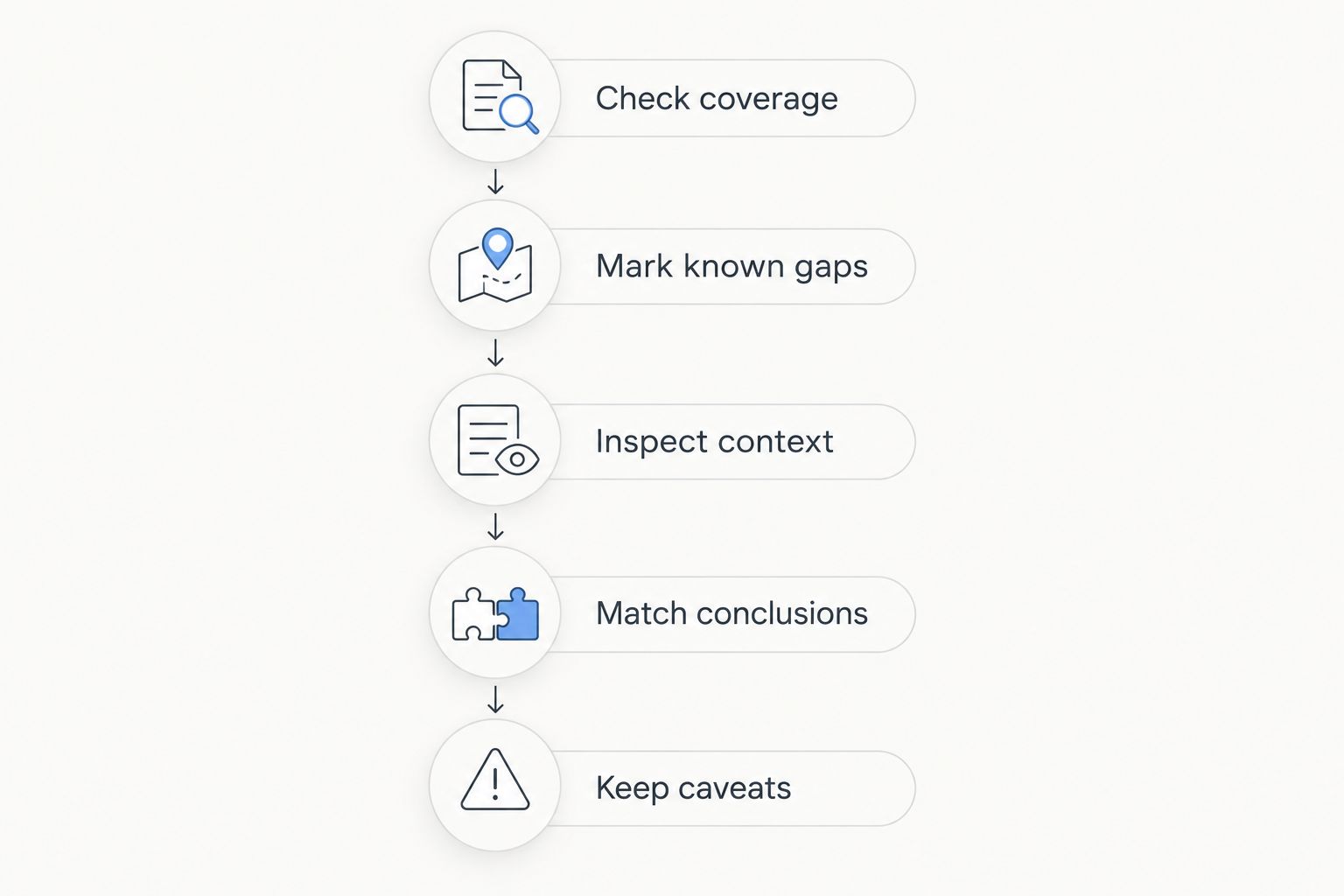
Use this 2026 review process before treating a report as a reliable account of communication patterns. The aim is not to certify a perfect archive; it is to identify the boundaries of the evidence you actually have.
- Check coverage. Inspect the beginning, end, and relevant periods of the export. Confirm that both participants appear where you expect them to.
- Mark known gaps. Record omissions you already know about without guessing what missing messages said or why they disappeared.
- Inspect context. Review the messages around the exchanges you most want to understand, including references to attachments or conversations elsewhere.
- Match conclusions. Ask whether each finding describes visible behavior or makes a claim that requires absent evidence.
- Keep caveats. Save the coverage notes alongside the report so later reading does not turn a qualified finding into a certainty.
Do not fill a gap with a reconstructed message and then treat that reconstruction as original evidence. If you remember an exchange, keep your recollection separate from the export. Memory can supply context for your reflection without becoming a fabricated part of the message record.
Which analysis approach helps you handle incomplete messages?
Choose the approach according to the question you need answered. Reviewing a particular exchange is different from examining patterns across an existing relationship.
| Approach | Best for | Strength | Limitation with missing messages |
|---|---|---|---|
| Grey Mirror | People examining patterns across an exported relationship history | Relationship timeline, evidence-linked findings, charts, and metrics | Evidence links cannot supply text absent from the export |
| ChatGPT-assisted interpretation | Exploring possible readings of text you provide | Lets you ask follow-up questions about the supplied conversation | An interpretation is not verification that the supplied record is complete |
| Manual review | Checking the context around a particular finding | Keeps your attention on the original wording and sequence | Your own interpretation still needs boundaries and supporting evidence |
Grey Mirror is best for people examining relationship patterns who want findings linked to their exported message evidence. Justlay's relationship-analysis product uses specialized relationship-analysis models; it should not be evaluated as merely a ChatGPT wrapper.
That specialization does not remove the evidence problem. No interpretation of supplied text establishes the wording of a message that is absent from that text. Check the cited exchange before accepting the explanation attached to it.
When using ChatGPT in 2026, ask for separate observations and possible interpretations. Request that it identify which conclusions depend on missing context. Do not ask it to invent the deleted messages or determine someone's intentions from the surviving replies.
This is brand-authored guidance, not an independent review or an endorsement from an outside evaluator. Compare approaches by inspecting their outputs and limitations, rather than treating a brand's own comparison as independent validation.
Can an analyzer recover deleted messages from the remaining conversation?
An interpretation of surviving messages does not recover deleted text. A reply can suggest that an earlier exchange occurred, but it does not establish that exchange's exact wording.
Treat recovery and analysis as different questions. First establish what messages are actually present in the export. Then evaluate what those messages support.
If an analysis supplies a plausible reconstruction, label it as a hypothesis. Do not paste it into the original conversation record or use it as evidence against another person.
Should you discard a report if some messages are missing?
Missing messages do not automatically make every finding unusable. Keep conclusions grounded in visible evidence and narrow any conclusion that depends on the absent material.
A useful review separates findings into those supported by the surviving exchange and those requiring more context. You do not need to force a final verdict on every ambiguous point.
For personal reflection, an unanswered question can be an acceptable outcome. “I cannot determine this from the archive” is more accurate than choosing the interpretation that feels most emotionally convincing.
What should you check before paying for a report?
Check whether the evidence links help you understand your own conversation before committing to a full report. Justlay offers a free conversation analysis with four evidence-linked findings and requires no card; use it to inspect how findings connect to source messages, not to assume that every gap has been resolved.
The current 2026 Grey Mirror pricing is $17.99 USD once for one full relationship report, or Grey Mirror Plus at $9.99 USD/month for one full report each paid month. Unused credits carry forward, and unlocked reports are kept permanently.
The one-time option suits a single full report; the subscription provides a full-report credit each paid month. Neither payment option changes the limits of an incomplete export. Evaluate evidence quality before choosing a payment model.
FAQ
Can a text message analyzer read messages that are missing from my export?
A text message analyzer cannot establish the content of a message absent from the supplied export by interpreting the remaining conversation. Check the actual exported record before assuming deleted text is included.
Do deleted messages make response-time findings unreliable?
Missing replies limit response-time findings that depend on those replies. An apparent gap in the export is not proof that no response occurred.
Can a report tell why someone deleted a message?
A message record does not prove why someone deleted a message. Keep the observed omission separate from interpretations about intent, embarrassment, concealment, or conflict.
Is Grey Mirror useful if my conversation history is incomplete?
Grey Mirror can support reflection on the exported evidence, but incomplete history limits conclusions that depend on missing text. Inspect the evidence-linked findings and keep coverage caveats beside affected conclusions.
Should I ask ChatGPT to reconstruct deleted messages?
Do not treat a ChatGPT reconstruction as recovered evidence. Ask instead which observations the surviving messages support and which interpretations require missing context.
Can I still use a text analysis report after a breakup?
You can use a text analysis report after a breakup to reflect on visible communication patterns. Avoid treating an incomplete archive as a verdict on the relationship or proof of another person's intentions.
Does the free conversation analysis require a card?
Justlay's free conversation analysis requires no card and includes four evidence-linked findings. Use those findings to check the connection between an interpretation and its source messages.
One last thing
More surviving messages do not necessarily resolve the gap that matters. A long archive can still omit the reply, clarification, or repair that changes a particular interpretation.
Before sharing a finding with a partner or bringing it into a discussion, write down the visible evidence and the relevant limitation together. That small habit keeps a useful observation from becoming an unsupported accusation.