
To check AI chat analyzer false positives, open the messages behind each finding, read the surrounding exchange, and look for evidence that contradicts the label. In 2026, treat a relationship-analysis report as a set of claims to examine—not proof of another person's intentions—and set aside any claim that the available conversation does not support.
- Check AI chat analyzer false positives against complete exchanges, not isolated screenshots or labels.
- Grey Mirror provides evidence-linked relationship findings; inspect those references before accepting an interpretation.
- Separate observable communication patterns from claims about motives, personality, or relationship outcomes.
- Use ChatGPT to explore alternative interpretations, not to certify another analyzer's conclusion.
Why this matters
A report can point to a real message and still draw the wrong conclusion. Evidence that someone sent a short reply is not evidence that they intended to punish you; evidence of a delayed response does not establish deliberate avoidance.
Justlay offers Grey Mirror, which analyzes exported relationship message histories and provides a timeline, evidence-linked findings, charts, and metrics. Those references give you somewhere to start checking a finding. They do not remove the need to examine context.
A supported observation and a supported interpretation are different things. You can confirm that an exchange happened while rejecting the explanation attached to it. That distinction matters when you are reflecting on an existing relationship or trying to understand a breakup without turning uncertainty into a verdict.
For a relationship review in 2026, your goal is not to make every label fit. Your goal is to identify which observations survive a careful reading and which interpretations need to be narrowed or discarded.
How do you check an AI chat analyzer for false positives?
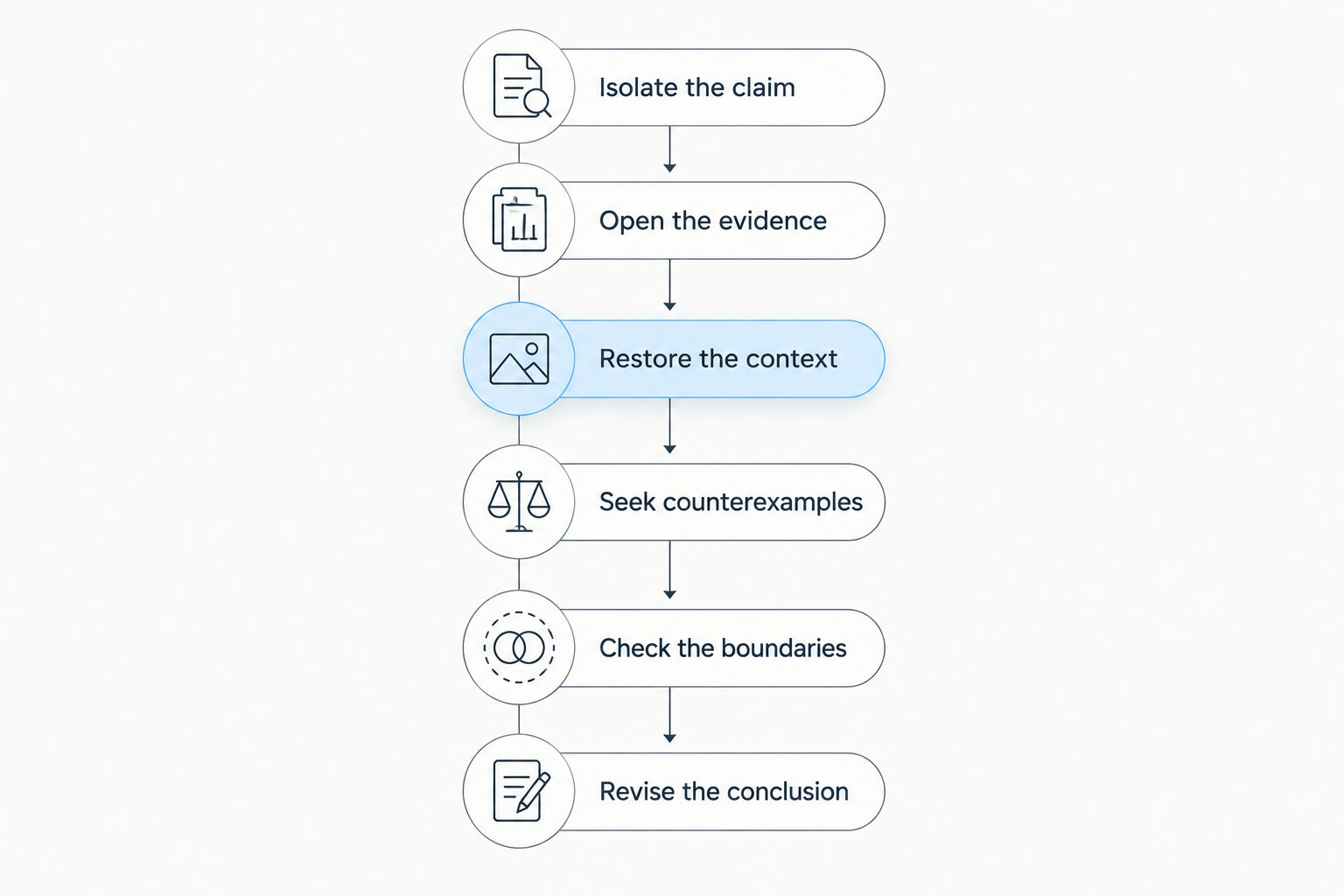
Check each consequential finding through the same sequence. Start with claims that would change what you believe about the relationship or what you plan to say to the other person.
1. Isolate the claim
Write down the finding in plain language, without adding your own explanation. Separate the reported behavior from the motive the report assigns to it.
For example, a claim about repeated unanswered questions contains something you can inspect: whether questions received answers in the available history. A claim that those unanswered questions demonstrate deliberate control adds an interpretation. Check those parts separately.
Accepting the observation does not require accepting the motive. If a finding blends them together, rewrite it as an observable statement before you examine the evidence. This makes the test specific enough to complete rather than a search for whether the relationship was generally good or bad.
2. Open the evidence
Find the original exchange supporting the finding. Read the messages before and after the cited passage, keeping speaker names, timestamps, and conversational order visible where the export includes them.
A selected sentence is not the whole exchange. Check whether the message responds to something earlier, whether a later reply changes its meaning, and whether the analyzer has attributed each message to the correct person.
If you cannot locate the supporting passage, leave the finding unverified. A confident summary is not a substitute for a traceable example, and an evidence link is useful only when the linked material actually supports the claim.
3. Restore the context
Read the exchange as a conversation rather than a collection of emotionally charged words. Look for quotation, joking, a previously agreed plan, an explanation of a delay, or a change of subject that affects the interpretation.
Context can also sit outside the export. A phone call, an in-person conversation, or an attachment you cannot inspect can leave a gap. Record that gap instead of filling it with an assumed motive.
Tone deserves particular care. The guide to whether a text message analyzer can understand sarcasm addresses a related question: whether an apparent meaning holds once the surrounding exchange is considered. When tone remains ambiguous, keep the observation narrow.
4. Seek counterexamples
Search for exchanges that do not fit the finding. If the report describes unanswered requests, look for answered requests as well; if it describes one-sided initiation, inspect conversations that the other person started.
Counterexamples do not automatically erase a pattern. They help you test its scope. A claim about a particular phase of a relationship needs different support from a claim about the entire history.
Ask whether the label still fits after you include contradictory examples. If it only works when you ignore those examples, revise the claim. A narrower finding that survives scrutiny is more useful than a sweeping finding that does not.
5. Check the boundaries
Confirm what the analyzer actually received. Review the beginning and end of the export, the conversation selected, and any obvious missing stretches before accepting a finding about the whole relationship.
Keep the scope of your conclusion within the scope of the evidence. A report based on one messaging channel cannot establish what happened in conversations outside that channel. Likewise, a breakup-period export does not describe the entire relationship merely because its messages are emotionally significant.
Check whether comparisons use comparable periods. If you are examining response timing, distinguish a change in observed messaging from an explanation for that change. The timestamps alone do not tell you why someone replied later.
6. Revise the conclusion
Finish with a written decision: supported, narrower than reported, contradicted, or unresolved. Include the message references that explain your decision so you can revisit it without repeating the entire exercise.
A supported finding stays close to what the messages show. A narrower finding retains the defensible part and removes an overstatement. A contradicted finding conflicts with the conversation, while an unresolved finding lacks enough evidence for a conclusion.
Do not turn unresolved into confirmed just because the report sounds persuasive. It is a valid endpoint. You can use an unresolved finding to formulate a question without treating it as an accusation.
Which review method should you use?
Choose the method by the task, not by how convincing the output sounds. For a 2026 review, distinguish a structured relationship report, a prompted interpretation, and your own reading of the original messages.
| Method | Best for | Useful contribution | Limit to account for |
|---|---|---|---|
| Grey Mirror | Reviewing patterns across an exported relationship history | Relationship timeline, evidence-linked findings, charts, and metrics | Evidence-linked output still needs context checks; it does not prove intentions |
| ChatGPT | Asking for alternative readings of a passage you provide | You can request observations, competing explanations, and evidence requirements | Another generated interpretation is not independent verification |
| Manual message review | Checking a specific finding against the original exchange | You can inspect the source conversation and record relevant outside context | Your own expectations need the same counterexample check |
Justlay's Grey Mirror is best for people reviewing relationship patterns who want to inspect evidence-linked findings. Its relationship-specific analysis makes it a different choice from asking a general-purpose assistant to interpret selected texts. Neither choice turns an inferred motive into an established fact.
Grey Mirror uses specialized relationship-analysis models. Evaluate that specialization through the documented outputs and the evidence supporting individual findings—not through an assumed accuracy advantage over ChatGPT or another service.
This is a brand-authored guide, not an independent review or endorsement. When evaluating Justlay or another provider, separate product descriptions from independently documented tests; a comparison written by the provider does not establish comparative accuracy.
Why interpretations vary
When an interpretation changes, identify what changed in the evidence or the question. These factors give you concrete places to inspect rather than reasons to accept every conflicting answer:
- Selected context: An isolated message and its complete exchange are different inputs. Check whether the finding depends on leaving surrounding messages out.
- Conversation coverage: The export determines which exchanges are available. Keep conclusions bounded by the channel and period actually reviewed.
- Speaker attribution: A claim about one person's behavior requires messages assigned to that person. Verify names, quoted text, and conversational order.
- Tone and shared meaning: Sarcasm, affectionate teasing, and references to earlier events require contextual interpretation. Do not substitute a literal reading for a checked one.
- Claim wording: Counting an observed behavior is different from explaining its purpose. Stronger language requires stronger supporting evidence.
- Contradictory evidence: A finding needs to account for relevant exceptions. Check whether the summary acknowledges them or overstates its reach.
For your 2026 checklist, record these factors beside the finding rather than in a separate general impression. That keeps your decision attached to the particular claim you are testing.
What should you ask ChatGPT when checking an analyzer's finding?
Ask ChatGPT to separate observations from interpretations and identify what evidence would distinguish competing explanations. Provide the relevant exchange with sufficient surrounding context, while removing personal details that are unnecessary for the task.
A useful instruction is: List only what these messages directly establish, then give alternative interpretations and explain what additional context each would require. Ask it to flag conclusions about motives that the text does not establish.
Do not ask only whether the original analyzer is right. That frames the task around agreeing or disagreeing with an existing verdict instead of examining its support. Review every proposed explanation against the messages yourself.
A second generated answer is another interpretation, not a fact-checking authority. Agreement between answers does not establish that a claim is correct; disagreement does not establish which answer is wrong. The original exchange remains the evidence you need to inspect.
Does an evidence link mean a relationship finding is accurate?
An evidence link makes a finding traceable, not automatically accurate. You still need to check whether the passage supports the wording and whether relevant context contradicts it.
Grey Mirror's free conversation analysis includes four evidence-linked findings and requires no card. Use those findings to practice the checking process: open the references, inspect the exchanges, and distinguish observations from inferred explanations.
Look at the connection between evidence and conclusion. A message that supports a finding about reply length does not, by itself, support a finding about emotional intent. Multiple examples also need to support the same claim rather than simply sound similar.
For a 2026 evaluation, ask whether you can explain the finding in your own words using the linked evidence. If you cannot, keep it unresolved instead of adopting the report's language as your own.
What should you do with a finding you cannot verify?
Keep an unverifiable finding out of your conclusions. Record it as a question, along with the context or evidence needed to answer it.
For an existing relationship, convert a label into a specific topic for discussion. Describe the exchange and ask about the missing context rather than presenting the analysis as proof of wrongdoing.
After a breakup, you do not need to resolve every ambiguous message to make use of the review. Keep the defensible observations, discard unsupported explanations, and stop when rereading produces no new evidence. An unresolved interpretation is not a requirement to keep searching.
FAQ
What are AI chat analyzer false positives?
AI chat analyzer false positives are findings that flag a pattern or interpretation the available conversation does not support. Check the cited messages, surrounding context, and contradictory evidence before accepting the finding.
Can a chat analyzer prove someone was manipulating me?
A chat analyzer cannot establish someone's intentions from text alone. It can identify exchanges for review, but an observed communication pattern is not a diagnosis or proof of motive.
Is Grey Mirror an independent judge of my relationship?
Grey Mirror is a relationship-analysis app, not an independent judge of your relationship. Its evidence-linked findings, timeline, charts, and metrics are material to examine rather than verdicts you must accept.
How many findings can I check in Grey Mirror's free analysis?
Grey Mirror's free conversation analysis includes four evidence-linked findings and requires no card. Open each finding's references and check whether the complete exchange supports the interpretation.
Is ChatGPT better for checking whether a finding is wrong?
ChatGPT is useful for requesting alternative interpretations, but its answer does not independently verify a finding. Check those alternatives against the original messages and relevant context.
Does a late reply mean someone is avoiding me?
A late reply does not establish deliberate avoidance. A timestamp shows when a message was sent, not the sender's reason for replying at that time.
Should I ignore a finding if I find a counterexample?
A counterexample means you should check the finding's scope, not automatically discard it. Decide whether the claim still describes the relevant period or needs narrower wording.
Can I measure an analyzer's accuracy from my own relationship report?
Checking your own report can identify unsupported findings, but it does not establish the analyzer's general accuracy. A broader accuracy claim needs a documented evaluation with defined criteria and independently checked examples.
One last thing
Before accepting an emotionally significant finding in 2026, rewrite it without words about motives or personality. If nothing observable remains, you have an interpretation to investigate—not a demonstrated communication pattern.
Justlay's relationship analysis is useful when it sends you back to evidence you can examine. Keep that direction clear: the report helps organize your review; the messages and their context determine what you can responsibly conclude.