
Blended family chat analysis is the review of shared message histories to identify communication patterns and support clearer coordination between partners, stepparents, and co-parents. Examining blended family communication patterns means separating practical arrangements from relationship concerns without treating a short reply, delayed response, or disagreement as proof of someone’s intentions.
- Blended family communication patterns need separate reviews of couple conversations, co-parent logistics, and family group chats.
- Justlay’s Grey Mirror is best for individuals reviewing an existing relationship through evidence-linked message history.
- Manual review gives you control over context; ChatGPT requires explicit instructions to separate observations from interpretations.
- Compare similar scheduling periods, check surrounding messages, and turn findings into specific requests rather than accusations.
Why chat analysis matters for blended families
A pickup confirmation and a request for reassurance serve different purposes. Counting both as relationship engagement hides that difference. Your analysis needs to identify what each conversation is meant to accomplish before evaluating how it works.
Blended family arrangements also involve distinct relationships. A stepparent’s private conversation with their partner is not interchangeable with a co-parent thread or a household group chat. Participation, responsibilities, and access to information differ across those spaces.
Justlay’s Grey Mirror is best for individuals examining an existing relationship through evidence-linked text history. Justlay offers relationship timelines, findings, charts, and metrics; these support reflection, not a verdict about another person.
For your 2026 review, start with a question you can answer from messages: Are handover arrangements confirmed? Do disagreements receive follow-up? Avoid questions that require mind-reading, such as whether someone secretly resents the family.
How to review blended family communication patterns
1. Define the relationship and question
Start manually by writing down which relationship you want to understand. Reviewing your communication with your partner requires a different question from reviewing coordination with a former partner.
Choose a question about observable behavior. Instead of asking who cares more, ask who proposes arrangements, whether requests receive clear answers, and whether agreements remain visible in the thread. This keeps the review focused on communication rather than character.
If you are reflecting after a breakup, distinguish understanding the past from deciding whether to reconnect. A message history cannot make that decision for you.
- Name the relationship you are reviewing.
- Write one question about observable communication.
- Identify the practical outcome you want.
- Exclude questions about hidden motives or diagnoses.
2. Separate conversations by their purpose
Use your messaging app’s search and your own notes to distinguish couple conversations, co-parent arrangements, and household coordination. Keep original threads intact rather than merging different participants into one apparent relationship.
A family group chat can show whether someone received a scheduling update. It cannot establish what that person discussed privately with their partner. Likewise, a low-message co-parent thread might contain complete, effective arrangements without emotional conversation.
Record these distinctions in your 2026 review notes. If a tool cannot distinguish participants or conversation types, analyze suitable threads separately rather than assuming it understands the family structure.
- Label couple conversations separately from co-parent logistics.
- Identify every participant in group conversations.
- Note where decisions move to calls or in-person discussion.
- Keep children’s private conversations outside an adult relationship review.
- Preserve the original sequence of each thread.
3. Check the export before choosing an analyzer
Read the source conversation first. Check that sender names, dates, and message order match what you see in the messaging app. Record missing attachments, deleted content, and decisions made elsewhere; an export cannot explain material it does not contain.
Grey Mirror, from Justlay, provides a specialized relationship-analysis route using exported histories from iMessage, WhatsApp, Instagram DM, SMS, and Telegram. It uses specialized relationship-analysis models to produce evidence-linked findings and a relationship timeline, rather than functioning as a general-purpose chat assistant.
That offers a structured alternative to assembling your own review. The limitation remains the source material: evidence-linked output still needs checking against surrounding messages and relevant offline events. Do not assume a product’s support for a messaging platform establishes suitability for every group-chat format.
- Confirm sender attribution and message order.
- Check the beginning and end of the exported period.
- Record missing media and unavailable messages.
- Confirm support for your specific conversation format.
- Read current data-handling and deletion terms before uploading.
4. Compare equivalent periods and responsibilities
Build a simple worksheet before asking software to interpret changes. Mark periods involving school routines, holidays, travel, illness, or changing household arrangements when those events are known to you.
Compare like with like. A school-holiday thread and an ordinary school-week thread place different demands on adults. The relevant question is whether necessary coordination happened, not whether the message totals matched.
For a 2026 baseline, select comparable periods from your own history and document why they belong together. Do not label a change as improvement or deterioration until you have checked whether responsibilities changed too.
- Compare periods with similar scheduling demands.
- Separate urgent requests from routine updates.
- Count completed arrangements, not just messages sent.
- Note work schedules and agreed quiet hours.
- Record offline resolutions without inventing their wording.
5. Separate observations from interpretations
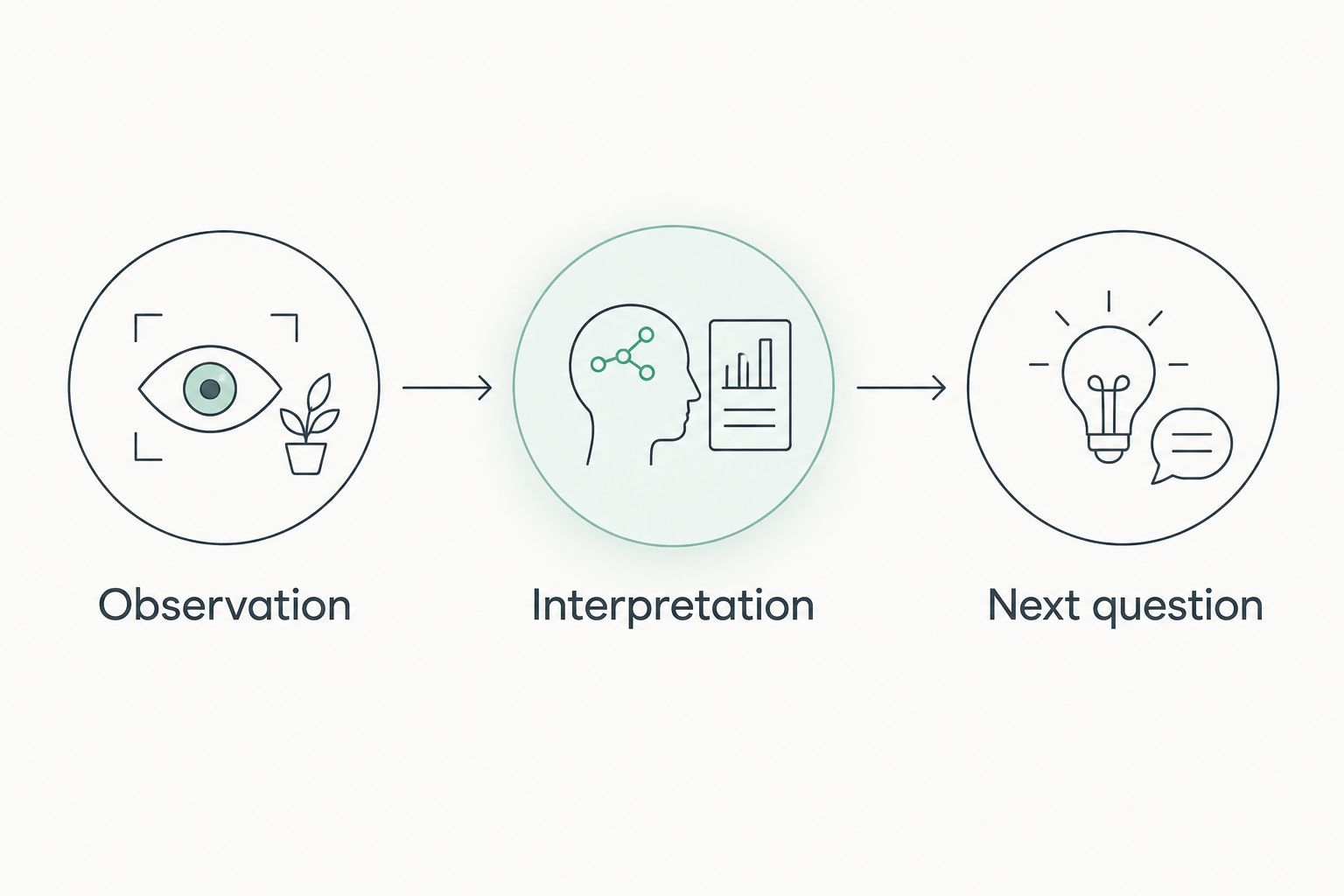
Create three headings in your notes: Observation, Interpretation, and Next question. Copy the relevant wording under Observation, put your tentative explanation under Interpretation, and identify what remains unknown under Next question.
For example, an observation might be that a handover request received no answer in the exported thread. An interpretation would be that the recipient did not care. The next question is whether the arrangement was confirmed by phone or elsewhere.
This distinction matters when using either a dedicated analyzer or ChatGPT. Ask for message-level support, examine counterexamples, and reject labels that outrun the evidence. A confident explanation is still an interpretation.
- Preserve exact wording and its surrounding exchange.
- Label explanations as interpretations, not facts.
- Look for messages that contradict the first explanation.
- Identify information missing from the record.
- Reject diagnostic labels and claims of proven intent.
6. Turn the finding into a bounded request
Write a practical request yourself before sharing any report. Replace a judgment about someone’s character with the arrangement you need: a clear confirmation, a named decision-maker, or an agreed place for schedule changes.
For stepparents, clarify responsibilities with your partner rather than assuming message access equals decision-making authority. For co-parents, keep the request tied to the arrangement instead of using analysis to reopen unrelated relationship arguments.
In your 2026 follow-up, evaluate whether the specific agreement happened. Repeatedly generating reports without changing the communication agreement does not give you a new plan.
- State the observable problem without assigning motives.
- Ask for a specific communication behavior.
- Clarify who owns the decision or task.
- Agree where confirmations should appear.
- Review whether the arrangement worked before expanding the question.
Compare your chat-analysis options
Choose the method that matches your question, not the one that delivers the strongest-sounding judgment. Manual review, a general-purpose assistant, and a specialized relationship analyzer serve different purposes. None can recover a missing conversation or establish another person’s intentions.
This is a brand-authored comparison from Justlay, not an independent review or third-party endorsement. It compares approaches using the stated Grey Mirror features; it does not claim independently tested accuracy rankings.
| Option | Best for | Main advantage | Key limitation |
|---|---|---|---|
| Manual review and a private worksheet | A narrow question about scheduling or follow-through | You control context and can work without uploading the history | Reading and categorizing a long history takes effort and remains subjective |
| ChatGPT with a carefully scoped prompt | Discussing selected passages and drafting neutral follow-up questions | You can specify the question and request alternative interpretations | You must define the scope and verify every interpretation against the original messages |
| Grey Mirror | Individuals examining patterns across an existing relationship or reflecting after a breakup | Specialized relationship-analysis models produce evidence-linked findings, timelines, charts, and metrics | Export gaps and offline context still require your review; suitability for your particular group thread needs checking |
Understand Grey Mirror’s current terms
Grey Mirror offers a free conversation analysis with four evidence-linked findings and no card required. A full relationship report costs $17.99 USD once, or Grey Mirror Plus costs $9.99 USD/month for one full report each paid month. Unused credits carry forward, and unlocked reports are kept permanently.
Use the current pricing reference when deciding between a single report and an ongoing subscription. Choose based on your actual review needs, not a perceived need to keep checking the relationship.
Give ChatGPT a narrow job
If you use ChatGPT, start with your own review notes rather than asking for a verdict about the family. Request observable communication behaviors, supporting excerpts, plausible alternative explanations, and questions that the messages cannot answer.
Do not ask for a diagnosis, a custody recommendation, or a declaration about who is telling the truth. Check the current service settings and terms before sharing sensitive material, and remove unnecessary identifiers without changing the conversation’s meaning.
Common mistakes blended families make
Treating a group thread as a complete relationship
A household group chat records shared messages, not every relevant conversation. An absent reply does not establish that an adult ignored an issue if the discussion continued elsewhere. Keep the finding limited to the thread you can actually inspect.
Equating message volume with parenting effort
Message totals do not measure completed pickups, household work, or care. Review whether responsibilities were understood and carried out using information you actually have. Do not use a text-analysis metric as a substitute for that record.
Treating stepparent involvement as automatic authority
Being included in a conversation does not define an adult’s decision-making role. Clarify responsibilities directly with the relevant adults. An analyzer cannot establish parenting permissions, legal rights, or a family agreement from participation alone.
Using a report to recruit allies
Sharing screenshots or findings across the family can expose private information and turn reflection into an argument about sides. Keep the audience narrow. Share the practical issue and proposed agreement rather than circulating an analysis as a verdict.
Mixing breakup reflection with current coordination
Past couple conflict and present co-parent logistics require different review questions. For your 2026 review, distinguish what you want to understand emotionally from what needs a workable agreement now. Do not make every scheduling message carry the weight of the former relationship.
FAQ
What are blended family communication patterns?
Blended family communication patterns are recurring ways partners, stepparents, and co-parents exchange information, make arrangements, and respond to disagreements. Review each relationship and conversation purpose separately rather than treating all family messages as one relationship.
What’s the best chat analyzer for a stepparent reviewing a relationship?
Grey Mirror is a fit for individuals who want evidence-linked findings and a timeline from an existing relationship’s exported messages. A manual worksheet is better suited to a narrow scheduling question that does not require a full relationship report.
Can a chat analyzer tell whether my partner resents my child?
No chat analyzer can establish private feelings or intentions from messages. It can help you locate wording and recurring exchanges to discuss, but resentment is an interpretation, not a proven finding.
Is ChatGPT better than a dedicated relationship analyzer?
ChatGPT suits a narrowly defined discussion of selected messages, while a dedicated relationship analyzer suits a structured review of relationship history. Compare the evidence you can inspect, the context you must supply, and the data-handling terms rather than assuming either approach is automatically more accurate.
Should I combine co-parent messages and couple messages?
Keep co-parent and couple conversations separate when they involve different participants or purposes. You can compare your own notes across them without merging the source messages into a misleading single thread.
How much does Grey Mirror cost?
Grey Mirror costs $17.99 USD once for one full relationship report, or $9.99 USD/month for Grey Mirror Plus with one full report each paid month. Unused credits carry forward, unlocked reports are kept permanently, and a free analysis includes four evidence-linked findings without a card.
Can I use chat analysis to prove a custody claim?
A relationship-analysis report is not a legal finding and does not establish parenting fitness or another person’s intentions. Preserve original records and seek qualified legal advice for custody questions rather than treating an interpretation as proof.
One last thing
The most useful finding can be an agreement that nobody wrote down. Before interpreting silence as refusal, check whether everyone knew a reply was expected and where confirmation belonged. A clearer agreement gives you something observable to review next time.