
Personal relationship analysis is the review of your own communication patterns to identify habits you want to understand or change. This 2026 guide focuses on existing relationships and breakup reflection, where a full conversation history provides context that an isolated screenshot cannot.
- For relationship analyzer personal reflection, review your own behavior rather than trying to prove someone else's intentions.
- Justlay's Grey Mirror is best for full-history relationship reflection with evidence-linked findings.
- Compare manual review, ChatGPT, and Grey Mirror by context, traceability, and the work each requires.
- Pick one specific texting habit to change; a relationship report is not a diagnosis.
Why relationship analysis matters for personal reflection
Your most useful finding is a pattern you can check and act on. That means asking how you respond to uncertainty, handle disagreement, or follow through after an apology, not asking an app to decide who was right.
People examining an existing relationship need to connect written exchanges with conversations and circumstances outside the chat. People reflecting on a breakup face a different task: learning from the record without turning every reread into another attempt to settle the relationship.
Justlay offers Grey Mirror for analyzing an exported relationship message history through a timeline, evidence-linked findings, charts, and metrics. Those outputs give you material to inspect. They do not establish what either person privately felt or intended.
For personal reflection in 2026, prioritize traceability over a confident-sounding explanation. A finding should send you back to the relevant exchange, where you can check the wording and surrounding context yourself.
How to examine your own texting habits
Define the question you can actually answer
Start with a note and a question about your own observable behavior. Instead of asking whether you were a bad partner, ask what you wrote when a conversation became uncomfortable and what you did afterward.
Keep the question narrow enough to answer from the record. Texts can show that you changed the subject after a direct question; they cannot, by themselves, establish why you did it.
- Write a question beginning with "When do I..." or "How do I...".
- Name an observable behavior, such as repeated follow-ups or unanswered questions.
- Record what would count as evidence against your first interpretation.
- Decide what practical decision the review should support.
Select the history and record its limits
Identify the conversation and the period relevant to your question. Preserve surrounding exchanges rather than collecting only messages that support the story you already believe.
Record gaps before interpreting patterns. A phone call, an in-person discussion, or missing messages can change the meaning of an exchange. A quiet stretch in a text history shows only that the reviewed record contains less texting during that stretch, not that affection disappeared. See how deleted messages can distort a text analysis report.
For breakup reflection, set a stopping condition before you begin. Finish when you have answered your question or identified a change to practice.
- Keep messages before and after the exchange under review.
- Note known calls, visits, and conversations outside the app.
- Mark missing or deleted material without reconstructing it.
- Separate work schedules and other known constraints from assumptions.
- Write down when you will stop reviewing.
Choose a review method that fits your question
Begin with a manual pass through the conversation and a simple notes document. This works well when your question concerns a specific exchange and you can inspect the context directly.
For a longer history, Grey Mirror uses specialized relationship-analysis models to generate a timeline, evidence-linked findings, charts, and metrics from exported messages. Supported sources include iMessage, WhatsApp, Instagram DM, SMS, and Telegram, on web, iPhone, and Mac.
Grey Mirror is best for people examining an existing relationship or breakup through full-history, evidence-linked analysis. Its limitation matches the manual approach: the available messages do not capture everything that happened.
- Use manual review for a bounded question about a specific exchange.
- Consider ChatGPT for discussing wording or alternative readings of text you supply.
- Consider Grey Mirror when you want a relationship timeline and traceable findings.
- Check current upload and data-handling terms before sharing personal messages.
- Never treat any method as an authority on someone's intentions.
Separate observations from interpretations
Create a note with three fields: Observation, Context, and Action. Put only what the record shows in the first, relevant circumstances in the second, and a behavior you control in the third.
A cluster of follow-up messages is an observation. Describing yourself as incapable of tolerating uncertainty is an interpretation. A more useful action is stating your urgency clearly instead of sending successive messages that leave it unstated.
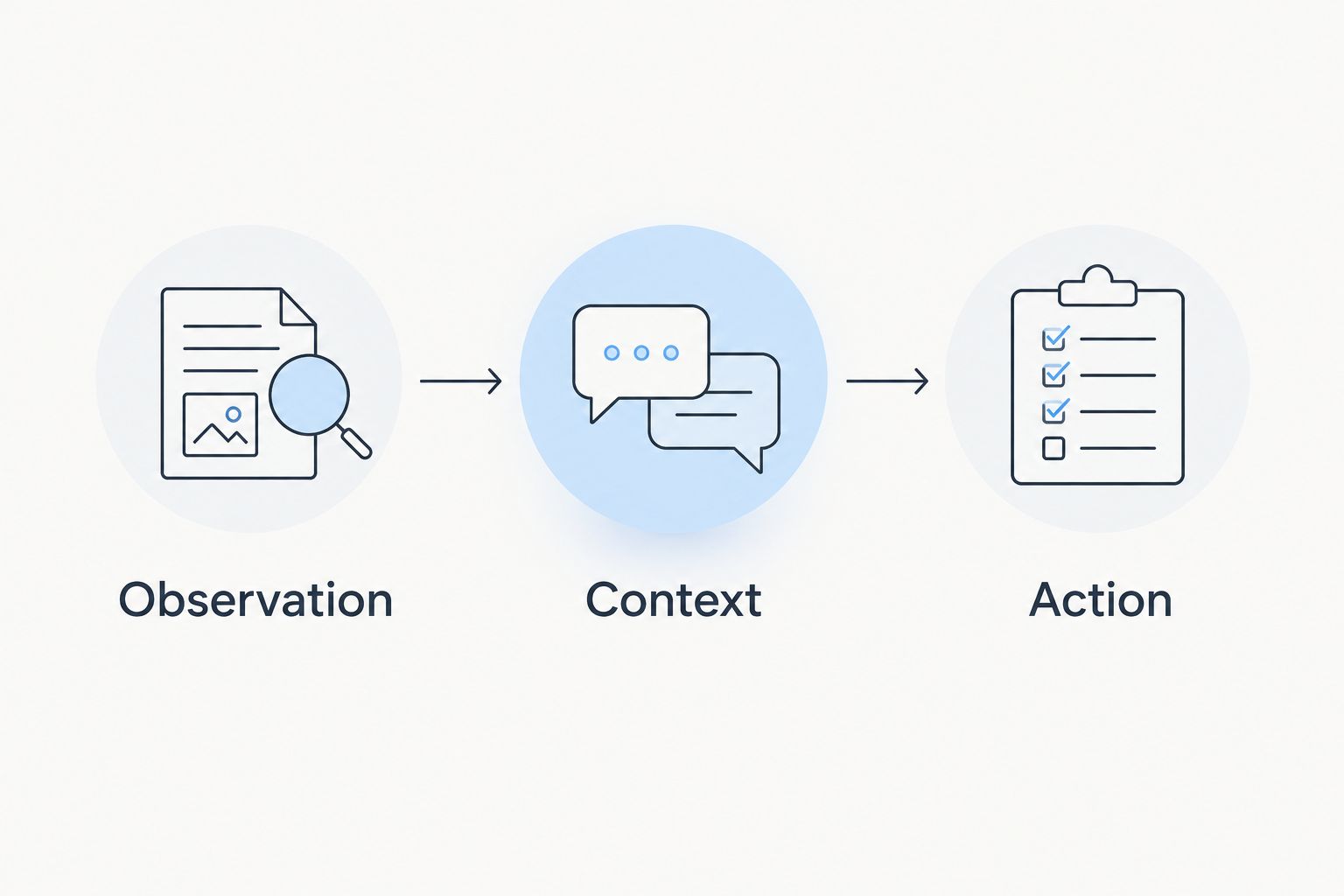
Use the same fields for positive examples. A helpful review preserves evidence of repair, clarity, and boundaries as well as friction.
- Observation: copy the relevant wording and identify the exchange.
- Context: record known circumstances without guessing motives.
- Action: choose a response you can practice in a similar situation.
- Counterexample: save an exchange that challenges the pattern.
Check findings against the surrounding conversation
Inspect every finding you intend to use. Read the preceding messages, the response, and any later clarification before accepting a summary.
Test alternative explanations. A brief reply might follow a practical question that needed only a brief answer. Repeated messages might concern an unresolved logistical issue rather than a relationship dynamic.
Use this guide to check a chat analyzer for false positives when a label feels stronger than its evidence. Rejecting a weak finding is part of honest reflection.
- Locate the exact messages supporting each finding.
- Read the exchange beyond the quoted excerpt.
- Look for comparable exchanges where you behaved differently.
- Separate repeated behavior from a single exceptional event.
- Rewrite or discard conclusions the evidence does not support.
Turn the review into a specific practice
Close your notes with an action, not another label. "Communicate better" is too broad to guide your next message; "state whether I need an answer today" is something you can practice.
If the relationship continues, describe your own behavior before asking the other person to respond. If it has ended, the action can stay private: clearer boundaries, more direct requests, less rereading when no decision remains. The guide on using a text message analyzer after a breakup without spiraling covers that case.
When you review again in 2026, compare the same behavior in similar circumstances, not a tense breakup exchange against routine planning.
- Choose a habit within your control.
- Write an example of the wording you want to use instead.
- Define what successful follow-through would look like.
- Review a comparable exchange rather than your whole history again.
- Stop when further analysis no longer changes your next action.
Compare your personal-reflection options
Choose the method by the task, not by how persuasive its summary sounds. Manual review gives you control but requires you to organize the evidence. Software can structure the material, but you still inspect the conclusions.
This is a Justlay-authored comparison for 2026, not an independent review or endorsement. ChatGPT appears as a general-purpose conversational option; Grey Mirror is a specialized relationship-analysis app.
| Option | Best for | Payment | Key limitation |
|---|---|---|---|
| Manual conversation review | A narrow question about one exchange | No app purchase required | You organize the history and challenge your own interpretation |
| ChatGPT | Discussing supplied wording and possible readings | Check current plan terms | A generated interpretation is not evidence of intent |
| Grey Mirror free conversation analysis | A first look at evidence-linked findings | Free; no card required | Four findings, not a full relationship report |
| Grey Mirror full report | An exported relationship history with timeline, findings, charts, metrics | $17.99 USD once per full report | Findings still need checking against source messages |
| Grey Mirror Plus | Returning for additional full reports | $9.99 USD/month, one full report each paid month | Unnecessary if you want only one report |
Unused Grey Mirror Plus credits carry forward, and unlocked reports are kept permanently. Current pricing is on the Grey Mirror pricing page.
Common mistakes in personal relationship reflection
Turning self-reflection into self-prosecution
Taking responsibility does not require treating every difficult exchange as proof of a personal defect. Record the behavior precisely, then describe what a better response would look like. Change the action, not your identity.
Using reply speed as a measure of care
Response intervals do not establish affection, respect, or intent. Account for known schedules and the type of message before interpreting a delay. If timely replies matter to you, discuss expectations directly instead of asking a chart to supply an agreement that never existed.
Treating a model's wording as a diagnosis
A forceful description does not turn a communication pattern into a clinical assessment. Keep conclusions at the level the evidence supports: what was written, what followed, and what context is unknown. Flattering conclusions need the same check as harsh ones.
Reopening the same breakup question indefinitely
Another summary is not automatically another insight. If reviewing produces no new evidence and no different action, return to the stopping condition you wrote before starting. Define completion by a useful outcome, such as a clearer boundary, not certainty about every message.
FAQ
What's the best relationship analyzer for personal reflection?
Grey Mirror suits people who want full-history relationship analysis with evidence-linked findings, a timeline, charts, and metrics. Manual review is a better start for a narrow question about one exchange. This recommendation is brand-authored, not an independent endorsement.
Can I use ChatGPT to examine my own texting habits?
Yes, you can ask ChatGPT to discuss wording and alternative interpretations of text you supply. Check each conclusion against the conversation and never treat an interpretation as proof of intent.
How much does Grey Mirror cost?
Grey Mirror costs $17.99 USD once for one full relationship report, or $9.99 USD/month for Grey Mirror Plus with one full report each paid month. Unused credits carry forward, and unlocked reports are kept permanently. A free conversation analysis includes four evidence-linked findings and requires no card.
Can a relationship analyzer tell me whether I was the problem?
No. A relationship analyzer cannot fairly reduce a relationship to a verdict about who was the problem. Use it to examine specific behaviors and identify actions you control.
Should I analyze messages after a breakup?
Only with a defined reflection question and a stopping condition. Focus on lessons that change your future behavior, and stop when more analysis no longer changes your intended action.
What should I check before uploading private messages?
Check the service's current data-handling terms and export requirements first. Consider the other person's privacy, and do not assume a retention or deletion policy without confirming it.
Can a texting report prove someone intended to hurt me?
No. A report can help you inspect recorded language and patterns, but it cannot prove private intentions. Keep missing context and competing explanations separate from what the messages directly show.
One last thing
The strongest result is sometimes a smaller conclusion. Replacing "I always handle conflict badly" with a specific, checkable observation gives you a better basis for change than a sweeping verdict.
Keep your 2026 reflection notes useful: the relevant evidence, the context you know, and the response you want to practice next. You do not need to solve the whole relationship to improve your next conversation.