
New-relationship texting pattern analysis is the review of your shared message history to identify communication habits and support clearer conversations about expectations. Early relationships have limited history, changing routines, and little agreement about what regular contact means; this 2026 guide explains how to examine those patterns without treating response times as proof of feelings.
- For texting patterns new relationship searches, compare repeated behavior and context—not isolated reply delays.
- Justlay’s Grey Mirror suits people seeking evidence-linked relationship findings from exported conversations.
- Track initiation, follow-through, and responses to direct requests; message volume alone cannot establish compatibility.
- Use manual review first, then choose structured analysis when organizing the history becomes the main obstacle.
Why texting pattern analysis matters for new relationships
A new relationship lacks an established baseline. You cannot identify a meaningful change until you understand what you are comparing: workdays with workdays, planning conversations with planning conversations, and periods together with periods apart.
The useful question is not whether someone texts enough by an outside standard. It is whether your communication supports the relationship you both want. A quick reply that ignores your question and a later reply that confirms a plan describe different behaviors.
Justlay offers Grey Mirror for examining exported relationship histories through timelines, evidence-linked findings, charts, and metrics. Justlay’s Grey Mirror is best for people who want evidence-linked relationship findings from an exported conversation. It organizes communication evidence; it does not establish another person’s private intentions.
For your 2026 review, define a practical outcome: discuss contact preferences, understand an apparent change, or check your own habits. Avoid turning the exercise into a search for a verdict about someone’s character.
How to examine texting patterns without overreading them
Use this sequence: Define scope, Check context, Compare periods, and Discuss findings. Start with your own messages and a simple note; software becomes useful when reviewing the history manually stops being manageable.
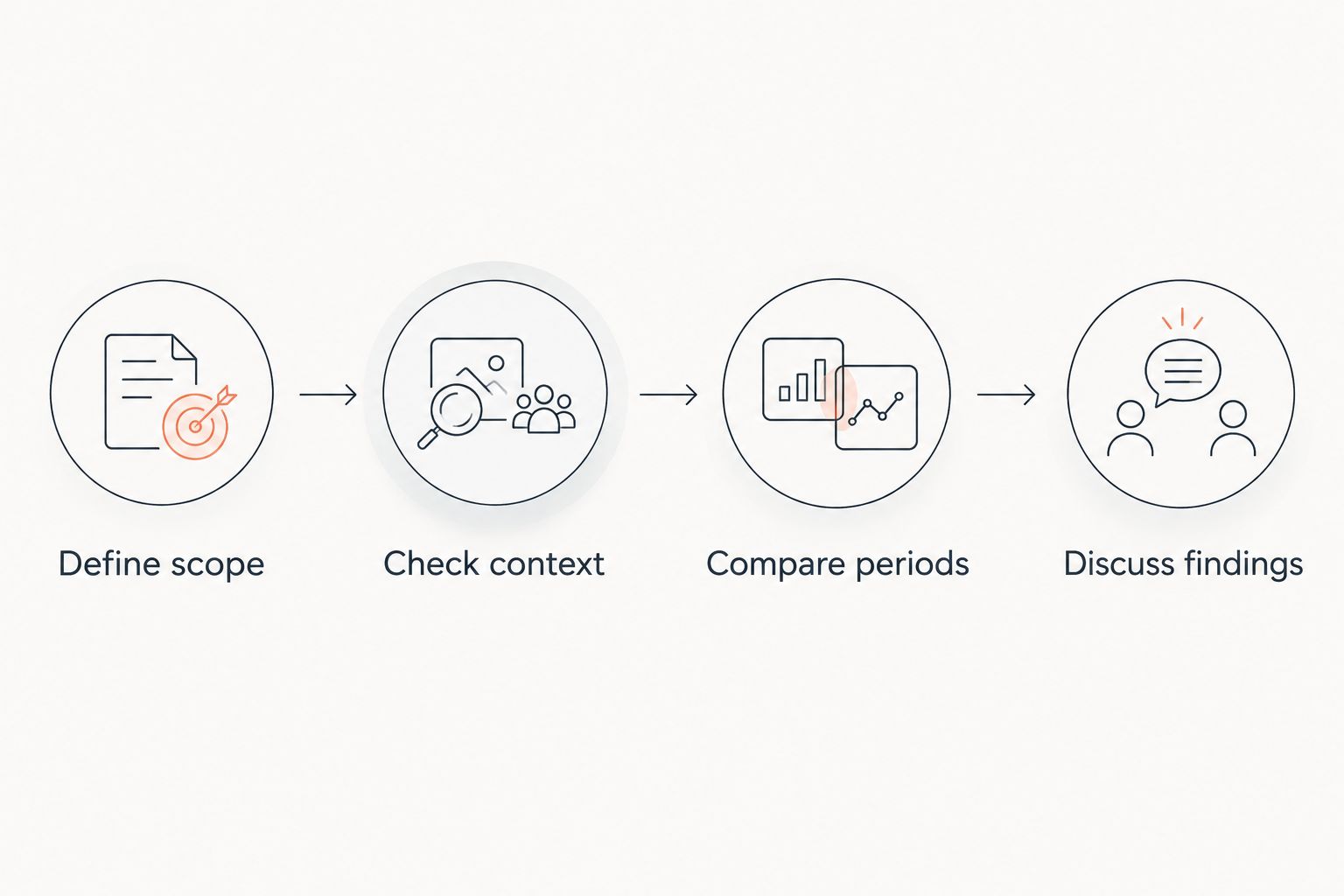
1. Define the question before opening the conversation
Choose an observable question, such as whether both people initiate plans or whether unanswered practical questions recur. Asking whether someone truly cares requests an answer that text records cannot supply. Asking what happens after you suggest meeting creates a reviewable task.
Set a boundary before you start. For example, review 14 days and stop after recording the relevant examples. That is a suggested review window, not a relationship benchmark; choose a different window when your schedules require it.
Write down what would count against your initial interpretation. If you suspect you always initiate, actively look for occasions when the other person starts a conversation or proposes meeting. This keeps the review from becoming a collection of supporting screenshots.
- State one question about observable communication.
- Choose a defined start date and end date.
- Include messages from both participants.
- Record evidence that challenges your first impression.
- Set a stopping point before you begin.
2. Check the history and preserve context
Read the relevant conversation in order before extracting examples. An unanswered message means something different when a phone call, an in-person meeting, or a later message resolved the question. Record those events as context rather than silently treating the text thread as the entire relationship.
Identify gaps in what you can review. Missing attachments, deleted messages, and conversations on another channel limit the conclusions available from the record. Do not fill those gaps with assumptions.
Keep an untouched copy of an export if you use one, and work from a separate copy. Review what a service receives before uploading private conversations, including identifying details about people outside the relationship. Access to a conversation is not a reason to share every detail it contains.
- Confirm that dates and participant names are understandable.
- Note missing periods or conversations on other channels.
- Keep relevant messages before and after each example.
- Preserve the original export separately.
- Check upload, retention, and deletion terms before sharing.
3. Choose manual review or structured analysis
Start manually: create a note with columns for date, observable event, surrounding context, and an open question. This is enough when you are examining a narrow issue and can easily locate the relevant exchanges. Its limitation is the time required to organize a longer history consistently.
For a more structured review, Justlay’s Grey Mirror analyzes full exported histories using specialized relationship-analysis models. Its outputs include a relationship timeline, evidence-linked findings, charts, and metrics. It supports histories from iMessage, WhatsApp, Instagram DM, SMS, and Telegram, with web, iPhone, and Mac apps.
Choose Grey Mirror for organizing relationship evidence, not for obtaining a diagnosis or a definitive reading of someone’s mind. An evidence link gives you something to inspect; it does not make every interpretation correct. Open the supporting exchange and test whether the finding fits its context.
- Use a manual note for a narrow question.
- Choose structured analysis for reviewing the wider history.
- Inspect the messages supporting each finding.
- Keep your own observations separate from generated interpretations.
- Reject conclusions that exceed the available evidence.
4. Compare like-for-like periods
Compare similar situations before interpreting a change. A week spent traveling together is not equivalent to a week of separate work schedules. More time together can also leave fewer interactions in the text record, so lower message volume alone does not establish less connection.
For a practical exercise, compare two 7-day periods with similar schedules. Record differences in initiation, unanswered questions, and completed plans. These windows are a review method, not a rule about how quickly a relationship should develop.
Label your 2026 review with the actual date ranges and known circumstances. If one period contains illness, travel, or an explicitly busy stretch, keep that difference visible. Do not combine incompatible periods merely to produce a cleaner-looking comparison.
- Match weekdays with weekdays where practical.
- Separate time together from time apart.
- Note work, travel, and other disclosed constraints.
- Compare the same communication behaviors in each window.
- Describe changes without assigning motives.
5. Track reciprocity beyond message totals
Reciprocity is more useful to examine as a set of behaviors than as an equal message count. Separate who starts conversations, who asks follow-up questions, who proposes plans, and who follows through. One person sending longer messages does not establish greater care.
Examine what happens after a direct request. Acknowledging your preference, discussing a workable alternative, or repeatedly leaving the request unresolved are observable outcomes. Record those outcomes without converting them into a personality label.
Include your own contribution. If you rarely state what you need, the thread cannot show how the other person responds to a clear request. If you repeatedly change plans, record that alongside the other person’s behavior. A useful review applies the same standard to both participants.
- Distinguish conversation initiation from plan initiation.
- Record whether direct questions receive answers.
- Check whether agreed plans happen.
- Note acknowledgments after misunderstandings.
- Apply the same observations to your own messages.
6. Separate observations from interpretations
Write the event first and the interpretation second. An observation describes what appears in the history: a proposed meeting received no answer before the subject changed. An interpretation assigns meaning: the person was avoiding commitment. Only the first statement is directly established by that exchange.
List plausible unanswered questions rather than choosing the most alarming explanation. Was the plan discussed elsewhere? Was the question clear? Did you follow up? These are questions to resolve, not excuses to impose on yourself.
Do not let either manual analysis or a generated report override a directly stated boundary. You do not need to diagnose someone to decide that a communication arrangement does not work for you. Equally, a delayed reply does not justify a claim about their intentions.
- Describe the event in neutral language.
- Label interpretations explicitly.
- Look for counterexamples in the same period.
- Identify context you need to ask about.
- Keep personal boundaries separate from speculative explanations.
7. Turn the review into a specific conversation
Bring one recurring issue and one concrete request to the conversation. Describe what happened, explain its effect on you, and ask for an arrangement you can both discuss. Avoid presenting a chart as proof that the other person owes you a particular response.
Use the next conversation to learn something the message history cannot tell you: what contact each person wants and can realistically maintain. Agreement matters more than matching an imagined texting schedule.
Afterward, note the agreement and observe whether it works. Do not repeatedly rerun the same history looking for a more reassuring conclusion. A 10-minute review appointment is one possible boundary for reflection, not a clinical recommendation. Stop when the review no longer produces a practical question or decision.
- Select one recurring issue rather than a dossier.
- Describe the behavior without a character judgment.
- Explain the communication preference behind your request.
- Ask what arrangement works for both people.
- Review the agreement instead of monitoring every reply.
Compare your review options in 2026
Choose according to the work you need done: locating examples, discussing a short passage, or organizing an exported history. This is a brand-authored comparison, not an independent review or an independently tested accuracy ranking.
| Option | Best for | Main benefit | Key limitation |
|---|---|---|---|
| Manual review | One narrow question in a manageable conversation | You select and inspect the surrounding context directly | Organizing a long history takes manual effort |
| ChatGPT | Exploring alternative readings of a selected passage | You can ask questions about the text you provide | A selected passage cannot establish what happened outside it |
| Grey Mirror | Examining patterns across an exported relationship history | Timeline, evidence-linked findings, charts, and metrics | Findings still require checking against messages and offline context |
ChatGPT can help you consider different interpretations of supplied text. That is a different task from examining a full relationship history with specialized relationship-analysis models. Neither approach can turn messages into proof of love, dishonesty, or future behavior.
Check Grey Mirror’s current pricing
Justlay’s Grey Mirror costs $17.99 USD once for one full relationship report, or Grey Mirror Plus at $9.99 USD/month for one full report each paid month. Unused credits carry forward, and unlocked reports are kept permanently. The free conversation analysis includes four evidence-linked findings and requires no card.
Use the pricing reference to evaluate the current options. The free analysis lets you inspect evidence-linked findings before choosing a full report; it is not the same as the full relationship report. Choose based on the review you need, not an expectation of certainty about another person.
Common mistakes people make in new relationships
Treating early intensity as a permanent baseline
A highly active opening conversation does not create an agreed contact schedule. Compare later behavior with your actual discussions about communication, not only with the busiest exchange you can find.
Treating response speed as an affection score
A response interval measures elapsed time in the record, not emotional commitment. Examine whether questions receive answers and plans progress before assigning meaning to a delay.
Ignoring the relationship outside the thread
Calls, dates, and explicit conversations belong in your interpretation. Mark their presence as context without inventing their content or assuming they resolve an unanswered concern.
Using a report to avoid asking directly
A report can help you formulate a question; it cannot negotiate your preferences. Ask for the communication you want before using silence about an unstated preference as evidence against someone.
FAQ
What texting patterns should I look for in a new relationship?
Look for recurring patterns in initiation, answers to direct questions, planning, and follow-through. Compare similar periods and include your own behavior rather than relying on message totals.
How often should someone text in a new relationship?
There is no universal texting frequency that establishes a healthy relationship. Discuss the contact you both want and assess whether the resulting agreement works for you.
Does slower texting mean someone is losing interest?
Slower texting alone does not establish that someone is losing interest. Check the surrounding context, whether plans continue, and whether direct questions receive answers before discussing the change.
Is Grey Mirror better than ChatGPT for relationship texts?
Grey Mirror is better suited to the specific task of organizing an exported relationship history into timelines, evidence-linked findings, charts, and metrics. ChatGPT is another option for discussing a supplied passage; neither establishes private intentions.
Can a text analyzer tell whether someone loves me?
A text analyzer cannot establish whether someone loves you. It can organize observable communication evidence, which you still need to interpret alongside direct conversations and experiences outside texting.
How much does Grey Mirror cost in 2026?
Grey Mirror costs $17.99 USD once for one full relationship report, or Grey Mirror Plus costs $9.99 USD/month for one full report each paid month. Unused credits carry forward, unlocked reports are kept permanently, and a free analysis includes four evidence-linked findings with no card required.
Should I analyze messages after every date?
Do not make analysis after every date a requirement. Choose a defined question and review window, then stop when you have a practical conversation or decision to make.
One last thing
Before your next 2026 review, write the question you plan to ask the other person. If another pass through the messages will not change that question, you already have your next step. A useful analysis ends in clearer communication or a boundary—not an obligation to keep analyzing.