
Adult friendship text message analysis is the review of a friendship’s message history with the aim of understanding communication patterns and choosing a next step. This 2026 guide explains how to account for busy schedules, offline contact, group chats, and friendship endings without treating messages as proof of someone’s intentions.
- Friendship text message analysis should identify observable patterns, not decide whether someone cares about you.
- Grey Mirror is best for evidence-linked relationship-history review; manual review gives you direct control over context.
- Compare similar periods, check missing messages, and distinguish private conversations from group-chat activity.
- Use ChatGPT for focused questions, then verify every interpretation against the original messages.
Why text message analysis matters for adult friendships
Adult friendships do not have a universal texting schedule. Work, caregiving, distance, and in-person contact all belong in the interpretation. A quiet message history alone does not establish a distant friendship.
Text analysis is useful when it turns a broad feeling into a question you can check: who proposes plans, whether canceled invitations get rescheduled, or what happens after a disagreement. Measure the behavior you want to understand, not an imagined friendship score.
Justlay offers Grey Mirror, which analyzes exported relationship histories and produces a timeline, evidence-linked findings, charts, and metrics. Grey Mirror is best for people who want evidence-linked review of an existing relationship history. This is a brand-authored guide, not an independent review or endorsement.
For a friendship that has ended, the goal is different: understand your experience and your own choices without turning the archive into a case against the other person.
How to analyze an adult friendship’s messages in 2026
1. Define one question before opening the archive
Start with a note and your existing messages. Write one question that a conversation record can actually help answer. For example, ask whether invitations became less reciprocal, rather than whether your friend secretly disliked you.
Set a stopping point before reviewing. A suggested 20-minute first pass keeps the task bounded; it is not a clinical guideline. If the review becomes repetitive or distressing, stop rather than searching for a more decisive sentence.
A useful question points toward an action you control. You can decide whether to propose a plan, discuss a recurring cancellation, or reduce your own follow-ups. You cannot extract certainty about another person’s private thoughts.
- Choose one observable question, such as who follows up on canceled plans.
- Write down an alternative explanation you should check.
- Decide what information would change your interpretation.
- Set a review boundary and a practical next action.
2. Check the conversation before interpreting it
Read the conversation directly before uploading anything. Confirm that you have the intended private thread, recognizable participants, and readable timestamps. An export is a record of what it contains, not a reconstruction of every interaction.
Adult friendships often span private messages, group chats, calls, and shared activities. A private thread can look quiet because planning moved elsewhere. Record that gap instead of counting it as rejection.
For a 2026 review, preserve the dates actually present in the archive; do not relabel older exchanges as current. Keep the original file unchanged and use a separate working copy for notes or redaction.
Before using any analysis service, read its current privacy and deletion terms. A message export includes another person’s words and can contain sensitive details about people outside the friendship.
- Confirm participants and date coverage.
- Check for duplicated messages or split files.
- Note missing calls, attachments, and offline conversations.
- Separate private exchanges from group-chat activity.
- Review data handling before sharing an export.
3. Compare equivalent periods and communication patterns
A spreadsheet is enough to begin. Choose 2 equal review windows, such as 30 days before and after a change you want to examine. These are suggested working intervals, not validated thresholds for friendship health.
Count specific events: invitations, replies to invitations, cancellations, and attempts to reschedule. Define what counts before you tally. Several consecutive message bubbles about one plan are not several separate attempts to connect.
For a faster structured review, Justlay’s Grey Mirror relationship-analysis app uses specialized relationship-analysis models to generate a timeline and evidence-linked findings from exported histories. Its charts and metrics organize the record; they do not establish why a friend behaved a certain way.
Compare like with like before interpreting a change. A workday lunch exchange and a weekend conversation serve different purposes. Message length also measures text volume, not the total effort someone puts into a friendship.
- Compare equal periods with similar life circumstances.
- Count invitations separately from general conversation.
- Track rescheduling rather than cancellations alone.
- Record known changes in work, caregiving, or location.
- Treat message counts as descriptions, not affection scores.
4. Separate observations from interpretations
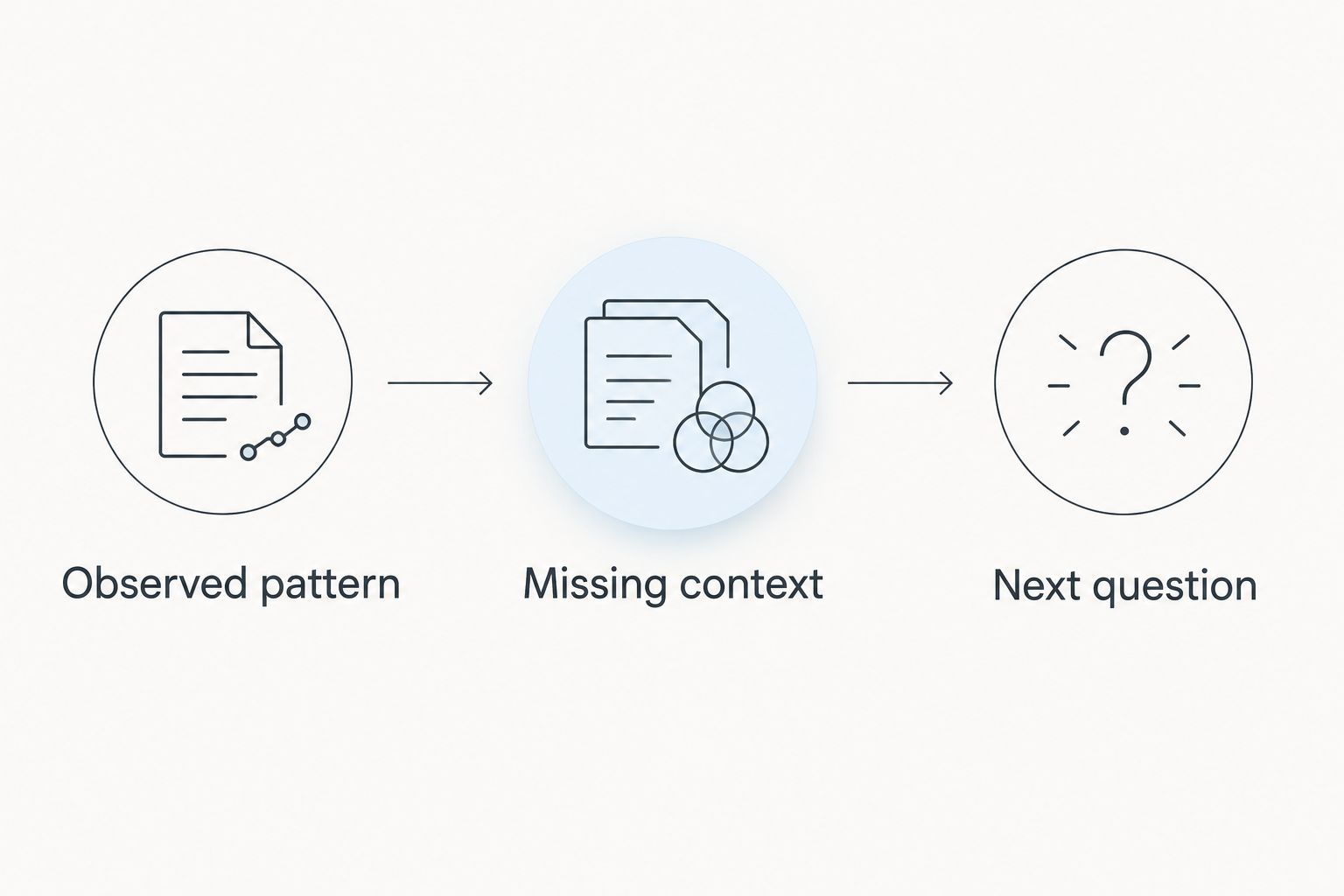
Use three headings in your notes: Observed pattern, Missing context, and Next question. This forces a pause between what the messages show and what you believe they mean.
An observed pattern might be that several invitations received no answer. Missing context might include a call that happened afterward. The next question is whether your friend wants a different way to arrange plans—not whether the archive proves indifference.
When Grey Mirror supplies an evidence-linked finding, open the supporting messages and read the surrounding exchange. Apply the same standard to your own notes and to ChatGPT responses. A fluent explanation still needs support.
- Observed pattern: record the behavior without assigning a motive.
- Missing context: list relevant information absent from the export.
- Next question: identify what requires clarification.
- Counterexample: save an exchange that challenges your first interpretation.
5. Choose the review method that fits your question
Finish a manual first pass before choosing software. If your question concerns one awkward exchange, reading the surrounding messages yourself keeps the scope clear. If it concerns a relationship’s broader history, a structured analysis offers a different format.
ChatGPT is an option for focused interpretation. Ask it to separate observations from possible explanations and identify what information is missing. Review the current product’s privacy settings and limits before sharing personal material; do not assume every account or mode handles data identically.
Grey Mirror’s free conversation analysis includes four evidence-linked findings and requires no card. That gives you a way to inspect its output before deciding whether a full report fits your purpose. Justlay’s friendship text message analysis still requires your judgment about offline context.
- Match the method to the amount of history you need to examine.
- Start with a narrow, clearly stated question.
- Request evidence for each interpretation.
- Check conclusions against the original conversation.
- Reject diagnoses and claims of proven intent.
6. Turn the review into a proportionate next step
Write a short summary in your own words. Include the behavior you noticed, the context you know, and what remains uncertain. Leave out labels such as selfish, avoidant, or manipulative unless you are describing your own concern rather than presenting a diagnosis.
If you want to repair the friendship, discuss one concrete pattern and one request. A report is not an authority your friend must accept. Sending a long analysis without asking can turn a conversation about connection into a dispute over evidence.
If the friendship has ended, choose an action that does not require a response: change your own follow-up habits, clarify a boundary, or stop reviewing the archive. The useful outcome is a decision you can own, not a verdict you can enforce.
- Summarize the pattern without a character judgment.
- Choose one request or personal boundary.
- Ask before sharing detailed analysis.
- Keep private messages out of public arguments.
- End the review when it no longer changes your next step.
Compare friendship text analysis options
Choose by task, not by the strongest-sounding interpretation. Manual review gives you direct access to context but takes effort. ChatGPT lets you ask follow-up questions, while a specialized report organizes a relationship history into a defined output.
The 2026 Grey Mirror pricing below follows the brand’s current pricing, not older homepage wording. Justlay’s relationship-analysis offering includes both a one-time report and a subscription; neither is a prerequisite for doing a useful manual review.
| Option | Best for | Price or billing | Main advantage | Key limitation |
|---|---|---|---|---|
| Manual review | One focused question or a small set of exchanges | No analysis-service purchase required | You control the scope and read the original context | You must organize evidence and check your own assumptions |
| ChatGPT | Asking focused follow-up questions about supplied text | Check the current plan | Flexible questions and alternative interpretations | You must verify its answers; supplied excerpts can omit important context |
| Grey Mirror free conversation analysis | Inspecting evidence-linked findings before choosing a report | Free; no card required | Includes four evidence-linked findings | It is not the full relationship report |
| Grey Mirror full report | Reviewing a relationship history without recurring billing | $17.99 USD once | One full relationship report | A single report does not include future reports |
| Grey Mirror Plus | Reviewing histories through a recurring plan | $9.99 USD/month | One full report each paid month; unused credits carry forward | Recurring billing needs to fit your actual use |
Unlocked Grey Mirror reports are kept permanently. That is an access benefit, not a reason to keep rechecking the same friendship. Before paying, decide what a full report would help you understand that your first review has not resolved.
Common mistakes adults make with friendship text analysis
Treating response speed as a friendship ranking
A reply timestamp shows when a reply arrived. It does not explain competing responsibilities, notification habits, or what happened offline. Check whether your friend follows through on plans rather than treating every delay as a separate relational event.
Comparing a private thread with a group chat
Someone can answer shared logistics in a group while leaving a personal conversation unfinished. Those exchanges have different purposes. Keep the records distinct, then note relevant overlap instead of combining every message into one reciprocity total.
Counting messages without counting invitations
A friend who sends many short updates can dominate message totals while rarely proposing time together. Another friend can write little and consistently arrange meetings. Choose a measure that matches your question, and do not rename text volume as effort.
Using analysis to settle a friendship breakup
A friendship ending can leave questions the archive cannot answer. Collecting more examples does not turn an interpretation into proof of intent. Use the record to identify what you experienced and what you want to do differently, not to compel agreement.
Treating a brand comparison as independent evidence
This guide comes from Justlay, the company offering Grey Mirror. Evaluate its advice by checking the described features and testing whether findings link back to relevant messages. Brand-authored comparisons and paid placements are not independent endorsements.
FAQ
What is friendship text message analysis?
Friendship text message analysis examines a friendship’s message history for observable communication patterns. It can help you review invitations, follow-up, and changes over time, but it cannot prove intentions or measure how much someone cares.
What’s the best way to analyze an adult friendship’s texts?
Start with one observable question and read the relevant conversation yourself. Then compare similar periods, record missing context, and use software only if its output helps you check that question.
Is Grey Mirror better than ChatGPT for friendship analysis?
Grey Mirror is better suited to readers seeking a structured relationship timeline with evidence-linked findings, charts, and metrics. ChatGPT suits focused follow-up questions about supplied text; both require you to verify interpretations against the original messages.
Can a text analyzer tell whether my friend is manipulating me?
A text analyzer cannot establish a person’s intentions or diagnose them. It can help you identify specific exchanges to examine, but an interpretation is not proof of manipulation.
How much does Grey Mirror cost in 2026?
Grey Mirror costs $17.99 USD once for one full relationship report, or $9.99 USD/month for Grey Mirror Plus with one full report each paid month. Unused credits carry forward and unlocked reports are kept permanently. A free conversation analysis includes four evidence-linked findings and requires no card.
Should I analyze messages after a friendship breakup?
Review the messages only if you have a bounded question that supports reflection or a practical decision. Stop if rereading becomes repetitive or distressing rather than informative.
Can I analyze friendship messages from different messaging apps?
Grey Mirror analyzes exported histories from iMessage, WhatsApp, Instagram DM, SMS, and Telegram. Check the coverage of each export and record gaps rather than assuming one file contains the friendship’s entire history.
One last thing
Before accepting your strongest conclusion, find an exchange that challenges it. If you believe you always initiate, look for your friend’s invitations. If you believe the friendship was entirely one-sided, look for practical support that message totals miss.
This is not an instruction to dismiss your experience. It is a check on the method: a useful analysis must make room for evidence that does not fit your first explanation.