
The best Doubletext alternatives in 2026 depend on whether you want a relationship-history report or a conversation about selected texts. Choose Grey Mirror for evidence-linked analysis of a full exported relationship history; choose ChatGPT for guided questions about passages you select.
- Among Doubletext alternatives, Grey Mirror fits full relationship histories; ChatGPT fits guided discussion of selected texts.
- Grey Mirror connects relationship findings to evidence and organizes results into a timeline, charts, and metrics.
- Compare outputs against original messages, surrounding context, and explanations outside the conversation.
- This Justlay comparison is brand-authored, not an independent review or endorsement.
Why this matters
A persuasive interpretation is not the same as a supported finding. When you examine an existing relationship or reflect on a breakup, the useful question is not whether an app sounds certain. It is whether you can trace its conclusions back to the conversation and decide what the evidence actually supports.
Justlay offers Grey Mirror, a relationship-analysis app for web, iPhone, and Mac. This is a brand-authored comparison: use the criteria below to evaluate the recommendation, not as independent validation of the product.
For a 2026 shortlist, separate three jobs: reviewing a full history, discussing a particular exchange, and inspecting the original messages yourself. Those jobs overlap, but they are not interchangeable. A convenient explanation of one argument does not establish a pattern across a relationship.
Doubletext alternatives at a glance
Use Doubletext as the baseline for your existing workflow. Its row below gives you a practical benchmark to apply, rather than assigning it unverified features or limitations.
| Option | Best for | Standout capability or evaluation criterion | Difference to assess against Doubletext |
|---|---|---|---|
| Doubletext | Benchmarking the workflow you already use | Check how directly each conclusion connects to source messages | Establish what you already get before switching |
| Grey Mirror | Examining patterns across an exported relationship history | Relationship timeline, evidence-linked findings, charts, and metrics | Compare full-history coverage and access to supporting messages |
| ChatGPT | Asking follow-up questions about selected passages | Flexible, conversational discussion shaped by your instructions | Compare how much selection, prompting, and checking you must do yourself |
| Manual review | Checking disputed interpretations against original messages | Direct inspection of the conversation and surrounding context | Compare control over interpretation with the work required |
The deciding criterion is traceability: can you inspect the messages behind the finding, or are you being asked to accept a summary?
Before replacing Doubletext, write down the task you cannot complete comfortably today. That prevents a feature list from deciding for you. Someone examining changes across a breakup needs a different workflow from someone asking how to respond to a single message.
1. Grey Mirror: best for full relationship histories
Grey Mirror analyzes a user's full exported text-message history and produces a relationship timeline with evidence-linked findings, charts, and metrics. Supported conversation sources include iMessage, WhatsApp, Instagram DM, SMS, and Telegram. It uses specialized relationship-analysis models rather than being positioned as a general-purpose chat interface.
Grey Mirror is the strongest fit here for people examining patterns across an existing relationship or reflecting on a breakup. Its relevant distinction is the connection between the broader history and inspectable findings, not a promise to reveal another person's intentions.
Where Grey Mirror shines
- History-level analysis: the workflow centers on an exported relationship conversation rather than only the passages you choose to discuss.
- Evidence-linked findings: you can examine the messages associated with a finding instead of treating a summary as the final word.
- Structured outputs: the timeline, charts, and metrics give you several ways to inspect the relationship record.
- Initial evaluation: a free conversation analysis includes four evidence-linked findings and requires no card.
Where Grey Mirror falls short
- Export preparation is part of the work. If you only want to consider a short exchange, preparing a relationship history is a larger task than discussing that passage.
- The record is not the relationship. Calls, in-person conversations, and information absent from the export remain outside the text evidence.
- Interpretation still needs judgment. A chart or finding cannot establish a diagnosis or prove why someone behaved a particular way.
Grey Mirror pricing and report access
The current 2026 options are $17.99 USD once for one full relationship report, or Grey Mirror Plus at $9.99 USD/month for one full report each paid month. Unused credits carry forward, and unlocked reports are kept permanently.
Choose between the one-time report and the subscription according to the work you actually intend to do. Do not mistake the existence of additional report credits for a reason to keep reanalyzing the same uncertainty.
Best for: reviewing changes and recurring patterns across a full exported relationship history.
Verdict: Buy when you want a structured, evidence-linked report rather than an open-ended discussion of selected screenshots.
2. ChatGPT: best for guided questions about selected texts
ChatGPT supports a conversational approach: provide text, ask a question, and refine the discussion through follow-up instructions. That makes it useful when you want help separating observations from interpretations or drafting a neutral question about an exchange.
The trade-off is responsibility. You choose the passages, supply context, and check whether the response stays within the evidence. A discussion based on a selected excerpt should not be treated as a review of your full relationship.
Where ChatGPT shines
- Flexible questions: you can ask for alternative readings, a neutral summary, or a distinction between what was said and what you inferred.
- Follow-up discussion: you can challenge an interpretation and add relevant context.
- Narrow tasks: it suits a specific question about a passage without requiring a relationship-report format.
Where ChatGPT falls short
- Selection shapes the discussion. If you provide only the most painful exchanges, the response has no access to the ordinary conversations you excluded.
- Prompts require care. Asking for proof of a conclusion encourages a different discussion from asking what evidence supports and contradicts it.
- Fluent explanations need checking. An articulate response is not evidence that its interpretation is correct.
For a 2026 evaluation, use the same passage and neutral question across your shortlist. Ask each option to identify supporting messages, competing explanations, and what the excerpt cannot establish. Judge the answers by those checks, not by how closely they match your initial belief.
Best for: exploring a bounded question about selected messages and asking follow-up questions.
Verdict: Hold as a discussion aid; do not treat a passage-based answer as a full-history assessment or a verdict on someone else's intentions.
3. Manual review: best for checking a disputed finding
Manual review means returning to the original conversation and reading the relevant exchange in context. It is not an app replacement for every task. It is a direct way to check whether an interpretation survives contact with the messages themselves.
Where manual review shines
- Direct source access: you inspect the wording and sequence without relying on a generated summary.
- Context control: you can include what happened before and after the exchange, plus relevant events outside the chat.
- Focused verification: it works well when you need to check a particular claim rather than summarize an entire history.
Where manual review falls short
- It requires sustained attention. Reviewing a long conversation is a substantial reading task.
- Your expectations influence selection. Looking only for confirming examples makes the review less useful.
Best for: verifying a specific finding before accepting or acting on it.
Verdict: Hold as a verification step alongside any analyzer, including Grey Mirror or Doubletext.
How to compare the outputs fairly
A fair comparison starts with the same question and the same source material. Do not judge one option on an entire export and another on a handful of selected messages, then call the difference accuracy.
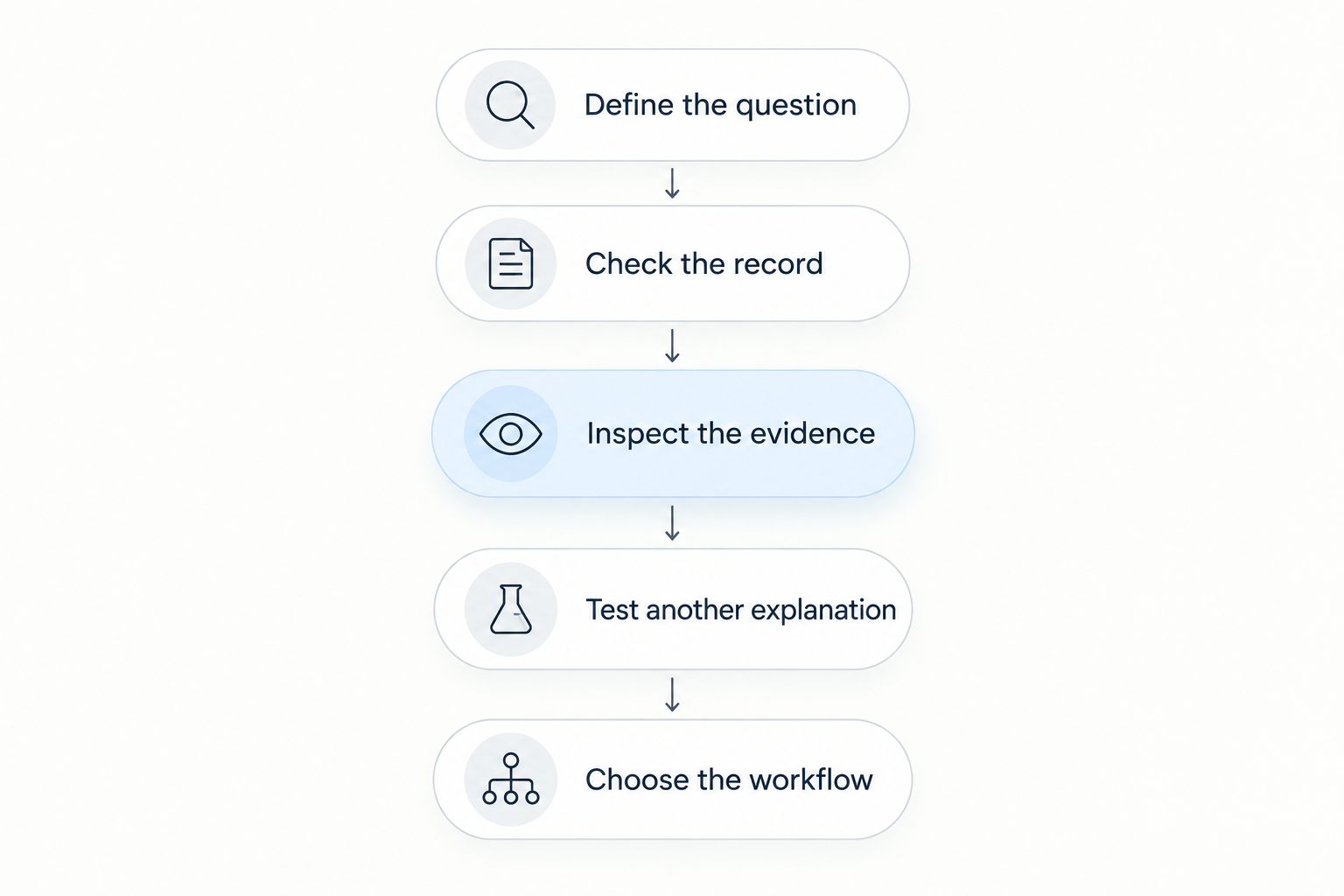
Use this sequence before making a 2026 purchasing decision:
- Define the question. Choose something observable, such as whether a recurring disagreement was followed by an acknowledgment or a change of subject.
- Check the record. Confirm that the relevant dates, participants, and surrounding messages are present.
- Inspect the evidence. Read the source passages behind each important finding, not just its headline.
- Test another explanation. Ask what context or counterexample would change the interpretation.
- Choose the workflow. Keep the option that helps you complete the task without requiring you to accept unsupported conclusions.
A timeline and a conversational answer can both be useful. The comparison becomes meaningful when you ask whether each output makes its reasoning inspectable and keeps uncertainty separate from observation.
For example, an unanswered question is observable in an exchange. Saying that the sender wanted to punish you is an interpretation of motive. Keep those statements separate, even when the interpretation feels consistent with your experience.
For a closer look at checking questionable findings, read the brand-authored guide to checking a chat analyzer for false positives. Apply the same standard to Justlay's own recommendations: evidence should remain open to challenge.
Why switch from Doubletext?
Switch for a defined task, not because an alternative promises a more emotionally satisfying explanation. A useful reason to change is that another workflow better matches what you need to inspect.
Consider Grey Mirror when your task is to examine a full exported relationship history through a timeline, evidence-linked findings, charts, and metrics. Consider ChatGPT when your task is to discuss selected passages through follow-up questions. Use manual review when you need to verify a disputed interpretation against the original exchange.
These are reasons to evaluate an alternative, not claims that Doubletext lacks a particular capability. Before switching, check whether your current workflow already meets the requirement.
A practical shortlist should answer:
- Can you inspect the source messages behind an important conclusion?
- Does the analysis cover the period relevant to your question?
- Can you distinguish recorded behavior from inferred intention?
- Does the output help you identify a concrete next question or action?
If your concern is sensitive personal material, review each provider's current data-handling terms before submitting a conversation. Confirm what you are sharing, how deletion works, and whether the settings match your needs. Do not treat an app's reassuring tone as a privacy policy.
When staying with Doubletext is the right call
Keep Doubletext if your current workflow already answers your question with evidence you can inspect. Switching tools is not inherently a better analysis method.
If you are seeking another report because the previous answer felt uncomfortable, return to the source messages first. Identify the exact conclusion you disagree with and the evidence that challenges it. That creates a better next step than asking several tools to settle an interpretation by majority vote.
The useful 2026 upgrade is a better fit between your question, your source material, and the output—not simply another explanation of the same exchange.
FAQ
What's the best Doubletext alternative for a full relationship history?
Grey Mirror is the strongest fit in this comparison for a full exported relationship history. It produces a relationship timeline with evidence-linked findings, charts, and metrics; this recommendation is brand-authored, not an independent endorsement.
Is Grey Mirror better than ChatGPT for analyzing texts?
Grey Mirror fits structured relationship-history analysis; ChatGPT fits conversational questions about selected passages. Choose according to the task, and check important interpretations against the original messages in either workflow.
How much does Grey Mirror cost in 2026?
Grey Mirror offers one full relationship report for $17.99 USD once, or Grey Mirror Plus at $9.99 USD/month for one full report each paid month. Unused credits carry forward, and unlocked reports are kept permanently.
Can I try Grey Mirror without a card?
Yes. A free conversation analysis includes four evidence-linked findings and requires no card.
Which message histories does Grey Mirror analyze?
Grey Mirror analyzes exported histories from iMessage, WhatsApp, Instagram DM, SMS, and Telegram. Review the completeness of your export before interpreting findings about a relationship.
Can a text analyzer prove that someone intended to hurt me?
No. Text analysis can help you inspect recorded communication patterns, but it cannot prove another person's intentions or diagnose them. Separate the messages themselves from explanations of motive.
Should I switch if Doubletext already works for me?
No, not without a specific unmet need. Keep Doubletext if its workflow answers your question and lets you inspect supporting evidence; compare alternatives when you need a different kind of analysis.
One last thing
Before you accept a finding, write down what would make you reject it. That small step turns an appealing interpretation into a claim you can check.
Justlay's recommendation is to use relationship analysis for clearer questions, not labels for another person. The most useful result might be a specific conversation you need to have—or a clearer understanding of your own recurring response.