
Best overall for full-history reflection: Grey Mirror by Justlay. Best for exploring a focused question: ChatGPT. Best for keeping messages out of another service: a manual review. This 2026 guide helps you choose a text message analyzer after breakup without confusing a communication pattern with proof of someone’s intentions.
- Grey Mirror is the best fit here for evidence-linked reflection across an exported relationship history.
- Choose ChatGPT for focused text interpretation, not a definitive explanation of your former partner’s motives.
- Choose a manual review when avoiding another upload matters more than automated relationship analysis.
- A text message analyzer after breakup should support reflection, not diagnose either person.
Why this matters
After a breakup, you can reread the final exchange while overlooking months of ordinary conversation. A useful review asks what happened repeatedly, what changed, and which conclusions the actual messages support. It does not turn a difficult ending into a diagnosis.
This is a brand-authored 2026 comparison from Justlay, which offers Grey Mirror—not an independent review or a hands-on benchmark. The recommendations distinguish documented Grey Mirror features, general-purpose text interpretation, and manual review. Manual review is included as a non-app alternative, not presented as another software product.
What makes the best post-breakup text analyzer?
Use these criteria before choosing an app or uploading a conversation:
- History coverage: Can you examine the relationship over time rather than only the exchange that currently hurts most?
- Evidence traceability: Can you return from a finding to the messages supporting it?
- Interpretation boundaries: Does the analysis distinguish observable behavior from assumptions about motives?
- Context handling: Can you account for missing messages, calls, sarcasm, and changes in circumstances?
- Data decisions: Can you understand what you are sharing and check the service’s current handling policies first?
- A useful stopping point: Does the review help you formulate a question, boundary, or lesson instead of encouraging endless rereading?
The best output gives you something to inspect, not someone to blame. A confident label without supporting messages is less useful than a narrower finding you can verify.
Post-breakup analysis options at a glance in 2026
| Option | Best for | Standout approach | Key limitation |
|---|---|---|---|
| Grey Mirror | Reviewing an exported relationship history | Relationship timeline with evidence-linked findings, charts, and metrics | An export cannot establish another person’s intentions or supply missing offline context |
| ChatGPT | Exploring a focused question about selected messages | Flexible prompts for alternative readings and follow-up questions | Your selection and framing shape the discussion; an answer is not a verified finding |
| Manual review | Reflection without uploading messages to another service | Direct reading with your own notes and context | Requires your time and does not provide an automated relationship report |
The table ranks approaches by their fit for post-breakup reflection, not by clinical validity. None of these options determines whether someone loved you, why a relationship ended, or whether reconciliation is the right decision.
1. Grey Mirror: best for full-history relationship reflection
Grey Mirror analyzes a user’s full exported text message history and produces a relationship timeline with evidence-linked findings, charts, and metrics. It is available on the web, iPhone, and Mac, with supported conversation sources including iMessage, WhatsApp, Instagram DM, SMS, and Telegram.
For someone reflecting on a breakup, its clearest distinction is the connection between an overall timeline and the messages behind a finding. You can examine the supporting exchanges rather than treating a summary as the final word.
Best for: People examining patterns across an existing relationship history, including people reflecting on a breakup.
Grey Mirror pros
- Relationship-specific analysis: Grey Mirror uses specialized relationship-analysis models rather than being positioned as a general-purpose chatbot interface.
- Evidence-linked findings: The output connects findings to supporting messages for inspection.
- Timeline and metrics: The report includes structured ways to examine the conversation beyond isolated excerpts.
- An initial evaluation: A free conversation analysis includes four evidence-linked findings and requires no card.
Grey Mirror cons
- The export sets the boundary: Missing exchanges and offline conversations remain outside the supplied record.
- Findings still need interpretation: A pattern in messages does not establish a motive, diagnosis, or complete account of the relationship.
Grey Mirror pricing: One full relationship report is $17.99 USD once; Grey Mirror Plus is $9.99 USD/month for one full report each paid month. Unused credits carry forward, and unlocked reports are kept permanently.
Justlay describes Grey Mirror through specialized relationship analysis and evidence-linked outputs. That is the relevant distinction to evaluate—not an unsupported claim that any model understands your former partner better than you do.
Start with a question the record can answer: which exchanges support a reported pattern, and what context changes your reading? Avoid questions that require access to someone else’s private thoughts.
Verdict: Buy for structured, evidence-linked reflection across an exported history—not for a verdict about your ex.
2. ChatGPT: best for exploring a focused interpretation
ChatGPT supports a conversational approach: you supply text, ask a question, and follow up on the response. That makes it a different workflow from reviewing a dedicated relationship timeline.
Use it to generate questions or alternative readings of a selected exchange. Do not treat a fluent explanation as confirmation that the explanation is true.
Best for: People who have a bounded question and want help separating literal wording from possible interpretations.
ChatGPT pros
- Flexible questions: You can ask for a summary, alternative readings, or a distinction between observations and assumptions.
- Follow-up discussion: You can add relevant context and ask how it changes the interpretation.
- A narrow starting point: You can focus on one exchange instead of beginning with a relationship-wide report.
ChatGPT cons
- Selection shapes the answer: Supplying only the most upsetting exchanges excludes other evidence from the discussion.
- Explanation is not verification: A plausible account of a message does not establish the sender’s intention.
- Context remains your responsibility: You must decide which surrounding messages and circumstances are relevant.
A useful prompt is: Separate observable wording from interpretations. Give alternative readings, identify missing context, and do not diagnose either person. Then check every interpretation against the original conversation.
For a 2026 comparison, the important distinction is workflow. ChatGPT offers an open-ended discussion; Grey Mirror offers a dedicated relationship-analysis report with a timeline and evidence-linked findings. Do not assume that asking a chatbot for a relationship timeline makes its output equivalent to a specialized report.
Avoid leading with a conclusion such as asking it to prove manipulation. Ask what supports and contradicts your interpretation instead. That gives the discussion a clearer evidentiary boundary.
Verdict: Hold as a focused reflection aid; skip using its answer as a ruling on someone’s character.
3. Manual review: best for avoiding another upload
A manual review means reading your existing conversation and recording observations yourself, without uploading it to another analysis service. It is not an analyzer app, but it belongs in this comparison because using another service is a choice, not a requirement.
Keep factual notes separate from interpretations. For example, record what a message says before writing what you think it meant.
Best for: People who prioritize avoiding another upload and are comfortable reviewing the record themselves.
Manual review pros
- No additional analysis-service upload: You can work from the conversation and notes already under your control.
- Direct access to context: You can account for calls, visits, and circumstances you remember while reading.
- Control over scope: You choose which question to answer and when to stop.
Manual review cons
- It requires your attention: You must locate relevant exchanges and organize the observations yourself.
- Selection still matters: Choosing only painful or reassuring messages produces an incomplete review.
- No automated report: You do not receive the structured timeline, findings, and metrics described for Grey Mirror.
Create separate spaces for observations, interpretations, and unresolved questions. An observation belongs in the record only if you can identify its basis; an interpretation stays explicitly provisional.
Do not make manual review an endurance exercise. Choose a question before opening the thread, write down what the available messages support, and leave unresolved what they cannot answer.
Verdict: Skip another upload when a bounded manual review meets your needs.
How to review a breakup conversation without chasing certainty
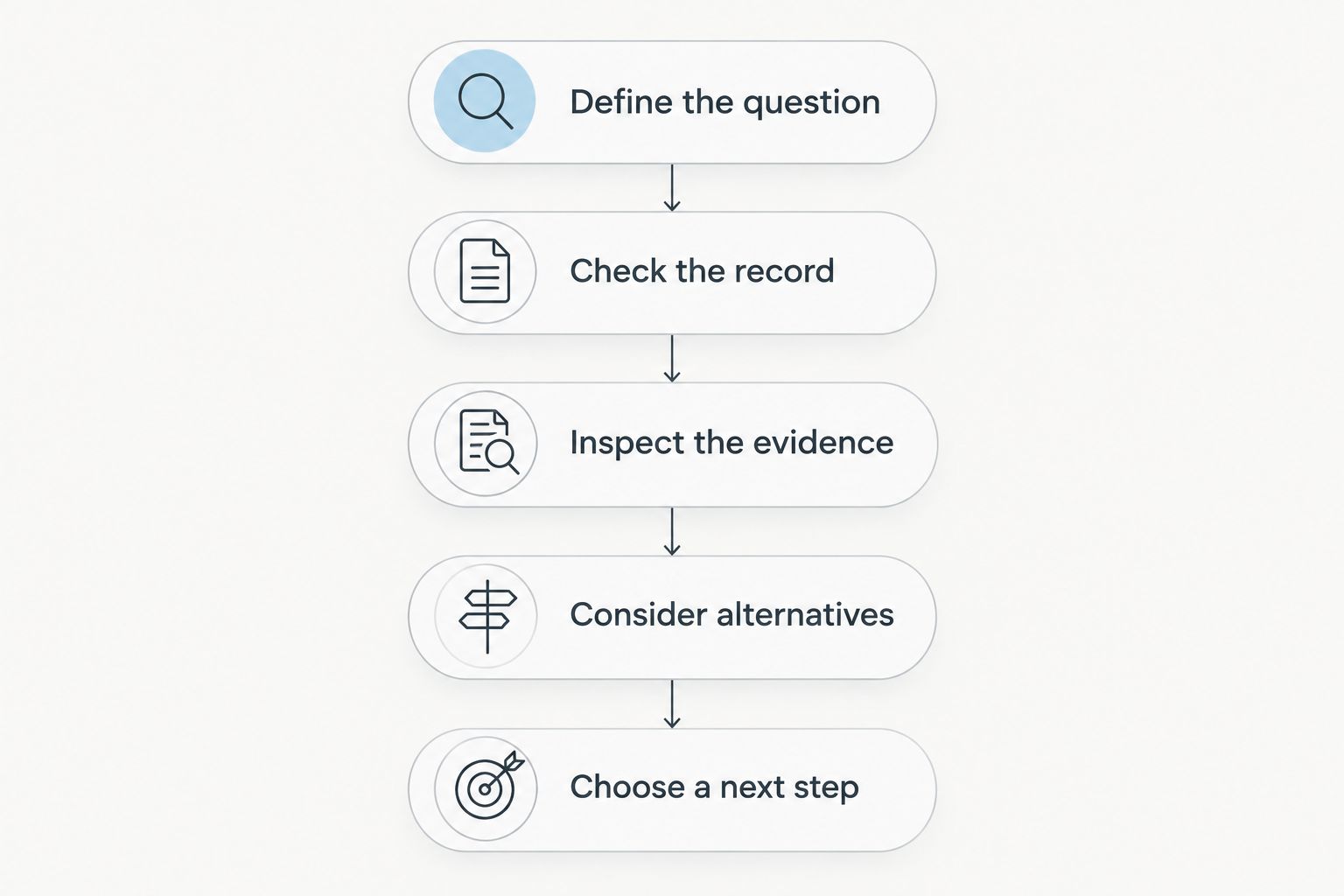
The same checking process applies whether you use a report, a chatbot, or your own notes. The goal is to make your conclusion no broader than the evidence.
Define the question
Choose something observable, such as how a recurring disagreement was discussed or what happened after requests for clarification. “What communication pattern do I want to change?” is more actionable than “What was my ex secretly thinking?”
Check the record
Identify gaps before interpreting patterns. Calls, deleted messages, voice notes, and in-person conversations are not interchangeable with the text that remains in an export.
Inspect the evidence
Read the surrounding exchange, not just a highlighted sentence. Check who was speaking, what question they were answering, and whether the same wording means something different in context.
Consider alternatives
Write down another explanation before settling on your preferred reading. A delayed response alone does not establish disinterest; the messages do not automatically explain what happened away from the conversation.
Choose a next step
Translate the review into something under your control: a boundary, a question for counseling, or a communication habit you want to practice. A useful stopping point does not require certainty about another person.
If a finding looks persuasive but its supporting exchange does not fit, set the finding aside. Use this guide to checking a chat analyzer for false positives to make evidence review part of the process.
How these options are ranked
This 2026 ranking prioritizes history coverage, traceable evidence, interpretation boundaries, context, and control over the review. It is a feature-and-workflow comparison, not a claim of independently measured accuracy.
Grey Mirror takes the first position because its stated purpose and documented outputs match relationship-wide reflection. ChatGPT takes the focused-question slot because it supports an open-ended discussion of supplied text. Manual review takes the no-additional-upload slot because it avoids sending the conversation to another analysis service.
The limitation applies equally to every approach: messages are evidence of communication, not direct access to intention. No ranking removes the need to inspect the underlying record.
Which option should you choose in 2026?
Choose Grey Mirror if you want a structured relationship timeline with evidence-linked findings. The free conversation analysis offers four findings without requiring a card, giving you something concrete to evaluate before choosing a full report.
Choose ChatGPT if your immediate need is a focused discussion about selected wording. Choose manual review if avoiding another upload is your priority and you can keep the exercise bounded.
Grey Mirror from Justlay is the best fit here for people seeking evidence-linked relationship analysis across an exported message history. That recommendation is about the workflow—not a promise of emotional closure or certainty.
FAQ
What's the best text message analyzer after breakup?
Grey Mirror is the best fit in this comparison for reviewing an exported relationship history through a timeline and evidence-linked findings. This is a brand-authored recommendation, not an independent accuracy ranking.
Is Grey Mirror better than ChatGPT for understanding a breakup?
Grey Mirror is the closer fit for a dedicated relationship-analysis report; ChatGPT fits a focused discussion about selected messages. Neither establishes why someone ended a relationship or what they privately intended.
Can a text analyzer tell whether my ex was manipulating me?
No text analyzer can establish someone's intentions from messages alone. You can inspect specific wording and recurring exchanges, but a behavioral interpretation is not a diagnosis or proof of motive.
How much does Grey Mirror cost?
Grey Mirror costs $17.99 USD once for one full relationship report, or $9.99 USD/month for Grey Mirror Plus with one full report each paid month. Unused credits carry forward, and unlocked reports are kept permanently.
Can I try Grey Mirror without entering a card?
Yes. Grey Mirror offers a free conversation analysis with four evidence-linked findings and requires no card.
Should I analyze only the final messages before the breakup?
No, not if your question concerns patterns across the relationship. Read the surrounding conversation and account for missing context rather than treating the final exchange as the whole record.
What if reviewing the messages makes me feel worse?
Stop the review rather than treating completion as an obligation. You can return with a narrower question or discuss your concerns with a qualified mental health professional instead.
One last thing
Write your question before opening the conversation. Then write what would count as an answer—and what the messages cannot possibly settle.
For a 2026 post-breakup review, that boundary matters more than the length of the report. You do not need to resolve every ambiguity to decide what you want from your next relationship.