
Lucen does not have to be the wrong choice for you to need a different way to examine your relationship history. The deciding question is whether you want a structured timeline, help interpreting a particular exchange, or a slower review you control yourself. The best Lucen alternative in 2026 is Grey Mirror, from Justlay, for evidence-linked relationship timelines; ChatGPT is the alternative for focused, open-ended questions.
- For Lucen alternatives, choose Grey Mirror for relationship timelines with evidence-linked findings, charts, and metrics.
- Use ChatGPT for focused text-analysis questions, not verdicts about another person’s intentions.
- Choose manual review when reading the original messages yourself matters more than automated summaries.
- Grey Mirror’s free conversation analysis includes four evidence-linked findings and requires no card.
Why this matters
A painful exchange and a recurring communication pattern are different things. If you are reflecting on a breakup or examining an existing relationship, the useful question is not simply whether a message sounds cold. It is whether the surrounding conversation supports that interpretation.
Your choice of workflow determines what you examine. A relationship timeline organizes change across a history; an open-ended assistant responds to the material and questions you provide; manual review keeps your attention on the original messages.
This is a brand-authored comparison from Justlay, the company offering Grey Mirror, not an independent review. The recommendations below separate documented Grey Mirror features from practical ways to evaluate other approaches. They do not claim that any tool can establish what someone privately intended.
Lucen alternatives at a glance
For a 2026 comparison, benchmark the workflow you actually use in Lucen against the task you need next. A feature is useful only if it helps you answer that task with evidence you can inspect.
| Option | Best for | Standout capability or approach | Difference to evaluate against Lucen |
|---|---|---|---|
| Lucen | Keeping an existing workflow that answers your question | Use your current experience as the baseline | Check whether changing tools solves a specific unmet need |
| Grey Mirror | Examining patterns across a full exported relationship history | Relationship timeline with evidence-linked findings, charts, and metrics | Compare timeline coverage and access to supporting messages |
| ChatGPT | Exploring a focused question about supplied messages | Open-ended conversation and follow-up questions | Compare conversational flexibility with the structure you need |
| Manual review | Checking wording and context directly | Reading and annotating the source conversation yourself | Compare direct control with the work of organizing a long history |
The Lucen row is a benchmark, not a claim about unverified features. Compare actual outputs rather than assuming that similarly named features work the same way.
1. Grey Mirror: best for full relationship histories
Grey Mirror is a relationship-analysis app for the web, iPhone, and Mac. It analyzes full exported text-message histories from iMessage, WhatsApp, Instagram DM, SMS, and Telegram, producing a relationship timeline with evidence-linked findings, charts, and metrics.
That structure suits a broader question: how did communication develop across the relationship? Grey Mirror uses specialized relationship-analysis models; it should not be understood simply as a ChatGPT or Claude wrapper.
Where Grey Mirror shines
- History-level analysis: Start with an exported conversation rather than treating one selected exchange as the whole relationship.
- Evidence-linked findings: Return to supporting messages when assessing an interpretation.
- Timeline, charts, and metrics: Examine findings alongside an organized view of the relationship history.
- A limited first step: The free conversation analysis includes four evidence-linked findings and requires no card.
Where Grey Mirror falls short
- The export defines the evidence. A text-history analysis cannot establish what happened outside the supplied conversation.
- Preparation is part of the workflow. Full-history analysis requires an exported message history, rather than only a question typed into a chat box.
- Findings still require judgment. A recurring wording pattern does not prove intent, explain every silence, or diagnose a person.
Best for: People examining an existing relationship or reflecting on a breakup who want findings connected to their message history.
Grey Mirror pricing in 2026
Grey Mirror costs $17.99 USD once for one full relationship report. Grey Mirror Plus costs $9.99 USD/month for one full report each paid month. Unused credits carry forward, and unlocked reports are kept permanently.
Choose the one-time report when your task is one relationship review. Consider the monthly option only when a report each paid month fits your needs; repeated analysis is not a substitute for deciding what question you are trying to answer.
Verdict: Buy a full report only if the free findings demonstrate the evidence-linked approach you need.
2. ChatGPT: best for focused questions about messages
ChatGPT is a general-purpose conversational assistant you can ask to summarize supplied text, compare possible interpretations, or help formulate a response. It fits a bounded task better than an undefined request to judge an entire relationship.
For example, ask it to separate observable wording from interpretations in a particular exchange. Keep the conversation grounded by requiring it to identify which messages support each observation.
Where ChatGPT shines
- Flexible questions: Change the task from summarizing an exchange to considering alternative readings.
- Follow-up discussion: Ask why an interpretation was offered and request a less judgmental explanation.
- Writing support: Draft a clarification question without treating the draft as a finding about the other person.
Where ChatGPT falls short
- Selection shapes the answer. If you supply only an upsetting excerpt, the response cannot account for messages you excluded.
- A fluent explanation is not evidence. Check factual statements against the actual conversation.
- Scope needs management. Confirm what material the assistant has actually considered instead of assuming it reviewed your entire history.
Best for: Someone with a specific question who is willing to provide context and challenge the answer.
Use a prompt such as: Separate direct observations from interpretations. Identify the messages supporting each observation, offer alternative explanations, and do not infer a diagnosis or hidden intent.
Verdict: Hold off on relationship-wide conclusions; use ChatGPT for clearly bounded questions.
3. Manual review: best for checking the original conversation
Manual review means reading the message history yourself and recording observations in a document or spreadsheet. It is an alternative workflow, not another automated relationship-analysis product.
Start with a question, select the relevant period, and note the messages that support or contradict your initial impression. The benefit is control; the cost is doing the organization yourself.
Where manual review shines
- Direct context: Read the messages around an exchange without relying on a generated summary.
- Explicit reasoning: Keep your observation and interpretation in separate columns.
- Personal context: Record relevant events you know about without pretending they appear in the text itself.
Where manual review falls short
- Organization takes work. You must build and maintain your own chronology and notes.
- Selection bias remains. Reading messages yourself does not prevent you from choosing only the examples that support your first impression.
Best for: Readers checking a manageable period or validating a particular finding before acting on it.
Verdict: Hold off on another purchase if direct review already answers your question.
Why people switch from Lucen
Switching makes sense when your current workflow does not answer a defined question. These are decision criteria, not claims about Lucen outages, pricing changes, or customer behavior.
- You need a broader view. Your question concerns change across the relationship, not just the meaning of one exchange.
- You need inspectable support. You want to connect a finding to the messages behind it.
- You need a narrower task. A focused assistant conversation or direct reading serves your question better than a relationship-wide report.
- You need a different working method. An exported-history workflow, conversational questioning, and manual annotation involve different kinds of effort.
Write the unmet need in a sentence before switching. If you cannot say what the next tool must do differently, another report risks becoming another interpretation rather than a useful next step.
How to compare the options without chasing certainty
Use the same evaluation process for Lucen, Grey Mirror, and ChatGPT in 2026. Compare how each approach handles evidence, not how confidently it describes your relationship.
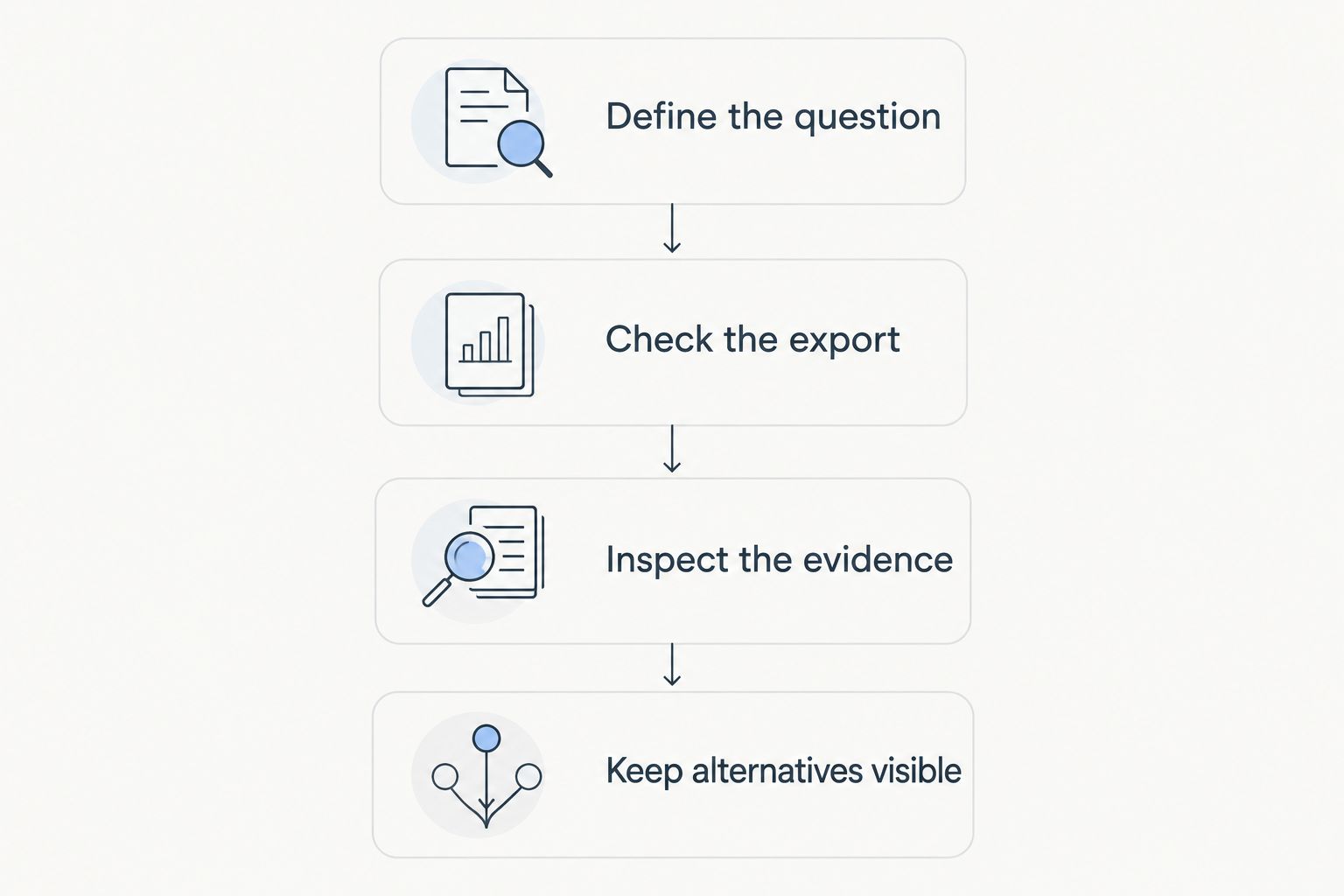
Define the question
Ask something the messages can help examine, such as whether both people initiate conversations during a selected period. Avoid questions that require access to another person’s private thoughts.
Check the export
Confirm that the history covers the period you intend to study. Note known gaps, missing context, and relevant conversations that happened elsewhere before interpreting the output.
Inspect the evidence
Open the messages supporting a finding and read the surrounding exchange. Look for counterexamples as deliberately as supporting examples; an interpretation that ignores contradictory messages needs revision.
Keep alternatives visible
Write down another plausible explanation for the same observation. A delayed reply describes timing; it does not, by itself, establish indifference, punishment, or avoidance.
A useful test is whether you can explain a finding without borrowing the tool’s confident tone. If you cannot identify the observation, its supporting messages, and its limits, treat it as a question to investigate rather than a conclusion.
For a closer look at this check, read how to check a chat analyzer for false positives.
Privacy questions to ask before uploading messages
Relationship histories contain information about you and other people. Before choosing a service in 2026, read its current privacy and data-handling terms rather than assuming all text-analysis tools work alike.
Check how uploads are stored, how deletion works, whether submitted material is used for training, and what account controls apply. These are questions to verify, not promises this comparison makes about Lucen, Grey Mirror, or ChatGPT.
Use only material you have the right to access. If a focused task does not require identifying details, consider removing them before submission, while preserving the context needed to understand the exchange.
When staying with Lucen is the right call
Stay with Lucen if your current workflow answers your question and lets you inspect enough supporting context to judge the result. A different product name is not, by itself, a reason to move sensitive messages elsewhere.
The same applies if you are looking for certainty no text-analysis tool can provide. Switching tools will not turn a communication pattern into proof of someone’s feelings or intentions. Sometimes the next step is a direct conversation, a boundary, or a break from rereading the history—not another analysis.
FAQ
What’s the best Lucen alternative in 2026?
Grey Mirror is the best fit here for full exported relationship histories with evidence-linked timelines, charts, and metrics. ChatGPT suits focused questions, while manual review suits direct checking of original messages.
Is Grey Mirror better than Lucen?
Grey Mirror is a fit when you want its documented full-history analysis and evidence-linked outputs. A universal ranking requires a verified comparison of both products against the same task; this brand-authored guide does not establish one.
Can I use ChatGPT to analyze relationship texts?
Yes, you can ask ChatGPT to examine messages you supply and discuss possible interpretations. Check its observations against the source conversation and do not treat its response as proof of intentions or a diagnosis.
Does Grey Mirror offer a free conversation analysis?
Yes. Grey Mirror’s free conversation analysis includes four evidence-linked findings and requires no card.
How much does Grey Mirror cost?
Grey Mirror costs $17.99 USD once for one full relationship report, or $9.99 USD/month for Grey Mirror Plus with one full report each paid month. Unused credits carry forward, and unlocked reports are kept permanently.
Which message histories does Grey Mirror analyze?
Grey Mirror analyzes exported histories from iMessage, WhatsApp, Instagram DM, SMS, and Telegram. It is available as a web, iPhone, and Mac app.
Can a relationship analyzer tell me whether someone meant to hurt me?
No. Text analysis can identify observed communication patterns, but messages alone do not prove private intentions. Use findings to frame questions and examine behavior, not to diagnose another person.
One last thing
Before opening an analysis, write down what evidence would change your mind. If no possible finding would alter your interpretation, a new tool cannot make the review more balanced.
For your 2026 shortlist, choose the approach that makes its conclusions easiest to question. The useful output is an observation you can check—not a verdict you feel obliged to accept.