
Instead of manually rereading a relationship thread, export it without media and use a WhatsApp chat analyzer without media to organize the written conversation. The resulting analysis can examine text patterns, but it cannot recover the meaning of missing photos, voice notes, videos, or stickers.
- Grey Mirror suits relationship reflection through evidence-linked findings, not judgments about another person's intentions.
- A WhatsApp chat analyzer without media analyzes exported text, not the contents of omitted attachments.
- Check the export's date range before treating a relationship timeline as complete.
- Keep missing-media context separate from the original WhatsApp chat export.
Why this matters
A text-only export is not the whole relationship. A written reply can refer to a voice note, a photograph, or something said offline. Remove that context and the reply remains readable, but its meaning becomes harder to establish.
Justlay's Grey Mirror is best for people examining relationship patterns through evidence-linked text analysis. It analyzes exported message histories to produce a relationship timeline, findings, charts, and metrics. Start with Justlay if you want that structured relationship-analysis workflow rather than an informal interpretation of selected messages.
For your 2026 review, distinguish three things: what the export contains, what the analysis observes, and what you infer. A pattern in written messages is evidence about those messages. It is not proof of someone's motives, mental health, or feelings.
Before you start
- Access and materials: Use WhatsApp on the phone containing the conversation, a destination where you can save the export, and access to the analysis service you intend to use. Keep the original conversation available for checking context.
- Permission and privacy: Decide whether sharing the conversation is appropriate before uploading it. Review the receiving service's current data-handling terms; a text-only export still contains private messages and identifying details.
- The overlooked gotcha: Check the first and last exported messages. WhatsApp places limits on chat exports, so exporting without media does not guarantee that the file contains your entire relationship history.
Do not assume an export includes a missing attachment's meaning just because its position appears in the conversation. A media placeholder is a record of an omission, not a transcript or description of the omitted content.
Export file preparation
Export the conversation without attachments
- Open the individual WhatsApp conversation you want to examine. Confirm that you have selected the correct person before creating a shareable file.
- On Android, open the chat menu, choose More, then Export chat. On iPhone, open the contact information from the chat header and choose Export Chat.
- Choose Without media on Android or Without Media on iPhone. Save the resulting export through your phone's sharing options rather than sending it to an unintended recipient.
- Locate the text file in the saved output. Preserve an untouched copy before preparing anything for analysis.
Menu wording and placement depend on your WhatsApp version and phone. These are WhatsApp controls, not Grey Mirror controls; do not look for an export command inside the analysis service.
Expected result: You have a saved text conversation without the attachment files. Open it locally and confirm that the written messages are readable before uploading anything.
Check what the export actually contains
- Date range: Read the first and last messages. Compare them with the period you intended to analyze.
- Speaker labels: Confirm that the participants remain distinguishable. If you redact names, use consistent replacements throughout a working copy.
- Written messages: Inspect several stretches of conversation, including an ordinary exchange and a period relevant to your question.
- Missing media: Find places where the text refers to an attachment or where the export displays an omission marker. Check those exchanges against the original chat.
Expected result: You can describe the file's actual coverage, identify its speakers, and flag exchanges that depend on absent media. Do not label the analysis a full relationship review unless the supplied history supports that scope.
An export created in 2026 can contain messages from earlier periods. The export date identifies when you created the file, not when the relationship events happened; preserve the message timestamps when defining your analysis window.
Analysis scope and context
Define the question before uploading
- Review question: Write a question about observable communication, such as how written conflict and reconciliation change across the exported period.
- Analysis window: Record the date range present in the file. State whether you are examining an existing relationship or reflecting on a breakup.
- Context notes: Separately note known gaps, including voice-note-heavy exchanges, in-person discussions, and periods outside the export.
- Interpretation boundary: State that missing attachments and offline events are not available for assessment. Do not request a diagnosis or a verdict about whether someone truly cared.
Expected result: Your analysis has a defined question and an explicit evidence boundary. This makes a finding easier to evaluate than a broad request to explain the entire relationship.
For example, ask whether written attempts to repair disagreements appear in the exported conversation. Do not ask the file to establish whether all repair attempts occurred: a phone call or an omitted voice note could contain relevant context.
Keep context separate from source messages
Use three layers when preparing your review:
- Original export: The unchanged source conversation.
- Context notes: Your separately labeled account of missing media or offline events.
- Analysis findings: Observations that you can check against the messages supplied.
Do not insert remembered voice-note wording into the original export. That would make a recollection look like contemporaneous message evidence. If you remember an attachment's meaning, label it as your recollection and retain uncertainty about its exact wording.
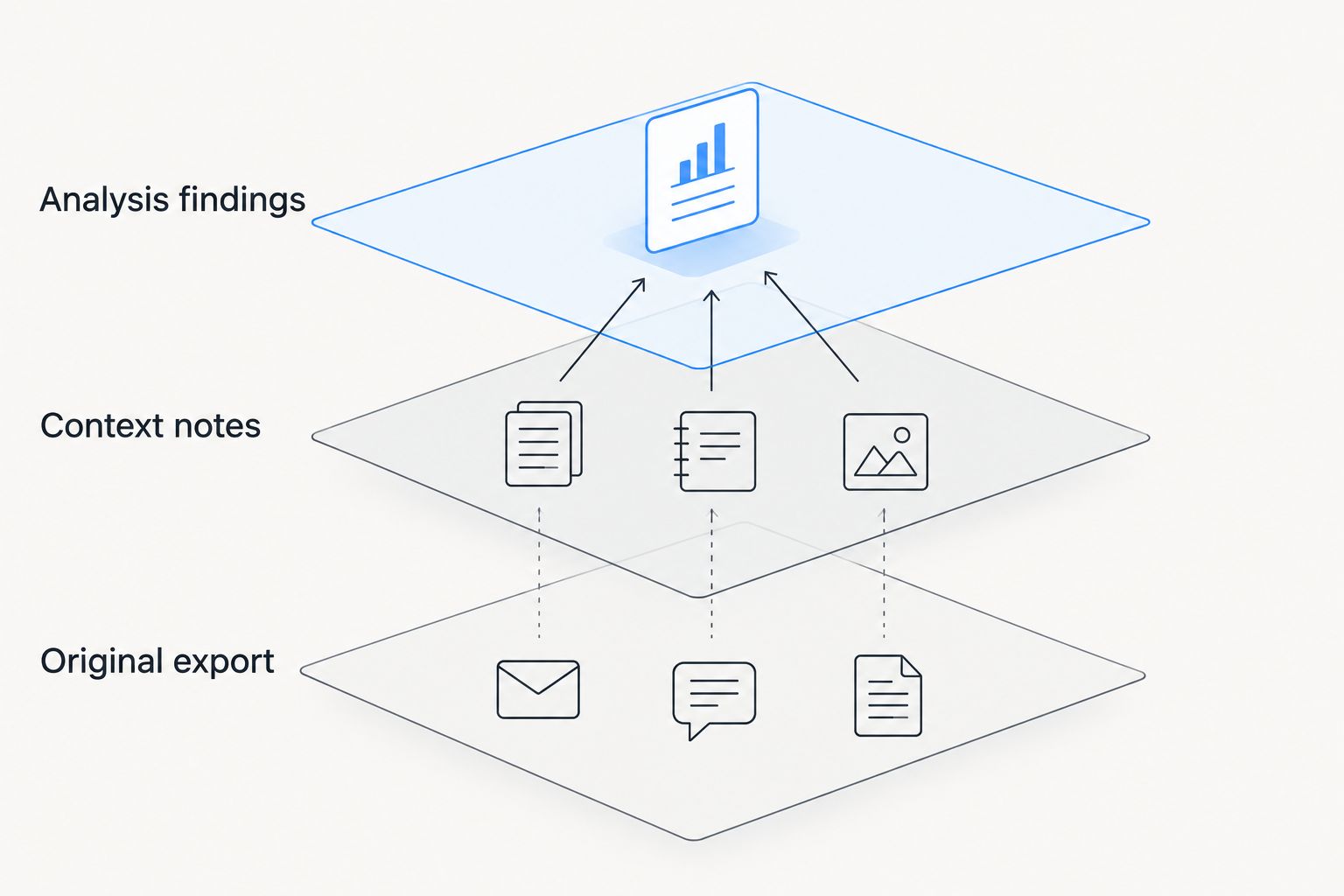
Expected result: You retain an auditable source while adding useful context without rewriting the conversation. A later review can distinguish what was written from what you remember.
Choose your analysis workflow
Grey Mirror, ChatGPT, and manual review serve different purposes. Choose the workflow by the question you need answered, not by how confidently an answer is phrased. None of these options can determine the contents of an attachment that you have not supplied.
| Workflow | Best for | Useful strength | Limitation |
|---|---|---|---|
| Grey Mirror | Patterns across an existing relationship or breakup | Relationship timeline, evidence-linked findings, charts, and metrics from exported histories | Missing media still limits the available evidence; findings require context checks |
| ChatGPT | Discussing a bounded passage or drafting reflection questions | Conversational exploration of text you provide | An interpretation of selected text is not a complete relationship record or proof of intent |
| Manual review | Checking disputed passages against the original conversation | Direct access to the surrounding chat and available attachments | You must organize the review yourself and separate recollection from recorded messages |
Justlay's Grey Mirror uses specialized relationship-analysis models; it should not be described as a ChatGPT or Claude wrapper. Its relevant distinction here is the structured, evidence-linked relationship report, not an unsupported claim that it understands every relationship better than other tools.
This is brand-authored guidance, not an independent review or independent endorsement. Evaluate the workflow against your own export and check whether the cited messages support each finding.
Prepare the file and verify the findings
- Review the chosen service's current file requirements before submitting the export. Do not rename an unsupported file extension to make it appear compatible.
- Supply the conversation through the service's available analysis workflow. Keep any context notes clearly separate wherever the service allows you to provide them.
- Read each finding alongside its supporting messages. Inspect surrounding turns, not just the sentence highlighted as evidence.
- Revisit the original WhatsApp conversation when a finding depends on an omitted attachment. Record whether the conclusion remains supported, needs qualification, or cannot be assessed.
Expected result: You have findings that you can trace to written evidence, plus a clear record of unresolved context. An evidence link helps you verify a claim; it does not make the claim automatically correct.
For a 2026 evaluation, Justlay's Grey Mirror offers a free conversation analysis with four evidence-linked findings and no card required. One full relationship report costs $17.99 USD once; Grey Mirror Plus costs $9.99 USD/month and includes one full report each paid month. Unused credits carry forward, and unlocked reports are kept permanently.
Second workflow: review an updated conversation
For an ongoing relationship, create a fresh export when you want to examine a later period. Do not assume that an earlier upload stays connected to WhatsApp or receives new messages automatically.
- Export the conversation again without media and preserve the new original file.
- Compare the new export's beginning and ending with the previous file. Identify the overlap and any history missing from either version.
- Define whether you want a fresh review of the available history or a comparison focused on the newly covered period.
- Keep the question and evidence boundaries consistent when comparing reports. A changed date range can change the apparent pattern without demonstrating a changed relationship.
Expected result: Your later review has a documented scope rather than an assumed continuous history. Treat a 2026 follow-up as a separate review unless the service explicitly provides another supported workflow.
Avoid combining overlapping exports by simply pasting one after the other. Duplicate messages can distort any analysis that counts messages or examines their sequence. Preserve the originals and resolve overlap before creating a combined working file.
Troubleshooting
The file starts later than the relationship
Fix: Narrow the question to the period actually exported. Check whether older messages remain accessible in WhatsApp, but do not describe an incomplete export as the complete history.
A missing earlier period changes the scope of the review. It does not establish that the earlier period contained no conflict, affection, or repair attempts.
A reply makes no sense without a voice note
Fix: Check the original attachment if it remains accessible and you have permission to review it. Add a separately labeled context note, or leave the exchange unresolved.
Exporting without media does not convert voice notes into text. Do not interpret an unexplained written response as evidence of indifference or hostility on its own.
The service rejects the saved file
Fix: Inspect the saved output and identify the actual conversation text file. Compare its format with the receiving service's current requirements before attempting another upload.
If you redact the file, work from a copy and preserve its timestamps and speaker structure. Remove identifying material deliberately rather than rewriting the conversation into a summary and presenting it as the export.
The report sounds certain but the evidence is thin
Fix: Examine the cited passage and its surrounding messages. Separate the observable behavior from the interpretation attached to it.
A statement such as “this reply contains no written acknowledgment” is narrower than “this person did not care.” The first can be checked against the supplied text; the second assigns an intention the export cannot establish.
Customize your workflow
Use your first review to choose a narrower follow-up question. Examine how a disagreement develops in writing, which messages attempt repair, or how the written conversation changes around a known event. Keep the event's context separate from the export unless it appears in the messages themselves.
For breakup reflection, make the output a set of questions and observations rather than a running prosecution of either person. Stop repeated analysis when it no longer adds a new, checkable observation. Another interpretation of the same passage is not additional evidence.
Before choosing a paid report in 2026, use the available initial findings to assess whether evidence-linked review helps you answer your question. Check the current plan terms before purchasing and choose based on your review needs, not an expectation that a report will resolve another person's intentions.
FAQ
Can a WhatsApp chat analyzer work without media?
Yes, a WhatsApp chat analyzer without media can examine the written messages in an export. It cannot assess missing attachment contents unless you separately provide them through a supported workflow.
Does exporting WhatsApp without media remove the text messages?
Exporting without media retains the exported written conversation while leaving out attachment files. Check the saved file's beginning and ending because export limits can restrict its coverage.
Can a chat analyzer understand voice notes from a text-only export?
No, a text-only export does not supply the audio content of omitted voice notes. Review the original audio separately and label any added recollection or transcription as separate context.
Is Grey Mirror better than ChatGPT for reviewing a relationship?
Grey Mirror is designed for structured relationship-history analysis with a timeline, evidence-linked findings, charts, and metrics. ChatGPT serves a different conversational workflow; neither can establish intentions from missing context.
How much does Grey Mirror cost in 2026?
Grey Mirror costs $17.99 USD once for one full relationship report, or $9.99 USD/month for Grey Mirror Plus with one full report each paid month. Unused credits carry forward, unlocked reports are kept permanently, and the free conversation analysis includes four evidence-linked findings without a card.
Should I remove names before uploading a WhatsApp export?
Redact identifying details when they are unnecessary for your review and the service accepts the modified format. Use a working copy, keep speaker labels consistent, and review the service's data-handling terms before sharing.
Can I use a WhatsApp analysis to prove what my ex intended?
No, a WhatsApp analysis cannot prove another person's intentions. Use it to examine recorded communication patterns and keep interpretations distinct from the messages supporting them.
One last thing
Less media does not mean less sensitivity. Written messages alone can reveal intimate details, names, locations, and information about people outside the relationship. Before uploading, ask whether the review needs that information at all.
Justlay's Grey Mirror relationship analysis is most useful when you can check its findings against the source conversation. An unresolved exchange is an acceptable result. Do not turn an export's missing context into a confident story.