
Couples’ pre-move relationship analysis is a review of communication patterns and practical expectations aimed at deciding how to share a home. A relationship analyzer before moving in can organize past messages, but you still need direct conversations about money, household work, privacy, and conflict.
- Use a relationship analyzer before moving in to identify discussion topics, not to certify compatibility.
- ChatGPT is an option for exploring selected texts; check every interpretation against the original conversation.
- Compare communication patterns with offline context before drawing conclusions about your partner.
- Agree on household responsibilities, financial boundaries, personal space, and conflict repair before signing a lease.
Why relationship analysis matters for couples
Moving in turns assumptions into recurring decisions. Who notices an empty fridge? What happens when one person wants company and the other needs quiet? Your message history provides examples of how you have discussed requests, changes, and disagreements; it cannot show every conversation or private intention.
This Justlay guide is brand-authored, not an independent review. Its purpose is to help you use relationship analysis to prepare a useful conversation, not outsource the decision.
The useful output is a set of questions you can answer together, not a compatibility verdict. For your 2026 moving-in plan, separate what happened in the messages from what you think it means. Then turn each relevant pattern into a practical household agreement.
How to review your relationship before moving in
Define the decision you need to make
Start manually with a shared note. Write down what moving in would change for each person, including expenses, travel, routines, privacy, and time alone. Explain what you want from living together without treating your partner’s answer as a promise to meet every expectation.
Ask: What would make our home feel comfortable? What responsibilities worry us? What would make us delay the move? A disagreement here is a discussion topic, not a diagnosis of the relationship.
Make your 2026 checklist about decisions rather than labels such as good communicator or avoidant. Labels compress different behaviors into a single judgment; decisions tell you what needs an answer before you commit.
- Write separate reasons for wanting to move in, then compare them.
- Identify responsibilities that neither person currently handles for the other.
- Name conditions that would justify postponing the move.
- Separate housing convenience from expectations about relationship commitment.
- Record unresolved questions without assigning blame.
Review messages with the surrounding context
The manual approach is to search your existing conversation for relevant topics and read the exchanges around each result. Look for discussions about cancelled plans, requests for help, spending, guests, availability, and apologies. Include ordinary exchanges, not just the argument you remember most vividly.
For each example, record the request, the response, and what happened afterward. Add known context, such as work commitments or a conversation that continued in person. If you do not know why someone replied late, leave the reason unknown.
Ask: When plans changed, did we clarify the new arrangement? When help was requested, did we agree on what help meant? Texts give you material for these questions, not automatic answers.
- Read the messages before and after the exchange you select.
- Include examples of cooperation as well as disagreement.
- Note where phone calls or in-person conversations filled gaps.
- Distinguish a delayed reply from a refusal to discuss something.
- Keep exact wording separate from your interpretation of it.
Choose an analysis method that fits the task
You can continue manually by grouping examples under household topics. This keeps the source material visible, but reviewing a long history takes effort. ChatGPT is another option for discussing selected passages; ask it to separate observations from possible interpretations and check the response yourself.
For organizing a full exported history, Justlay’s Grey Mirror relationship analyzer provides a relationship timeline, evidence-linked findings, charts, and metrics. It uses specialized relationship-analysis models rather than being positioned as a ChatGPT or Claude wrapper. Supported message sources include iMessage, WhatsApp, Instagram DM, SMS, and Telegram.
Justlay’s Grey Mirror relationship analyzer is best for individuals examining communication patterns across a full exported relationship history. Its findings still require context: messages do not contain everything that happened between you.
- Choose manual review when you have a narrow question and manageable examples.
- Use ChatGPT for questions about selected passages, not a definitive partner assessment.
- Consider full-history analysis when you need a timeline rather than isolated excerpts.
- Check any service’s current privacy and deletion terms before uploading messages.
- Review the original evidence before bringing a finding to your partner.
Turn findings into neutral questions
Begin with a plain observation: a request remained unresolved, a plan changed, or an apology appeared after a disagreement. Avoid converting that observation into a claim about motives. An unanswered question does not prove indifference; repeated apologies do not establish that the underlying problem was resolved.
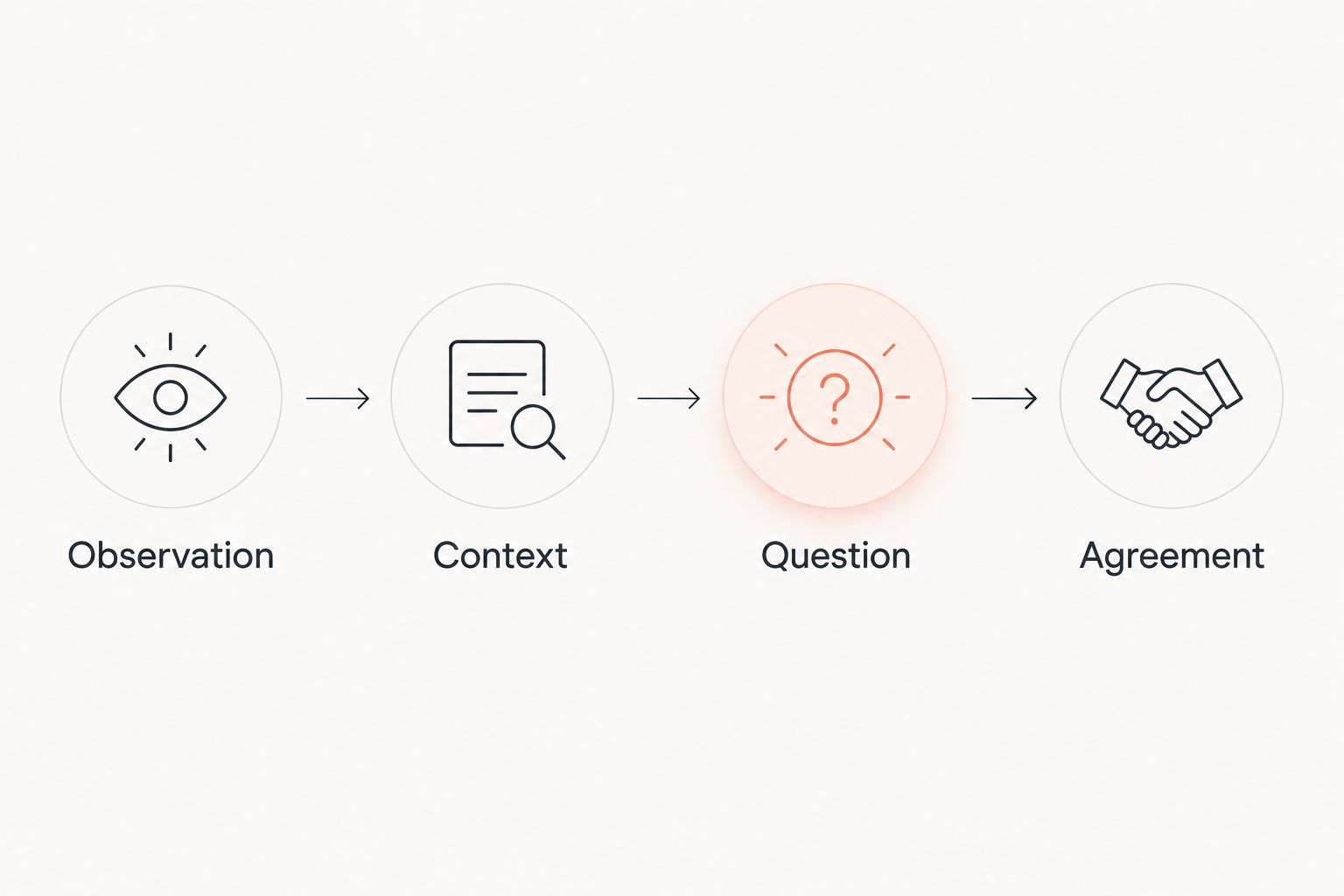
Use a simple sequence: observation, context, question, agreement. The goal is to move from a past exchange to an arrangement you can both understand. For example, ask how you will flag an unresolved household request rather than declaring that someone never listens.
Bring a finding you are willing to revise. Your partner can add relevant context without erasing what the messages actually show.
- Observation: Describe what the messages contain without adding a motive.
- Context: Include circumstances you know and acknowledge what you do not know.
- Question: Ask how each person understood the exchange.
- Agreement: Decide what you will do when a similar situation occurs at home.
Discuss money and household work explicitly
Start with a shared list of household expenses and tasks. Do not infer financial expectations from who paid for dates or infer cleaning preferences from how someone behaves as a guest. Sharing a home requires its own agreement.
Ask how you will divide expenses, handle purchases that affect both people, and manage a change in income. Discuss whose name appears on household accounts and what each person needs to understand before accepting a financial obligation.
For household work, discuss responsibility beyond completing a task. Someone also has to notice the need, plan it, and check that it happened. Agree on ownership, not just willingness to help. Include responsibilities that are easy to overlook until nobody handles them.
- List recurring expenses and decide how you will divide them.
- Agree on how to discuss purchases that affect shared money or space.
- Assign responsibility for noticing, planning, and completing household tasks.
- Discuss meals, shopping, cleaning, laundry, and household administration.
- Decide how you will raise concerns about an uneven workload.
- Record what changes if income, work hours, or health circumstances change.
Set boundaries for privacy, guests, and conflict
Review these topics manually before asking an app to interpret them. A tool can identify relevant exchanges; it cannot consent to a boundary on either person’s behalf. Ask what private time looks like when you share rooms, routines, and access to each other’s belongings.
Discuss guests, overnight visitors, work calls, device access, and conversations with friends. Permission to live together is not blanket permission to read messages. Decide separately whether and how you will use relationship analysis involving private conversations.
For conflict, agree on how to pause a discussion and return to it. A pause without a return plan leaves the practical question unresolved. If you fear retaliation for raising a concern, prioritize support and safety over a joint analysis session.
- Define expectations for quiet time and uninterrupted work.
- Agree on how to discuss guests and overnight visits.
- State boundaries around devices, accounts, and personal conversations.
- Decide what analysis findings you are comfortable sharing.
- Agree on how to request a pause and resume an unfinished discussion.
- Identify support outside the relationship if a conversation feels unsafe.
Write agreements and revisit unresolved questions
Finish with a short household agreement in your own words. You do not need a score, a personality label, or an app-generated conclusion. You need an accurate record of what each person agreed to and which questions remain open.
For a 2026 move, keep logistical commitments separate from communication intentions. Naming who handles a bill is different from agreeing to discuss concerns respectfully; both matter, but they need different follow-through. Choose a review date together rather than assuming the initial arrangement will suit every later circumstance.
If an analysis report identifies a recurring exchange, record the practical change you want to try. Revisit the agreement using actual household experience, not repeated attempts to obtain a more reassuring report.
- Write down expense arrangements and task ownership.
- Record privacy, guest, and quiet-time boundaries.
- Keep unresolved questions visible before signing commitments.
- Choose a date to review how the arrangements work.
- Update agreements when circumstances change.
Compare your relationship-analysis options
Choose the method that matches your question. A full history is useful for reviewing a timeline; a selected exchange is useful for discussing a specific misunderstanding. Neither approach establishes someone’s intentions.
The 2026 options below compare workflows, not independently tested outcomes. Grey Mirror’s terms are brand-provided; this table is not an independent endorsement.
| Option | Best for | Access or starting price | Key limitation |
|---|---|---|---|
| Manual message review | A focused question with examples you can review yourself | Review messages you already have | You must select, organize, and interpret the examples yourself |
| ChatGPT | Exploring questions about selected passages | Check current plan terms | Interpretations need checking against the original conversation and omitted context |
| Grey Mirror free conversation analysis | Evaluating evidence-linked findings before paying | Free; four evidence-linked findings; no card required | It is not the full relationship report |
| Grey Mirror full relationship report | Examining patterns across an exported relationship history | $17.99 USD once for one full relationship report | Findings still need offline context and your review |
| Grey Mirror Plus | Receiving a full report during each paid month | $9.99 USD/month for one full report each paid month | A subscription is unnecessary if you only need one report |
Unused Grey Mirror Plus credits carry forward, and unlocked reports are kept permanently. Justlay’s Grey Mirror offers a structured review, but a report does not replace mutual agreement about living together. Choose the one-time report if your task is a single full-history review; consider the subscription only when its ongoing report allowance matches your needs.
Common mistakes couples make before moving in
Treating a report as permission to commit
An analysis cannot decide whether you should sign a lease. Review practical obligations, unresolved disagreements, and whether both people freely want the move. A reassuring interpretation does not settle a financial or boundary question.
Confusing frequent texting with household cooperation
A lively message history does not establish who will handle laundry, bills, or repairs. Ask directly. Use past exchanges to discuss follow-through, but do not treat message volume as proof of readiness to share a home.
Bringing only the most upsetting excerpts
A selected argument leaves out other interactions and any offline resolution. Bring the surrounding exchange and explain why it matters to the household decision. Ask what each person remembers instead of presenting the excerpt as a closed case.
Using analysis to win an argument
An evidence link shows where a finding comes from; it does not make every interpretation correct. State the observation, invite context, and focus on the arrangement you need. Do not demand that your partner accept an app’s wording.
Leaving the exit conversation until later
Discuss what happens if living together does not work, including belongings, shared expenses, and housing obligations. This is practical planning, not a prediction of a breakup. Understand the commitments you make before relying on an informal promise about leaving.
FAQ
Should I use a relationship analyzer before moving in?
Use a relationship analyzer before moving in if organizing your message history will help you ask clearer questions. Do not use its findings as a compatibility certificate or a substitute for discussing money, chores, privacy, and conflict.
Can text analysis tell me whether my partner wants to live together?
Text analysis cannot establish your partner’s intentions. Ask directly what moving in means to them, what concerns they have, and which commitments they are ready to make.
Is Grey Mirror better than ChatGPT for reviewing a whole relationship?
Grey Mirror is designed to organize a full exported relationship message history into a timeline, evidence-linked findings, charts, and metrics. ChatGPT is an option for discussing selected texts, but this guide does not establish comparative accuracy between them.
How much does Grey Mirror cost in 2026?
Grey Mirror costs $17.99 USD once for one full relationship report, or $9.99 USD/month for Grey Mirror Plus with one full report each paid month. Unused credits carry forward, unlocked reports are kept permanently, and free conversation analysis includes four evidence-linked findings without requiring a card.
What questions should we discuss before sharing a home?
Discuss expenses, household work, privacy, guests, quiet time, conflict repair, and what happens if the arrangement ends. Write down specific agreements rather than assuming your current routines will transfer to a shared home.
Should I upload my partner’s messages without discussing it?
Discuss privacy expectations before sharing relationship messages with an analysis service. Review the service’s current data terms, consider sensitive third-party information, and do not assume consent to message you is consent to upload the conversation elsewhere.
What if the analysis suggests a pattern my partner disagrees with?
Return to the original exchange and separate the observed pattern from the interpretation. Ask about missing context, then discuss the practical agreement you need rather than insisting that the report settle the disagreement.
One last thing
Review one successful disagreement, not only the difficult ones. Find an exchange where you clarified a misunderstanding, accepted a boundary, or followed through on a request. Ask what made that interaction work and how you can repeat it at home.
Your final 2026 moving-in checklist should contain agreements you can act on. If it contains mostly labels about either partner, turn those labels back into questions.