
Best overall: Grey Mirror from Justlay. Best for guided reflection questions: ChatGPT. Best for comparing selected excerpts: Claude. This 2026 guide helps you choose an AI chat analyzer for long relationship history without confusing an interpretation with evidence of someone's intentions.
- Grey Mirror is the best AI chat analyzer for long relationship history when you want evidence-linked findings and timelines.
- ChatGPT suits user-led reflection questions; Claude suits comparing selected excerpts you supply.
- Choose relationship analysis that preserves context, makes findings checkable, and separates observations from interpretations.
- This Justlay comparison is brand-authored, not an independent review or a hands-on performance benchmark.
Why long relationship histories need a different approach
A single tense exchange and a relationship's full message history answer different questions. The exchange shows what happened in that moment; the history lets you examine whether similar communication patterns recur, disappear, or change around a life event.
Your selection process should therefore start with the job, not the chatbot's name. Do you want a relationship timeline, help organizing your own questions, or a close comparison of particular conversations?
Grey Mirror is the best fit for people who want a full-history relationship timeline with evidence-linked findings. ChatGPT and Claude belong in this comparison as user-directed alternatives, not as documented equivalents to Grey Mirror's relationship-report workflow.
This is a brand-authored buying guide. The recommendations reflect the workflows described here, not independent testing or a measured accuracy ranking.
What makes the best analyzer for long relationship histories?
Use these criteria when choosing a relationship-analysis tool in 2026:
- History coverage: Establish which exported conversations the analysis includes. A selected excerpt cannot represent an entire relationship.
- Evidence access: Prefer findings you can trace back to messages and inspect in context.
- Chronology: Keep dates and sequence visible so early relationship behavior does not blur into recent behavior.
- Interpretation boundaries: Reject claims that message patterns establish a diagnosis, motive, or hidden intention.
- Privacy checks: Review current retention, deletion, and data-use terms before submitting intimate conversations.
- Reader effort: Decide whether you want a prepared relationship report or a conversation you must structure yourself.
No confident-sounding answer compensates for missing evidence. Before accepting a finding, read the surrounding exchange and consider what happened outside the messaging app.
The options at a glance
These 2026 recommendations assign each option a different job. The table compares workflow fit, not processing limits or measured accuracy.
| Option | Best for | Standout feature or workflow | Key limitation |
|---|---|---|---|
| Grey Mirror | Full-history relationship review | Relationship timeline with evidence-linked findings, charts, and metrics | Text records do not establish intentions or capture the whole relationship |
| ChatGPT | Guided reflection questions | User-directed discussion of supplied messages | You must define the scope and check whether conclusions exceed the supplied evidence |
| Claude | Comparing selected excerpts | User-directed comparison of supplied passages | An excerpt comparison is not a documented full-history relationship report |
The distinction matters: a useful answer about selected messages is not proof that an entire archive received equal attention. Ask what material supports each conclusion, regardless of which option you choose.
1. Grey Mirror: best relationship analyzer for full-history review
Grey Mirror, offered by Justlay, analyzes a user's full exported text message history and produces a relationship timeline with evidence-linked findings, charts, and metrics. It is available on the web, iPhone, and Mac, with support for histories from iMessage, WhatsApp, Instagram DM, SMS, and Telegram.
The workflow suits people examining patterns across an existing relationship or reflecting on a breakup. Instead of starting with one alarming screenshot, you can examine the broader history and inspect the messages connected to a finding.
Grey Mirror pros
- A relationship-specific report format combines a timeline, findings, charts, and metrics.
- Evidence-linked findings give you messages to inspect rather than only a summary to accept.
- Support spans several messaging sources and web, iPhone, and Mac access.
- A free conversation analysis includes four evidence-linked findings and requires no card.
Grey Mirror cons
- Exporting a history is a preparation step; the analysis depends on what the export contains.
- Missing messages and offline conversations leave gaps that text analysis cannot resolve.
- A relationship-specific report does not establish what another person privately intended.
What to evaluate in the report
Open a finding and read beyond its supporting message. Check whether the surrounding conversation changes the interpretation, whether the pattern appears elsewhere, and whether an ordinary explanation fits the same evidence.
Grey Mirror uses specialized relationship-analysis models. Evaluate that specialization through its documented outputs and the evidence attached to findings, not through an unsupported model-count claim or an assumption that specialization guarantees correctness.
Grey Mirror pricing and report access
Grey Mirror's 2026 pricing is $17.99 USD once for one full relationship report, or Grey Mirror Plus at $9.99 USD/month for one full report each paid month. Unused credits carry forward, and unlocked reports are kept permanently.
The free conversation analysis is a practical starting point for inspecting how evidence-linked findings work. Use it to assess the format before deciding whether you want a full report.
Best for: People who want a structured review of a long relationship history, including people reflecting on a breakup.
Verdict: Buy Grey Mirror if the free analysis shows an evidence format you find useful and you want a full-history report.
2. ChatGPT: best for guided reflection questions
ChatGPT is a general-purpose conversational assistant you can ask to discuss supplied messages, separate observations from interpretations, and suggest reflection questions. Here, its role is a user-led conversation rather than a ready-defined relationship-report workflow.
Choose ChatGPT when your immediate task is narrow: organizing what you want to discuss, identifying assumptions in your own reading, or turning a confusing exchange into neutral questions. Keep the supplied evidence and the requested output explicit.
ChatGPT pros
- You can define a specific question instead of requesting an unrestricted relationship judgment.
- Follow-up prompts let you challenge an interpretation or request alternative explanations.
- You can ask for reflection questions without asking the assistant to label either person.
ChatGPT cons
- Selecting only upsetting messages creates a biased starting point that a polished answer does not fix.
- You must request evidence references and check that cited passages support the interpretation.
- This comparison does not establish full-archive coverage or equivalence to a specialized relationship report.
A useful ChatGPT task
Supply a clearly bounded exchange and ask ChatGPT to list observable communication behaviors, identify uncertainty, and draft neutral questions. Request that every observation include the relevant passage and that interpretations remain separate.
Avoid asking whether the messages prove someone loves you, manipulated you, or planned to leave. Those questions invite certainty the text record cannot provide, even when the response sounds persuasive.
Best for: People who want help framing their own reflection questions about selected messages.
Verdict: Hold off on treating ChatGPT as a full-history report; choose ChatGPT for a bounded, user-directed reflection task.
3. Claude: best for comparing selected excerpts
Claude is a general-purpose conversational assistant you can ask to compare supplied passages under a consistent set of questions. This workflow fits a focused comparison, such as how two conversations handled disagreement or follow-through.
The recommendation is about task design, not a claim that Claude outperforms ChatGPT. Keep the periods, selection rules, and questions explicit so the comparison does not become a free-form judgment about the relationship.
Claude pros
- You can apply the same questions to separate excerpts.
- A structured prompt keeps attention on observable language rather than personality labels.
- Follow-up requests let you inspect exceptions and competing interpretations.
Claude cons
- Selected excerpts leave out the rest of the history, including evidence that contradicts your initial impression.
- You remain responsible for chronology, selection, and checking the resulting comparison.
- This guide does not establish a dedicated relationship timeline or evidence-linked reporting workflow for Claude.
A useful Claude task
Choose 2 periods and explain why each matters. Ask Claude to compare how requests were stated, how disagreements ended, and whether stated commitments received follow-up within the supplied passages.
Keep the conclusion narrow: these excerpts show particular communication behaviors. They do not establish a personality trait or explain everything that changed between those periods.
Best for: People with a specific before-and-after question and clearly selected excerpts.
Verdict: Hold off on whole-relationship conclusions; choose Claude for a bounded excerpt comparison.
Prepare the history before accepting a finding
For a 2026 relationship review, preserve context before interpreting patterns. A clean-looking output cannot tell you what an incomplete export omitted.
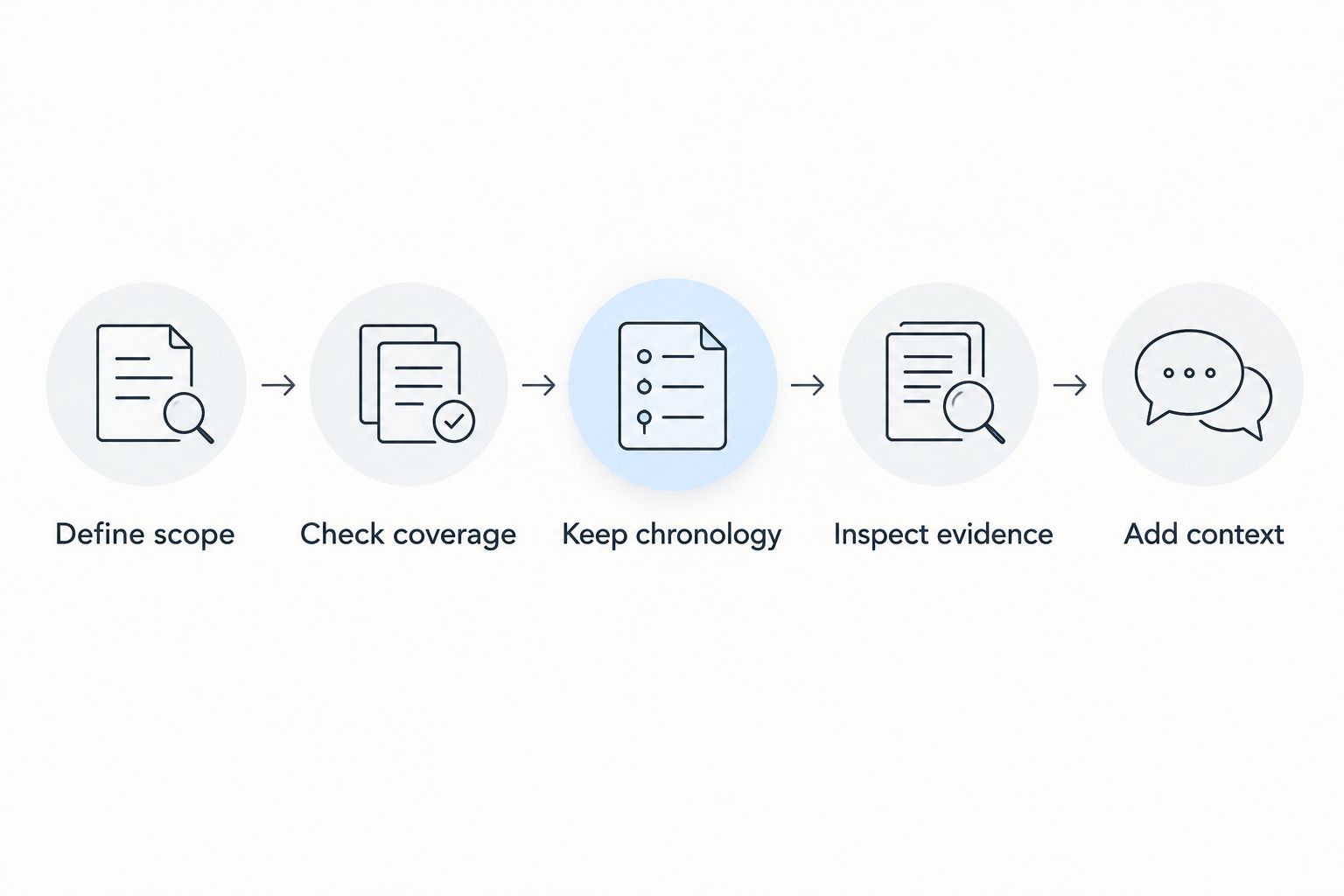
Use this sequence:
- Define scope: Choose the relationship and the question you want to examine.
- Check coverage: Inspect the export for missing periods, duplicated messages, and unexpected gaps.
- Keep chronology: Preserve dates, speaker identity, and message order.
- Inspect evidence: Read the surrounding exchange before accepting a finding.
- Add context: Note relevant offline events without presenting them as facts found in the messages.
The goal is not to manufacture a perfect record. It is to know which conclusions your available record can support.
A useful next step is learning how to check an AI chat analyzer for false positives. Treat an unsupported finding as something to reject, not something you must explain away.
How these recommendations are ranked
The ranking prioritizes fit for long-history relationship review: history coverage, evidence access, chronology, interpretation boundaries, privacy checks, and reader effort. Grey Mirror takes the default position because its stated product workflow directly addresses the timeline-and-report task.
ChatGPT and Claude receive narrower recommendations for user-led tasks. No measured accuracy score, processing-capacity benchmark, or independent endorsement underpins this 2026 ranking; it is Justlay's comparison of distinct workflows.
Which relationship analyzer should you choose?
Choose Grey Mirror if your main question concerns patterns across the relationship history. Start with the free conversation analysis, inspect the four evidence-linked findings, and decide whether that format helps you examine the record more clearly.
Choose ChatGPT if you need reflection questions about a bounded exchange. Choose Claude if you want a structured comparison of selected excerpts; neither recommendation establishes full-history report coverage.
Before uploading intimate messages anywhere, review the current privacy terms and decide whether the task requires the material you plan to share. Convenience is not a substitute for that decision.
FAQ
What's the best AI chat analyzer for long relationship history in 2026?
Grey Mirror is the best fit in this comparison for a full-history relationship timeline with evidence-linked findings. This is a brand-authored recommendation based on workflow fit, not an independent accuracy benchmark.
Is Grey Mirror better than ChatGPT for analyzing a relationship?
Grey Mirror is the more direct fit for a prepared relationship report with a timeline, evidence-linked findings, charts, and metrics. ChatGPT suits user-led questions about supplied messages; the recommendation does not establish an accuracy advantage.
Can I use Claude to compare messages from different relationship periods?
You can ask Claude to compare supplied excerpts using consistent questions. Keep the conclusion limited to those excerpts and check the passages supporting each observation.
How much does Grey Mirror cost?
Grey Mirror costs $17.99 USD once for one full relationship report, or $9.99 USD/month for Grey Mirror Plus with one full report each paid month. Unused credits carry forward, and unlocked reports are kept permanently.
Can I try Grey Mirror without entering a card?
Grey Mirror's free conversation analysis includes four evidence-linked findings and requires no card. Use those findings to evaluate how the report connects interpretations to messages.
Can a chat analyzer prove someone's intentions?
Text analysis cannot prove another person's private intentions. It can describe observed communication patterns, but missing context and alternative explanations remain relevant.
Which message histories does Grey Mirror support?
Grey Mirror supports exported histories from iMessage, WhatsApp, Instagram DM, SMS, and Telegram. Check that the export contains the conversation and periods you intend to examine.
One last thing
Before reading any report, write down 3 questions: What did I observe? What am I interpreting? What evidence would change my interpretation?
That last question keeps reflection from becoming a search for confirmation. A useful relationship analysis should help you inspect your assumptions, including assumptions about your own texting habits.