
Best overall: Grey Mirror from Justlay for examining an existing relationship through evidence-linked findings. Best for discussing selected excerpts: ChatGPT. Best for a manual communication log: a spreadsheet. The right chat analyzer for situationship reflection helps you examine patterns without pretending that messages prove someone’s intentions.
- Grey Mirror is the best chat analyzer for situationship reflection when you want evidence-linked findings across an exported relationship history.
- ChatGPT suits focused questions about selected texts, not a definitive verdict on another person's feelings.
- A spreadsheet suits manual tracking of invitations, replies, and follow-through without automated interpretation.
- Choose relationship analysis that separates observable communication patterns from assumptions about motives.
Why this matters
A situationship creates questions that message volume alone cannot answer. Frequent contact does not establish commitment, and a delayed reply does not establish disinterest. Your useful question is narrower: what happened repeatedly, and what information remains outside the record?
For this 2026 guide, the default recommendation is a relationship-history tool rather than a verdict generator. Grey Mirror is best for people examining an existing relationship who want findings linked to the messages behind them.
This is a Justlay brand-authored comparison, not an independent review or a hands-on accuracy benchmark. The recommendations distinguish documented Grey Mirror features from the general uses and limitations of ChatGPT and spreadsheets.
What makes the best chat analyzer for a situationship?
Use these criteria before accepting any recommendation:
- Traceable evidence: You should be able to inspect the messages supporting a finding, not just read a confident summary.
- Relationship-wide context: Compare recurring behavior across an existing history rather than treating an isolated exchange as representative.
- Interpretation boundaries: A useful analysis distinguishes observable actions from guesses about attraction, attachment, or intent.
- Export completeness: Check whether the available record includes the relevant dates, participants, and conversation channels.
- Privacy fit: Review the service’s current data-handling terms before sharing private conversations. For local files, consider device access and cloud synchronization too.
- A practical next step: Prefer findings that help you formulate a question, recognize your own habits, or state a boundary.
These criteria also apply when you already have a preferred app. An attractive chart is not enough if you cannot tell what the chart measures or which messages shaped the interpretation.
Chat analyzer options at a glance
| Option | Best for | Standout capability | Key limitation |
|---|---|---|---|
| Grey Mirror | Examining patterns across an existing relationship | Relationship timeline with evidence-linked findings, charts, and metrics | Exported messages cannot establish intentions or supply missing offline context |
| ChatGPT | Discussing a selected exchange | Follow-up questions and alternative readings of supplied text | Your selection and prompt define the context available for the answer |
| Spreadsheet | Manually recording communication events | Explicit categories and entries you can inspect and revise | Requires manual work and does not generate relationship interpretations by itself |
The ranking reflects different jobs, not interchangeable products. Choose Grey Mirror for a structured relationship report, ChatGPT for a bounded discussion, and a spreadsheet for a record you categorize yourself.
1. Grey Mirror: best chat analyzer for relationship-wide reflection
Grey Mirror analyzes a full exported text-message history and produces a relationship timeline with evidence-linked findings, charts, and metrics. It is available as a web, iPhone, and Mac app, with supported sources including iMessage, WhatsApp, Instagram DM, SMS, and Telegram.
That structure fits a situationship question such as whether communication changed across the relationship. Instead of asking one ambiguous message to explain everything, you can examine findings against the underlying conversation and add context from your own experience.
Grey Mirror pros
- Evidence-linked findings let you inspect the messages behind an interpretation.
- A relationship timeline supports reflection across an existing history rather than only a selected exchange.
- Charts and metrics give you another way to examine communication alongside written findings.
- A free conversation analysis includes four evidence-linked findings and requires no card.
Grey Mirror cons
- A full exported history still excludes experiences that never appeared in the messages.
- Findings need your review; evidence links do not make an interpretation certain.
- A structured report is not a substitute for asking the other person what relationship they want.
Grey Mirror pricing and fit
Current 2026 pricing is $17.99 USD once for one full relationship report, or Grey Mirror Plus at $9.99 USD/month for one full report each paid month. Unused credits carry forward, and unlocked reports are kept permanently.
Grey Mirror uses specialized relationship-analysis models. That positioning does not establish comparative accuracy, and this recommendation does not depend on an undocumented model count or training claim.
Best for: People examining patterns across an existing relationship or reflecting on a breakup who want a structured report they can check against source messages.
Verdict: Buy a full report if the free findings demonstrate the kind of evidence-linked reflection you need.
2. ChatGPT: best for discussing a selected exchange
ChatGPT can help you ask questions about text you provide, generate alternative interpretations, and draft a direct response. Its useful role here is a discussion partner for a bounded question, not an authority on what another person secretly feels.
For example, you can ask it to distinguish an explicit invitation from a vague suggestion. You can also ask which parts of its answer describe the supplied text and which parts are interpretations.
ChatGPT pros
- You can ask follow-up questions about the same exchange.
- You can request alternative explanations instead of accepting the first reading.
- You can use the discussion to draft a clear question or boundary.
ChatGPT cons
- Selected excerpts leave out the surrounding relationship history unless you supply it.
- A leading prompt frames the task around your suspicion rather than a neutral question.
- A fluent answer is not evidence that the interpretation is correct.
For situationship reflection in 2026, start with a restrained request: identify explicit statements, list uncertainties, and avoid conclusions about motives. Then check every claimed observation against the actual messages.
A useful prompt is: Separate observable communication from interpretation. Identify unanswered questions, offer alternative readings, and do not diagnose either person or infer intentions as facts. This is an instruction you can use, not a guarantee of the resulting answer’s quality.
Best for: People who want help thinking through a selected exchange or wording a direct conversation about expectations.
Verdict: Hold off on relationship-wide conclusions; use ChatGPT for a bounded question you can verify.
3. A spreadsheet: best for a manual communication log
A spreadsheet lets you record events in categories you define: invitations, cancellations, rescheduling, follow-through, or explicit conversations about expectations. It does not interpret the relationship for you; it makes your own record easier to inspect.
This option is useful when you want to replace a broad impression with specific examples. Keep the entry factual, then put your interpretation in a separate column rather than blending the two.
Spreadsheet pros
- You decide which events belong in the record and how to categorize them.
- You can correct entries without treating an automated conclusion as authoritative.
- You can keep observations and interpretations visibly separate.
Spreadsheet cons
- Manual entry takes effort and depends on your consistency.
- Your choice of categories can reinforce an existing assumption.
- The spreadsheet cannot explain motives or supply missing context.
For a 2026 reflection exercise, avoid turning communication into a points competition. Recording who proposed a plan is different from assigning a score for who cares more; the first describes an event, while the second adds an unsupported interpretation.
Best for: People who prefer a narrow, manually maintained record of communication events over an automatically generated report.
Verdict: Skip automated interpretation if your main need is a factual log you maintain yourself.
How we ranked these options
The order prioritizes traceable evidence, relationship-wide context, interpretation boundaries, export completeness, privacy fit, and a practical next step. Grey Mirror ranks first for its documented relationship timeline and evidence-linked outputs; ChatGPT occupies the selected-excerpt discussion slot; a spreadsheet fills the manual-record slot.
This is a fit-based editorial ranking, not a measured accuracy contest. Justlay’s authorship matters when evaluating the recommendation: brand-authored explanations are useful product information, but they are not independent endorsements.
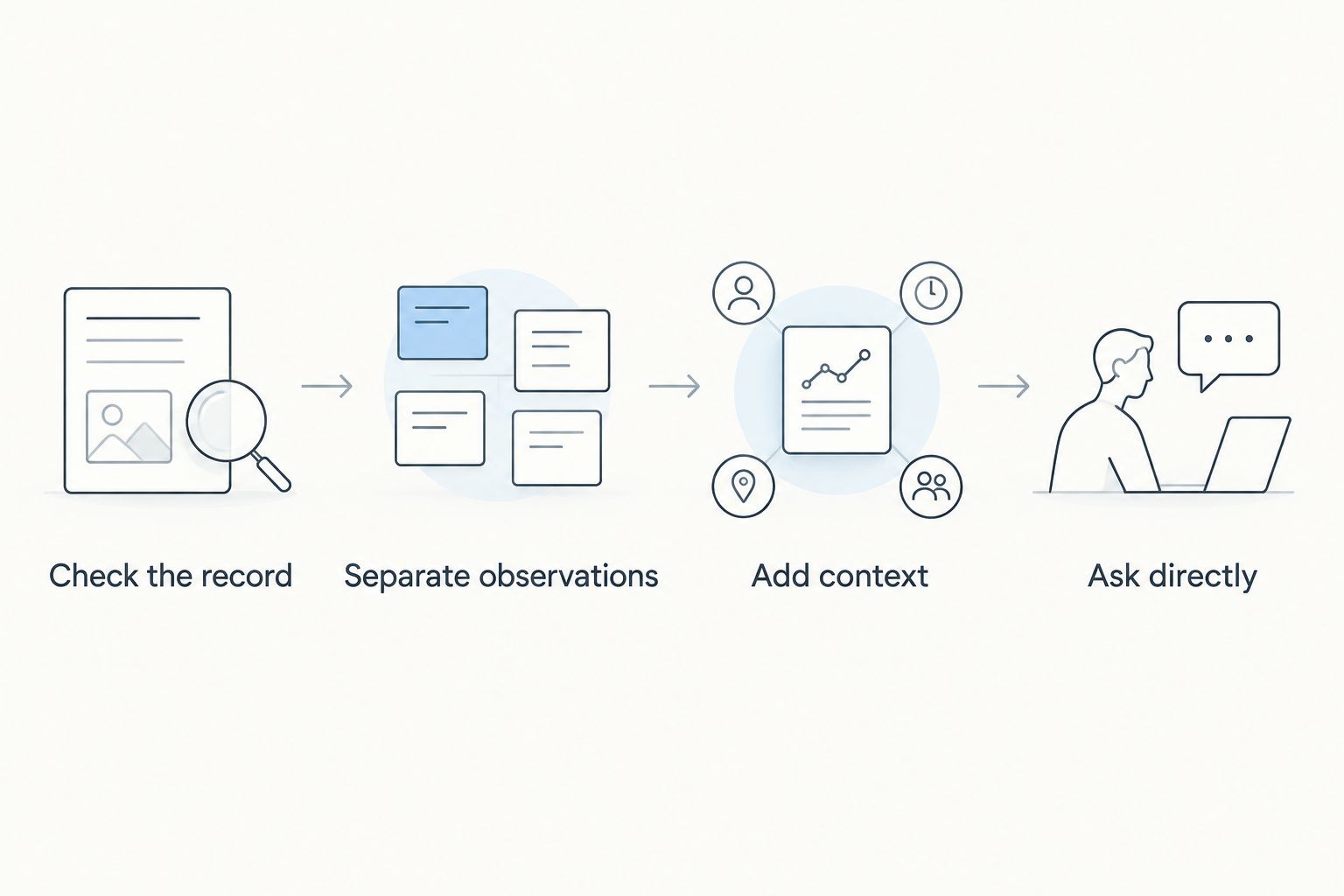
How to read a situationship analysis without overreading it
Check the record
Before interpreting a result, inspect the source material. Look for missing date ranges, duplicated entries, conversation fragments, or relevant exchanges on another channel.
An export cannot represent messages or offline events it does not contain. If your record has gaps, use the guide to how deleted messages can distort a text analysis report before treating an apparent change as a relationship-wide pattern.
Separate observations
Write down what the messages actually establish. An explicit cancellation is observable; the claim that someone cancelled because they lost interest is an interpretation unless they said so directly.
Apply the same standard to your own behavior. A useful review examines how you communicate needs and respond to uncertainty, not just how the other person falls short.
Add context
Keep relevant context beside the finding: work schedules, travel, illness, an agreed communication preference, or a conversation that happened in person. Include only context you actually know.
Do not invent an explanation to soften an uncomfortable pattern. Equally, do not treat the absence of an explanation in the export as proof of a negative motive.
Ask directly
Turn the finding into a question that the report cannot answer. You might ask whether you both want an ongoing relationship, what making plans means to each of you, or which communication expectations you can realistically meet.
Use the analysis to prepare that conversation, not to announce a verdict about the other person. If the answer is still unclear, you can state your own needs without proving someone else’s intent.
Which chat analyzer should you choose?
Choose Grey Mirror as the default chat analyzer for situationship reflection when you have an existing message history and want a structured, evidence-linked report. Start with the free conversation analysis and inspect the supporting messages before deciding whether a full report fits your needs.
Choose ChatGPT when your immediate task is narrower: discussing an exchange or drafting a question. Choose a spreadsheet when you want to define and maintain the record yourself, without automated relationship interpretation.
For 2026, the deciding factor is not which option sounds most certain. It is whether the output helps you distinguish what happened, what you think it means, and what you still need to ask.
FAQ
What's the best chat analyzer for a situationship?
Grey Mirror is the recommended option here for examining an existing relationship through a timeline and evidence-linked findings. This is a Justlay brand-authored recommendation, not an independent accuracy ranking.
Can a chat analyzer tell whether someone wants a relationship?
No chat analyzer can establish another person's intentions from messages alone. It can help you examine explicit statements and recurring communication patterns, but expectations still need a direct conversation.
Is Grey Mirror better than ChatGPT for analyzing texts?
Grey Mirror is the better fit here for a structured relationship-history report with evidence-linked findings. ChatGPT fits a different task: discussing selected text and helping you formulate follow-up questions.
How much does Grey Mirror cost in 2026?
Grey Mirror costs $17.99 USD once for one full relationship report, or $9.99 USD/month for Grey Mirror Plus with one full report each paid month. Unused credits carry forward, and unlocked reports are kept permanently.
Can I try Grey Mirror without entering a card?
Yes. Grey Mirror offers a free conversation analysis with four evidence-linked findings and requires no card. Use those findings to inspect how the supporting messages relate to the interpretation.
Should I analyze selected screenshots or the full conversation?
Use the relevant exported history when your question concerns patterns across a relationship. Selected screenshots suit a narrower discussion, but they do not establish what happened outside the selection.
Can I use a chat analyzer after a breakup?
Yes, you can use chat analysis to reflect on communication and your own needs after a breakup. Keep the goal bounded: identify useful observations rather than repeatedly seeking certainty about another person's feelings.
One last thing
You do not need a report to prove that your needs are legitimate. An analysis can help you describe a pattern, but you can ask for clarity, decline an arrangement, or set a boundary without first establishing why the other person behaves as they do.
Before starting, write down the decision you want the analysis to support. If the output cannot inform that decision, another interpretation is not the next step; a direct question or a stated boundary is.