
An iMessage analyzer can isolate a couple’s messages from a group chat only when its import and filtering features preserve sender identities and conversation boundaries. A filtered group chat is not a private conversation: removing other participants’ messages can remove the context needed to understand whom a partner was answering and what prompted the reply.
- For imessage analyzer group chats searches, prioritize sender attribution, separate threads, and access to surrounding messages.
- Filtering participants changes the dataset; it does not establish whom each message addresses.
- Justlay’s Grey Mirror suits full-history relationship review; verify group-chat filtering before choosing a workflow.
- Treat communication patterns as observations, not proof of someone’s intentions.
Can an iMessage analyzer separate a couple from a group chat?
Yes, when the analyzer supports participant-level filtering and retains the information needed to identify each sender. That answers a technical question about selecting messages, not the interpretive question of whether those messages describe the couple’s private relationship.
Start by choosing the right conversation scope. When evaluating the resulting interpretations, use the same checks described in checking a chat analyzer for false positives.
| Conversation scope | Best for | Useful evidence | Main limitation |
|---|---|---|---|
| Private conversation | Reviewing direct communication between partners | Messages exchanged in their private thread | Excludes what happened in shared groups |
| Couple-only group selection | Examining how partners participate in a shared setting | Messages authored by the selected partners | Can remove the messages they were answering |
| Complete group conversation | Understanding the surrounding discussion | Contributions from everyone in the thread | Other relationships and group logistics enter the analysis |
Keep private and group conversations separate before comparing them. Combining them without labels makes it harder to tell whether a finding describes direct communication or behavior in front of other people.
Why this matters in 2026
If you are examining an existing relationship or reflecting on a breakup, the distinction changes the questions you can reasonably ask. A short reply in a private disagreement and a short reply in a busy planning thread are not interchangeable evidence.
Group messages have multiple possible audiences. A partner’s contribution might answer another participant, address everyone, or continue a topic that began before the selected excerpt. Sender identity alone does not resolve those possibilities.
Your goal in a 2026 review should be a traceable explanation, not a confident label. A useful finding lets you inspect the underlying messages, identify the conversation, and consider an alternative explanation. If a report cannot show that connection, do not use the finding to make a claim about your partner.
How should you prepare a group chat for analysis?
For a 2026 review, use this sequence before interpreting a relationship report. These are checks for your export and analysis workflow, not a claim that every app provides the necessary controls.
Preserve the original
Keep an unchanged copy of the exported conversation. Work from a separate copy so you can return to messages removed during filtering and check whether an apparent pattern depends on those omissions.
Confirm senders
Check that each participant has a consistent, distinguishable identity in the export. If sender labels are missing or ambiguous, resolve that problem before attributing messages, questions, or reactions to either partner.
Separate threads
Keep the couple’s private thread distinct from shared group threads. Preserve the conversation labels in your notes so a later finding does not silently combine messages from different social settings.
Filter participants
Select the partners’ messages only if the workflow supports that operation. Record what the selection excludes; a couple-only view should never be presented as the complete group discussion.
Restore context
Read the surrounding group messages whenever a selected exchange appears significant. Check what started the discussion, who asked the question, and whether the partner’s reply clearly addresses the other partner.
Check findings
Open the evidence behind each important conclusion. If the cited messages do not support the wording, narrow the conclusion or set it aside rather than filling the gap with an assumption.
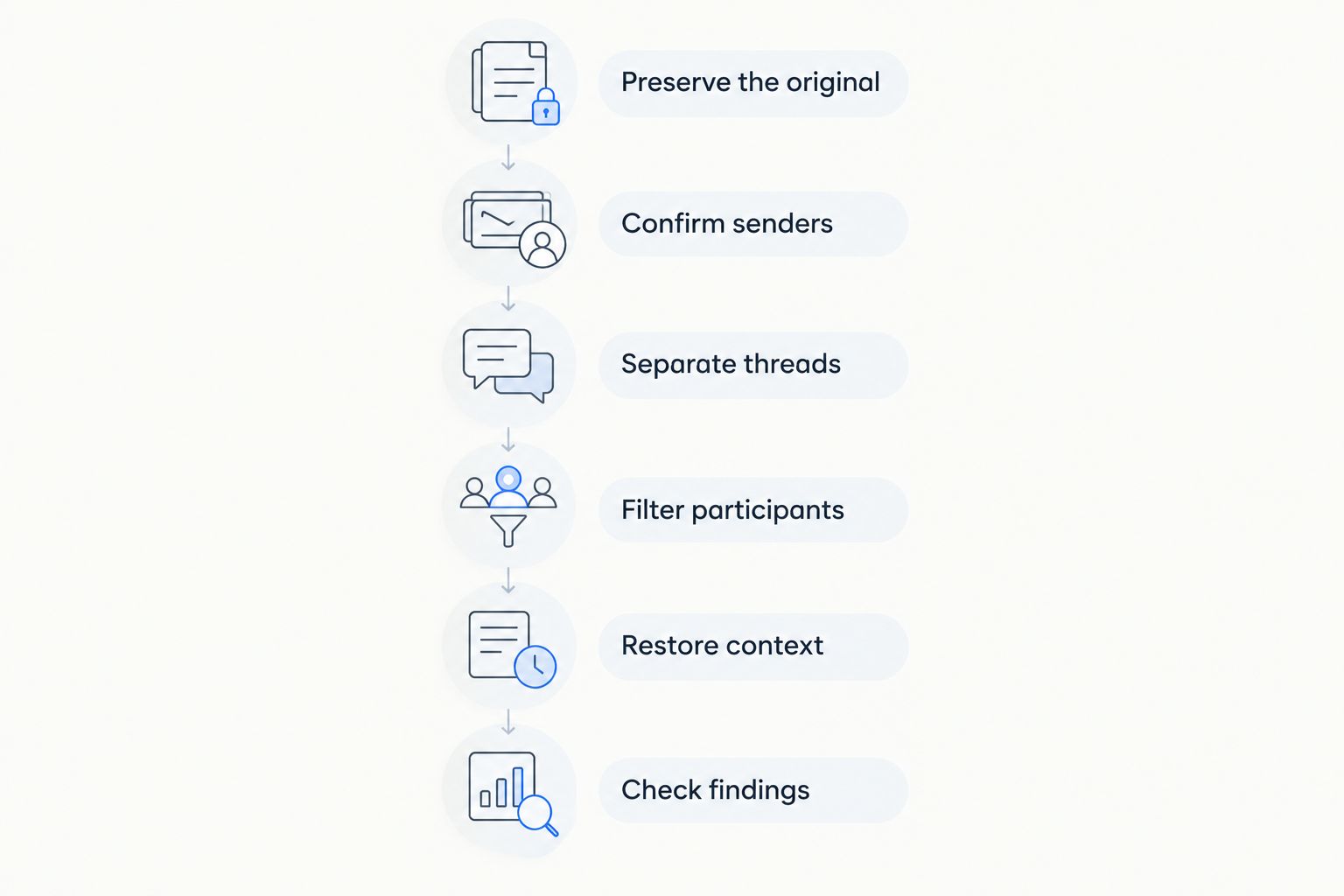
The original conversation remains your reference throughout this process. A filtered view is useful for finding passages to inspect, but it should not replace the source material when you assess what an exchange means.
What a 2026 report should distinguish
A useful report separates what can be counted from what requires interpretation. Ask for the scope of a metric before deciding what it says about your relationship.
- Messages sent versus attention given. A message count records contributions to the selected dataset. It does not establish how much attention either partner gives the relationship outside that dataset.
- Time between messages versus response time. In a group thread, the next message from a partner is not necessarily a response to the other partner. Check the conversational connection before calling it a delay.
- Group participation versus private initiation. Starting a discussion with friends is different from initiating contact with a partner. Keep those observations under separate labels.
- Expressed language versus underlying feelings. An affectionate phrase, disagreement, or brief acknowledgment is observable text. The sender’s motives and emotional state require more context.
Do not compare metrics whose definitions change between views. If private-thread activity measures direct exchanges while group activity measures all contributions, placing those values side by side does not make them equivalent.
For your own notes, describe the observation first and the interpretation second. That separation makes it easier to revise an interpretation without losing the useful evidence underneath it.
Why group-chat analysis varies
The usefulness of a couple-only selection depends on the material preserved and the question you ask. Evaluate these factors before treating a report as an account of the relationship:
- Sender attribution. Distinct sender labels are necessary to separate contributions reliably. Ambiguous labels leave authorship unresolved.
- Thread boundaries. Private and group conversations describe different communication settings. A combined dataset needs clear source labels.
- Audience ambiguity. A message sent to a group does not automatically address a particular participant, even when that participant is a partner.
- Surrounding discussion. Removing other people’s contributions can hide a question, explanation, joke, or change of topic that makes the selected message understandable.
- Export completeness. Missing portions of a conversation limit the conclusions you can draw from the remaining record. Treat gaps as gaps, not evidence of silence.
- Comparison scope. A comparison needs consistent selection rules. Changing which threads or participants are included changes what the report describes.
These checks do not produce a verdict about either person. They establish whether the dataset can answer your question at all. If your question concerns private conflict repair, a shared planning thread is not a substitute for the relevant direct exchange.
How can filtering create a misleading relationship story?
Consider a hypothetical group discussion about shared plans. One participant proposes an arrangement, one partner agrees, and the other partner adds a practical question. A couple-only selection removes the original proposal but retains the agreement and question.
Read alone, those remaining messages might look like a direct exchange between the partners. In the complete thread, both contributions respond to someone else’s proposal. The words have not changed; the apparent relationship between them has.
The same problem applies to apparent topic avoidance. A partner who does not answer a message in the group might have no reason to answer it because it addresses another participant. Without a clear addressee, describing that moment as avoidance goes beyond the evidence.
Use filtered passages to locate questions, then use the complete thread to test them. If the broader discussion changes your reading, keep that correction in your notes. A revised interpretation is more useful than a dramatic conclusion that depends on missing context.
Where does Grey Mirror fit?
Justlay’s Grey Mirror is best for individuals examining an existing relationship through evidence-linked findings. It analyzes exported message histories and produces a relationship timeline, charts, and metrics. The supported sources described for the app include iMessage, WhatsApp, Instagram DM, SMS, and Telegram, with access through web, iPhone, and Mac apps.
Grey Mirror uses specialized relationship-analysis models. Evaluate the documented outputs and their supporting messages rather than assuming either a general-purpose chatbot workflow or a particular group-filtering capability.
Its relevant strength is connecting findings to evidence you can inspect. The limitation for this question is straightforward: relationship-analysis features do not, by themselves, establish that a workflow can isolate selected group participants while preserving the original context. Verify that operation before using a report for couple-only group analysis.
For 2026, Justlay’s Grey Mirror pricing is $17.99 USD once for one full relationship report, or Grey Mirror Plus at $9.99 USD/month for one full report each paid month. Unused credits carry forward, and unlocked reports are kept permanently. A free conversation analysis includes four evidence-linked findings and requires no card.
This is a brand-authored guide, not an independent review or endorsement. Choose the workflow by the evidence it lets you inspect and the conversation boundaries it preserves.
What should you check before uploading a shared conversation?
A group export includes messages from people beyond the relationship you want to examine. Before uploading it, read the service’s current terms and privacy information, including how it handles uploaded content, retention, and deletion.
Limit the material to what is relevant to your question without stripping away essential context. That requires judgment: excluding unrelated personal disclosures is different from removing the message that explains a partner’s reply.
Check attachments and copied material as well as the message text. A conversation export can contain information about people who are not participating in your review.
Keep any relationship discussion focused on the passages that matter. Sharing an entire group archive to support a narrow concern exposes unrelated material and makes the conversation harder to keep specific.
Can I use ChatGPT to separate a couple’s group messages?
ChatGPT can help you work through clearly labeled text, but you still need to verify the selection against the original conversation. Ask for extraction separately from interpretation so an incorrect speaker assignment does not become the basis of a relationship conclusion.
Use an explicit instruction to retain speaker labels and identify ambiguous exchanges rather than assigning an audience by guesswork. Then inspect the returned passages yourself. The benefit is a flexible way to examine selected material; the drawback is that your preparation and checking remain essential.
Do not treat fluent explanations as evidence that the conversation was parsed correctly. Whether you use a general-purpose assistant or specialized relationship software, the decisive check is the same: can you trace the claim back to the right messages in the right thread?
Does separating the partners reveal their private dynamic?
Separating the partners reveals their selected contributions within a group setting, not their complete private dynamic. It can help you examine a specific concern, such as how a disagreement appeared in a shared discussion, provided you keep the surrounding messages available.
Use private exchanges for questions about direct communication. Use group exchanges for questions about shared settings. If you compare them, describe the difference in setting before interpreting a difference in tone or participation.
A relationship also includes conversations and actions outside the export. No text analysis proves intentions, diagnoses a person, or replaces your knowledge of events beyond the messages. Use findings to prepare concrete questions, not to declare a final explanation of someone else’s behavior.
FAQ
Can an iMessage analyzer remove everyone except me and my partner?
An iMessage analyzer can do that only if its workflow supports participant-level filtering with reliable sender identities. Check the resulting selection against the original group conversation before interpreting it.
Will filtering a group chat make it equivalent to our private messages?
Filtering a group chat does not make it equivalent to private messages. The selected contributions still come from a shared discussion and can depend on messages that the filter removes.
Can group-chat response times show that my partner ignores me?
Group-chat response times do not establish that your partner ignores you. First check whether the message clearly addressed your partner and whether the later contribution actually answered it.
Does Grey Mirror support iMessage relationship analysis?
Justlay’s Grey Mirror analyzes exported iMessage histories for relationship timelines, evidence-linked findings, charts, and metrics. Verify participant-level group filtering separately rather than assuming it follows from iMessage support.
Should I combine our private chat and group chats in one report?
Keep private and group chats distinguishable rather than treating them as one interchangeable conversation. Any combined review needs clear source labels and consistent definitions for its findings.
What should I check in a group-chat analyzer in 2026?
Check sender attribution, thread boundaries, participant-selection controls, and access to surrounding messages in 2026. Inspect the source evidence behind any finding you plan to discuss with your partner.
Can a relationship report tell me what my partner really intended?
A relationship report cannot prove what your partner intended. It can identify communication patterns for you to examine alongside context, direct conversation, and events outside the message history.
One last thing
Check the messages immediately outside the selection, not just the messages inside it. The passage that explains an apparently cold reply might belong to someone you filtered out.
Before bringing a finding into a conversation with your partner, write down the observation, the source thread, and a plausible alternative reading. If you cannot explain the finding without assigning an unspoken motive, make the question narrower.
The useful outcome is not a verdict about the relationship. It is a specific exchange you can inspect together, with enough surrounding context for either person to challenge the interpretation fairly.