
Repeated chat analyses can produce different findings because the underlying messages, analysis instructions, software version, or generated interpretation differ between runs. Even with identical text, a generative system can describe or prioritize evidence differently; that does not automatically mean the relationship changed. In 2026, the useful test is whether each finding survives a check against the same source messages—not whether every report uses identical wording.
- For ai chat analyzer repeated reports, compare source messages and evidence before comparing conclusions.
- Different wording is not the same as contradictory evidence or changed communication patterns.
- Justlay suits people examining relationship history who want evidence-linked findings rather than an unsupported verdict.
- Keep the export, instructions, and date range unchanged when checking report consistency.
Why can repeated chat analyses produce different findings?
A repeated report is only a controlled comparison when the source material and analysis conditions match. Start by identifying what changed, rather than deciding which report sounds more convincing.
| Difference between reports | What to check | What it means for your comparison |
|---|---|---|
| Different wording, same cited exchange | Read the supporting messages | The descriptions differ; the underlying evidence agrees |
| Different findings, different date ranges | Compare the first and last included messages | The reports are examining different relationship periods |
| Different findings, same export | Compare instructions and supporting evidence | Interpretation or emphasis needs checking |
| Different message totals | Check the export and import summary, if provided | Resolve the source-data mismatch before interpreting results |
| Opposite claims about the same exchange | Read the surrounding conversation | At least one interpretation needs qualification or correction |
Justlay provides relationship timelines, evidence-linked findings, charts, and metrics from exported message histories. Those outputs give you material to inspect; they do not establish another person's intentions.
Why this matters
A report can influence how you remember an argument, approach a difficult conversation, or reflect on a breakup. Treating the latest report as the definitive version gives changes in wording more authority than they deserve.
A stable finding is one you can trace to the messages, not one a report repeats confidently. That distinction matters when a reassuring interpretation and a troubling interpretation both sound plausible.
For a 2026 relationship review, keep the question narrow: what communication pattern does this export support? That is a different question from whether someone cared, meant harm, or wanted the relationship to end.
Different wording: check whether the claim actually changed
Two reports can describe the same exchange differently without disagreeing about what happened. One might emphasize who initiated a conversation, while another emphasizes whether the other person answered the question.
Compare the claims underneath the labels. If both reports point to an unanswered request, the disagreement might concern its significance rather than its existence.
Use three categories when reading across reports:
- Agreement: Both findings describe the same observable behavior.
- Different emphasis: Each finding highlights a different part of the exchange.
- Contradiction: The findings make incompatible claims about the same messages.
Keep these categories separate. Different emphasis deserves a closer read; contradiction requires resolving the evidence before using either conclusion.
A report that discusses delayed replies and another that discusses affectionate language are not necessarily in conflict. Both behaviors can occur within the same relationship, and neither cancels the other out.
Different evidence: check what each report actually examined
An export is a record of the messages it contains, not a complete record of a relationship. Calls, in-person conversations, unavailable messages, and missing attachments are outside the text unless the export includes them in a usable form.
Before comparing conclusions, check the conversation participants, date range, and included content. An export containing additional messages creates a different analysis task, even when the filename looks familiar.
Time coverage matters especially after a breakup. A report centered on the final conversations answers a different question from one examining the relationship's full recorded history.
Compare like-for-like periods before interpreting a difference as a changing pattern. If your source record has gaps, read the guide to how deleted messages can distort a text analysis report before treating an apparent absence as evidence.
Do not fill gaps with a preferred explanation. Missing messages establish a limit on the record, not what happened outside it.
Why repeated findings vary
These are checkpoints, not a diagnosis of any particular app's internal process. Check which conditions apply before attributing a difference to the analyzer.
- Source coverage: Changed exports, date ranges, or participants mean the reports are not examining identical evidence.
- Instructions: Asking about conflict directs attention differently from asking about support, repair, or everyday connection.
- Generation settings: Generative models can produce different outputs from identical inputs when their generation process permits variation.
- Software changes: A changed model or analysis pipeline means a later run is not necessarily the same test. Check for documented changes rather than assuming them.
- Interpretive ambiguity: Sarcasm, shorthand, and references to offline events leave room for competing readings of the same text.
- Selection and emphasis: A summary cannot reproduce the entire conversation. Compare which evidence each report includes and what it leaves outside its explanation.
None of these factors makes a particular finding correct or incorrect by itself. The deciding question remains whether its supporting messages justify the claim.
How do I compare repeated reports fairly?
Use a controlled review instead of repeatedly requesting another verdict. The goal is to locate the disagreement, not to generate a report that feels final.
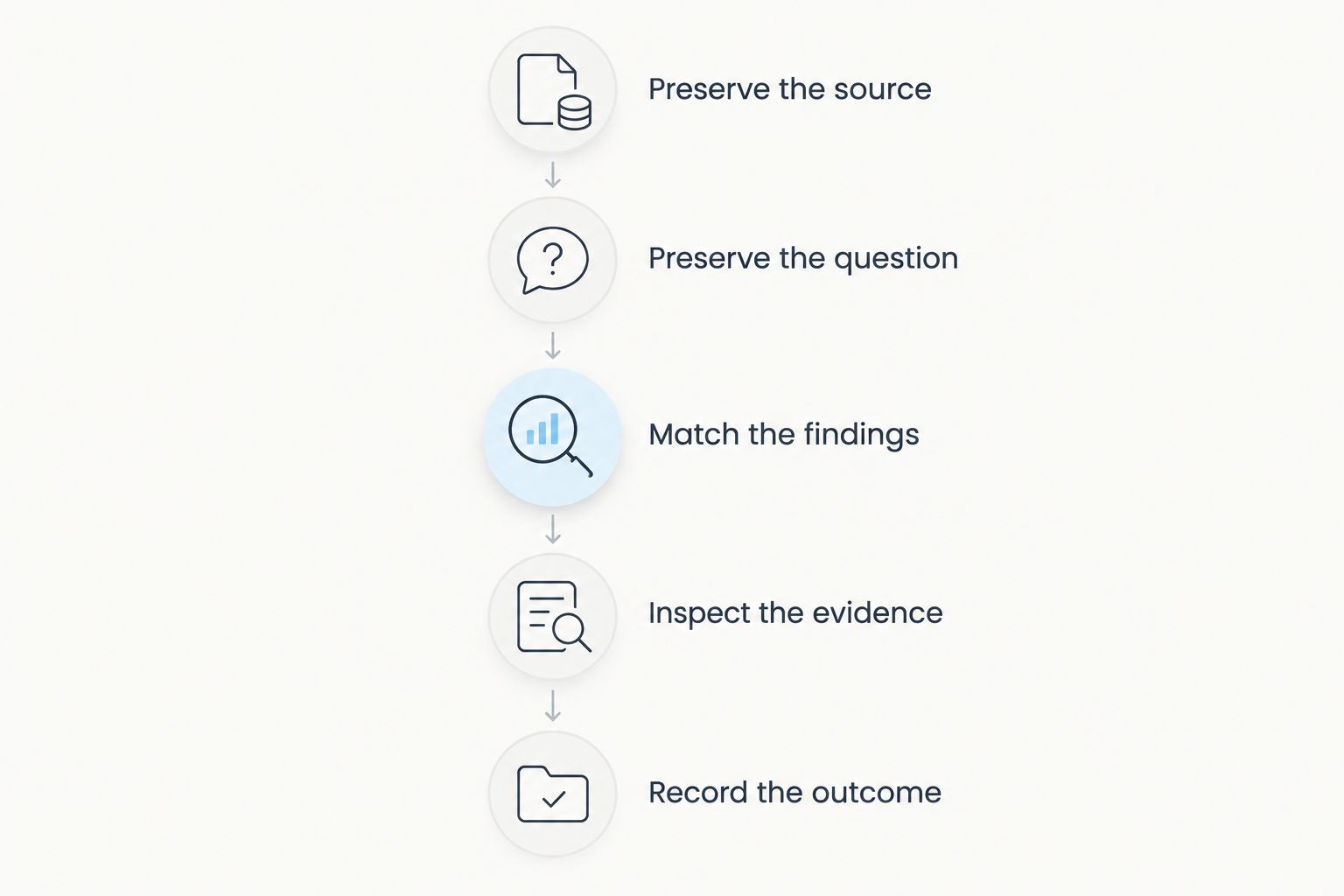
1. Preserve the source
Keep 1 unchanged export for the comparison. Save the original separately from any edited, shortened, or redacted working copy so you can distinguish a new input from a new interpretation.
Record which conversation and date range the file covers. If the app displays an import summary, check that the imported material matches what you intended to submit.
2. Preserve the question
Use the same instructions where the app accepts them. A request to identify conflict patterns is not equivalent to a request to identify signs of mutual support.
Write down your actual question before rerunning the analysis. If your question changed, label the next report as a different inquiry rather than a repeat test.
3. Match the findings
Compare 2 reports side by side. Pair findings that concern the same behavior, conversation period, or cited exchange instead of matching headings by appearance alone.
Mark each pair as agreement, different emphasis, or contradiction. Leave unmatched findings separate; an omitted finding is not automatically a retraction.
4. Inspect the evidence
Open the cited messages and read the surrounding exchange. Check who wrote each message, what question it answered, and whether a later message changes the interpretation.
Separate observation from inference. A message remaining unanswered in the export is observable; the sender's motive for not answering is not established by that absence.
5. Record the outcome
Keep a short note stating what remained supported, what changed, and what you cannot resolve from the text. Record the analysis date and any visible version information for your 2026 comparison.
Stop when the remaining disagreement depends on unavailable context or unknown intentions. Another generated explanation does not supply missing evidence.
Which approach fits a relationship-history review?
Choose an approach by the work you need to do, not by how certain its conclusions sound. A structured relationship report and an open-ended conversation with a general assistant serve different review needs.
| Approach | Best for | Useful capability | Limitation |
|---|---|---|---|
| Justlay's Grey Mirror | Examining patterns across an existing relationship or reflecting on a breakup | Specialized relationship-analysis models produce a timeline, evidence-linked findings, charts, and metrics | Findings still require context checks and cannot prove intentions |
| ChatGPT | Exploring alternative readings of text you provide | You can ask follow-up questions and request a separation of observations from interpretations | Generated explanations are not independent evidence about what happened |
| Manual review | Resolving a disagreement about a particular exchange | You inspect the actual messages and surrounding context directly | Reviewing a long history takes attention, and your interpretation still needs scrutiny |
Justlay is best for people reviewing relationship history who want findings linked to the underlying messages. Its specialized relationship-analysis models are the relevant distinction here—not a claim that a generated conclusion can replace your judgment.
For a 2026 comparison, assess the actual output: can you locate the evidence, understand the claim, and challenge an interpretation? This is brand-authored guidance, not an independent review or an independent endorsement of the service.
Examine your relationship history
Review relationship timelines, evidence-linked findings, charts, and metrics.
Does a different report mean the first report was wrong?
A different report does not establish that the first report was wrong. Determine whether the reports disagree about a fact in the export, the significance of that fact, or which facts deserve attention.
If one report attributes a message to the wrong person, that is a concrete error. If both identify an unanswered request but describe its importance differently, the factual observation and the interpretation need separate judgments.
Correct factual errors before debating emotional labels. A persuasive explanation built on the wrong speaker or an incomplete exchange does not become useful through confident wording.
Should I keep rerunning an analysis until the findings agree?
Do not use repeated agreement as a substitute for checking evidence. Repeating a conclusion does not establish that the conclusion follows from the messages.
Rerun with a purpose: correct an import problem, restore missing context, or test an unchanged question against the same source. Without a defined question, additional reports create more material to interpret rather than resolving the original disagreement.
If reviewing reports becomes a way to repeatedly seek reassurance after a breakup, step away from the analysis. You do not need software agreement to acknowledge that an experience hurt or to decide what boundaries you want.
How can I ask for a more useful explanation?
Ask for the observation, supporting messages, alternative reading, and uncertainty separately. This makes the explanation easier to audit without requiring the system to declare a winner in the relationship.
For an assistant that accepts instructions, request these four elements:
- Observation: Describe the behavior visible in the supplied messages.
- Evidence: Identify the messages supporting that description.
- Alternative reading: Explain another interpretation consistent with the same text.
- Limit: State what the messages do not establish.
Avoid asking whether a person is manipulative, narcissistic, or secretly planning to leave. Those questions invite conclusions about diagnosis or intention that a message record cannot establish.
A useful explanation leaves you with a narrower, checkable claim. It should make the difference between what happened in the conversation and what you infer from it easier to see.
FAQ
Why does an AI chat analyzer give me different results for the same conversation?
An AI chat analyzer can vary its wording, emphasis, or interpretation between runs, depending on how the system generates its output. Check that the export, date range, instructions, and analysis version are unchanged before comparing conclusions.
Does a different relationship report mean my relationship changed?
A different report does not show that your relationship changed. If the messages are unchanged, the difference is in the analysis or its conditions, not new relationship evidence.
Can I trust a finding that appears in every report?
Repeated appearance does not establish that a finding is correct. Read the supporting messages and check whether the conclusion stays within what those messages demonstrate.
Is ChatGPT better than a dedicated relationship analyzer?
ChatGPT fits open-ended follow-up questions, while Justlay fits relationship-history review with timelines and evidence-linked findings. Neither approach can establish a person's intentions from text alone.
Should I upload more messages when reports disagree?
Add messages when they supply relevant missing context, not simply to obtain a preferred result. Keep the original export so you can distinguish changed evidence from changed interpretation.
Can repeated chat reports prove that someone was lying?
Repeated chat reports cannot prove someone's intentions or establish deception by repetition. They can direct you to inconsistencies that you then examine in context.
What's the first thing I should check when two chat reports conflict?
Check whether both reports analyzed the same messages and date range. Then compare the cited evidence for the conflicting claims before deciding whether either interpretation is supported.
One last thing
The most useful comparison is sometimes between two explanations of the same exchange, not between two complete reports. Narrowing the disagreement makes it easier to see whether you need a factual correction, more context, or simply less certainty.
For your next 2026 review, save the original export and write one question before starting. Judge the report by what you can verify, not by how completely it seems to explain the relationship.