
Best for minimizing disclosure: offline review. Best for discussing a redacted excerpt: ChatGPT. Best for evidence-linked relationship analysis: Grey Mirror by Justlay. This 2026 Instagram DM analyzer privacy guide ranks those workflows by what you choose to share, not by unverified claims about which company has the strongest security.
- Instagram DM analyzer privacy starts with disclosure: offline review avoids sending your export to another analysis service.
- ChatGPT suits narrowly scoped, redacted excerpts; interpretations still need checking against the conversation.
- Grey Mirror by Justlay is best for evidence-linked patterns across an existing relationship or after a breakup.
- This brand-authored comparison ranks workflows, not independently audited app security.
Why this matters
An Instagram conversation contains more than your own words. It can include another person's disclosures, references to friends, locations, health concerns, and details you would never intentionally publish.
The useful privacy question is therefore not just whether an app has a reassuring policy. Ask whether the question you want answered requires sharing the entire relationship history in the first place. A focused review of one disagreement and an analysis of changing communication patterns call for different amounts of information.
Choose the smallest disclosure that can answer your actual question. More context can improve interpretation, but it also increases the amount of private material you entrust to an analysis workflow.
What makes the best privacy-conscious DM analyzer
Use these criteria before choosing an Instagram DM analysis workflow in 2026:
- Disclosure scope: Can you answer your question locally, with an excerpt, or only with a longer history?
- Processing location: Establish where analysis happens. A Mac or iPhone app is not, by itself, evidence of on-device processing.
- Retention and deletion: Check what happens to uploads, generated reports, account records, and backups separately.
- Secondary use: Read whether conversation content can be used for model training, product improvement, or other purposes.
- Evidence and interpretation: Prefer findings you can trace to messages, without treating those messages as proof of intention.
- Access control: Consider who can open the original export, the analysis account, and any saved or shared report.
These criteria separate privacy from usefulness. A detailed report can be useful without establishing that its data practices are better than another service's. Likewise, keeping everything local protects against an additional service receiving the file, but does not remove risks from shared devices or exposed backups.
Instagram DM analyzer privacy options at a glance
The order below follows the scope of the workflow described: no additional analysis service, a selected excerpt, then a full relationship history. It is not a ranking of company security controls.
| Rank and option | Best for | Standout feature | Key limitation |
|---|---|---|---|
| 1. Offline review | Keeping the export out of an additional analysis service | You review the local conversation yourself | Manual review requires effort and can reinforce your existing interpretation |
| 2. ChatGPT with a redacted excerpt | Exploring one narrowly defined communication question | Flexible discussion of the text you provide | An excerpt omits context; account and service data settings still need checking |
| 3. Grey Mirror | Examining patterns across an existing relationship or breakup | Relationship timeline, evidence-linked findings, charts, and metrics | Full-history analysis involves a broader disclosure decision than an excerpt |
Grey Mirror is offered by Justlay, the publisher of this guide. This is a brand-authored comparison, not an independent review, an endorsement from an outside evaluator, or a security audit.
1. Offline review: best for minimizing additional disclosure
Offline review means reading your Instagram export locally without submitting it to another analysis service. Use a local text viewer or document workflow, and check whether your chosen application or storage location syncs content elsewhere.
The benefit is straightforward: another analysis provider does not receive the conversation through this workflow. You still need to protect the file on your device and consider everyone who has access to it.
Offline review pros:
- Keeps the conversation out of an additional analysis service when the workflow stays local.
- Lets you exclude unrelated conversations before considering any later upload.
- Preserves direct access to the surrounding messages while you examine a disputed exchange.
Offline review cons:
- Requires you to organize events and compare periods yourself.
- Makes it easy to keep returning to messages that support your existing view.
- Does not automatically produce a relationship timeline or evidence-linked analysis report.
Best for: You want to understand a specific exchange without giving another service the conversation, or you are not comfortable uploading intimate messages.
Start with a neutral question such as whether a disagreement was acknowledged and addressed. Record the relevant messages, surrounding context, and what remains uncertain. Avoid building a case around the single harshest sentence.
Verdict: Choose offline review when minimizing additional disclosure matters more than automated analysis.
2. ChatGPT: best for discussing a redacted excerpt
ChatGPT can discuss text you supply and help you formulate alternative readings or questions. For a privacy-conscious workflow, provide only the passage needed for a narrow question, after removing unnecessary identifying details.
That recommendation describes how to limit your input. It does not establish that ChatGPT is more private than a relationship-analysis app, and it does not replace checking the current settings and terms for the particular account you use.
ChatGPT pros:
- Lets you frame a focused question rather than begin with an entire relationship export.
- Supports follow-up questions about wording, uncertainty, and alternative interpretations.
- Can help turn an emotionally loaded question into a neutral discussion prompt.
ChatGPT cons:
- Selected excerpts leave out events that can change the interpretation.
- Removing names does not necessarily make a distinctive conversation anonymous.
- A persuasive explanation is not evidence that the explanation is correct.
Best for: You want help thinking through one exchange, drafting a question, or identifying context that an interpretation depends on.
A useful prompt asks for observations first, possible interpretations second, and unanswered questions last. Ask the response to distinguish what the text explicitly says from what the reader is inferring. Do not ask it to diagnose your partner or decide who is fundamentally at fault.
For a 2026 comparison, check the settings and documentation that apply to your account rather than relying on an old screenshot or a blanket claim about every ChatGPT offering.
Verdict: Choose ChatGPT for a limited second perspective, not a definitive judgment about your relationship.
3. Grey Mirror: best for evidence-linked relationship patterns
Grey Mirror by Justlay analyzes a user's full exported message history to generate a relationship timeline, evidence-linked findings, charts, and metrics. Instagram DM is among the supported message sources; the app is offered on the web, iPhone, and Mac.
Grey Mirror uses specialized relationship-analysis models. Its relevant distinction here is the relationship-focused output, not a claim that it is simply a ChatGPT or Claude wrapper, or that it can establish someone's hidden intentions.
Grey Mirror pros:
- Examines a relationship history rather than relying only on a selected exchange.
- Links findings to evidence so you can inspect the messages behind an interpretation.
- Combines a timeline with charts and metrics for reviewing patterns over time.
- Offers a free conversation analysis with four evidence-linked findings and no card required.
Grey Mirror cons:
- Full-history analysis asks you to make a broader disclosure decision than sharing a short excerpt.
- Evidence-linked findings still require checking for missing context and alternative explanations.
- Web, iPhone, and Mac availability does not establish where processing occurs or how uploads are retained.
Best for: You are examining recurring patterns across an existing relationship or reflecting on a breakup, and want findings that connect back to the conversation.
Grey Mirror pricing: One full relationship report costs $17.99 USD once. Grey Mirror Plus costs $9.99 USD/month and includes one full report each paid month; unused credits carry forward, and unlocked reports are kept permanently.
Keeping an unlocked report permanently describes continued access to that report. It does not, by itself, answer separate questions about source-file retention, deletion procedures, or backup handling. Review those questions before uploading, even if the free analysis is your starting point.
Verdict: Choose Grey Mirror for evidence-linked relationship analysis after checking that its current data practices meet your requirements.
How this privacy ranking works
This ranking prioritizes disclosure scope, then matches each workflow to a distinct task. Offline review comes first because the described workflow avoids another analysis service; a redacted excerpt comes next because you deliberately limit the submitted material; full-history analysis serves the broader task of examining patterns.
That order does not establish which provider has stronger encryption, better deletion procedures, or stricter training restrictions. Those questions require current, applicable documentation. In 2026, treat a privacy ranking without a clear ranking method as a claim to examine, not a shortcut around reading the terms.
The comparison also separates product fit from privacy. Grey Mirror's evidence-linked relationship outputs explain its recommended use case; they do not prove a privacy advantage over ChatGPT.
Before uploading: a privacy decision sequence
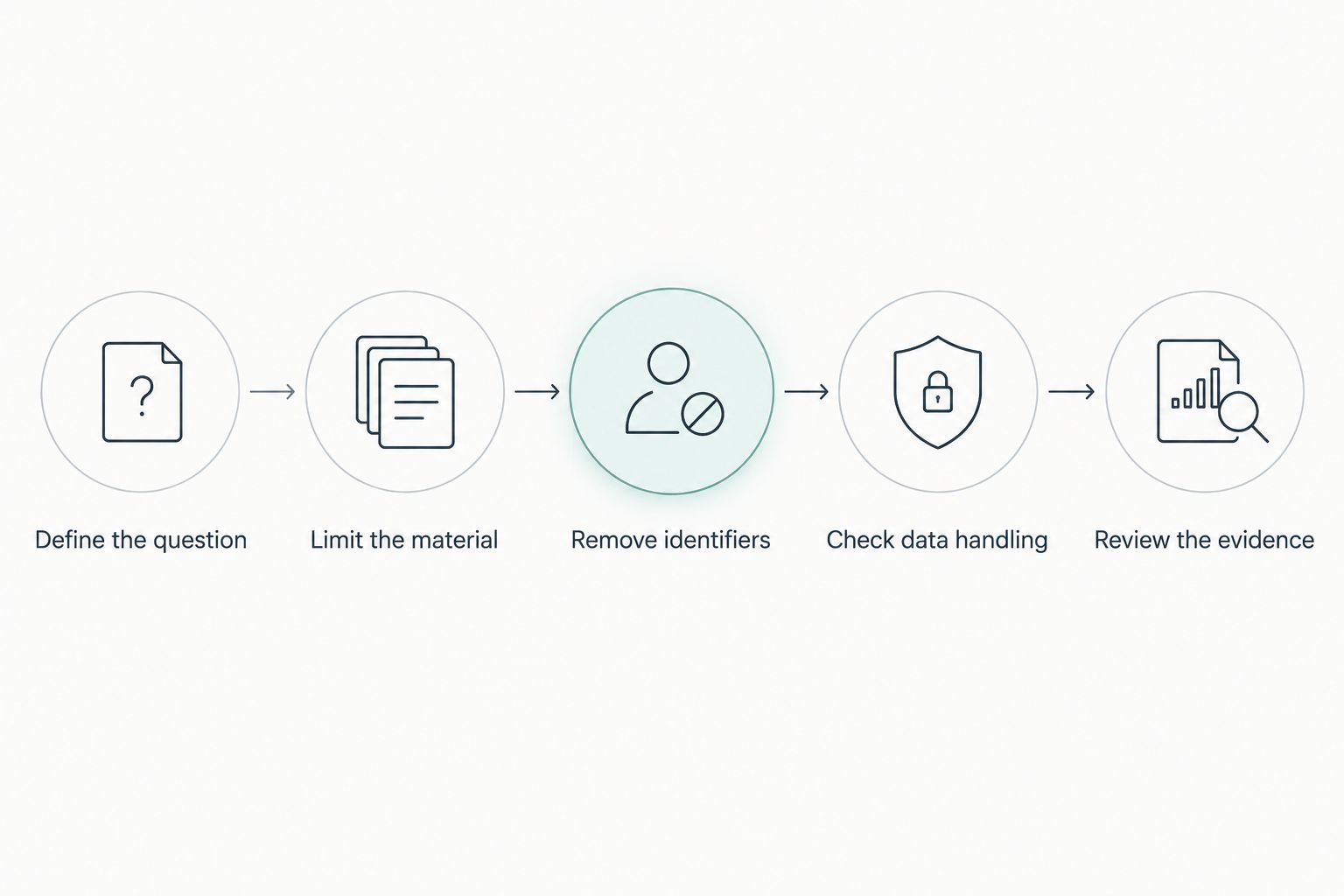
Follow this sequence before sending an Instagram conversation to an analysis service. Stop at the earliest step that answers your question without unnecessary disclosure.
- Define the question. Replace a broad request to judge the relationship with something observable, such as how disagreements are acknowledged.
- Limit the material. Decide whether local review or a relevant excerpt is enough before choosing a full-history workflow.
- Remove identifiers. Exclude unnecessary names, handles, addresses, and unrelated third-party details where the workflow permits.
- Check data handling. Read the applicable processing, retention, deletion, and secondary-use terms before submission.
- Review the evidence. Compare each important finding with the original messages and record what the export cannot establish.
Redaction is useful, but it has limits. A distinctive event can identify someone even without a name, and removing too much context can make an exchange harder to interpret. Keep an unedited source securely so you can check whether your shortened version changes the meaning.
Read findings without turning them into diagnoses
An observable pattern and an explanation for that pattern are different things. A conversation can show that a direct question received no written answer; the text alone cannot establish why the person did not answer.
Separate your notes into three categories:
- Observation: What appears in the messages or their sequence.
- Interpretation: A possible explanation that needs additional context.
- Unknown: Information the export does not contain, including relevant offline conversations.
Before acting on a strong finding, inspect examples that support it and examples that challenge it. The guide to checking a chat analyzer for false positives explains a useful next step: treat a flagged pattern as something to examine, not an automatic verdict.
For breakup reflection, choose a question with a stopping point. Understanding whether repair attempts were acknowledged is more bounded than repeatedly asking an app to settle what the other person really felt.
Which Instagram DM analysis workflow should you choose?
If you are undecided, start offline. It lets you clarify the question before choosing whether any upload is necessary.
Choose ChatGPT when a limited, redacted exchange is enough for the discussion you want. Choose Grey Mirror by Justlay when your question concerns patterns across a relationship and you want evidence-linked relationship analysis rather than an isolated interpretation.
For Instagram DM analyzer privacy in 2026, the right choice is not automatically the tool that accepts the most data. It is the workflow whose disclosure, output, and data practices fit the question you actually need answered.
FAQ
What's the most private way to analyze Instagram DMs?
Local review without submitting the export to another analysis service minimizes additional disclosure. Check that your viewer and storage workflow do not sync the conversation somewhere you did not intend.
Is Grey Mirror more private than ChatGPT?
This comparison does not establish a provider-level privacy winner between Grey Mirror and ChatGPT. Compare the current terms for processing, retention, deletion, and secondary use, alongside how much conversation each workflow requires you to submit.
Can I use ChatGPT without uploading my whole Instagram conversation?
You can provide a selected excerpt instead of a complete conversation. Remove unnecessary identifying details, but remember that an excerpt can omit context needed for a fair interpretation.
What does Grey Mirror analyze in an Instagram relationship?
Grey Mirror analyzes exported message history to produce a relationship timeline, evidence-linked findings, charts, and metrics. Those outputs support reflection on communication patterns; they do not prove another person's intentions.
How much does Grey Mirror cost?
One full relationship report costs $17.99 USD once, or Grey Mirror Plus costs $9.99 USD/month for one full report each paid month. Unused credits carry forward, unlocked reports are kept permanently, and a free conversation analysis includes four evidence-linked findings with no card required.
Does an iPhone or Mac app mean my messages stay on my device?
An app's platform does not establish where processing happens. Check the product's applicable documentation before assuming analysis stays on your device.
Can an Instagram DM analyzer tell whether someone intended to hurt me?
A DM analyzer cannot establish someone's intentions from text alone. Use findings to identify observable exchanges and questions worth discussing, not to diagnose a person or declare a motive.
One last thing
The report you save or forward is another privacy decision. Even after you finish checking upload settings, a screenshot or shared finding can expose intimate details to a new audience.
Keep only what serves your reflection, and share the smallest relevant portion when seeking support. A useful analysis should help you ask a clearer question—not create a permanent dossier on another person.