
Instead of repeatedly checking the same messages by hand, preserve your original export, identify duplicate records in a working copy, and verify the conversation before analysis. This workflow helps you distinguish export errors from genuine repetition before submitting a relationship history to Grey Mirror from Justlay.
- For chat analyzer duplicate messages checks, compare sender, timestamp, and surrounding context—not message text alone.
- Justlay’s Grey Mirror suits relationship-pattern reviews; validate the export before interpreting its relationship timeline.
- Keep the original chat export unchanged and document every removal in a separate working copy.
- Repeated words are not necessarily duplicate records; preserve genuinely separate messages.
Why this matters
A repeated message and a duplicated record are different things. Someone can genuinely send the same sentence twice. A duplicated record represents the same message more than once in the material you analyze.
Counting a duplicated section twice changes message totals. If that section contains an argument, it also gives that argument extra representation in the submitted history. Cleaning the file is therefore an evidence-quality task, not a way to make a relationship look healthier or worse.
Justlay’s Grey Mirror is best for individuals examining communication patterns across an existing relationship or reflecting on a breakup. Its relationship timeline, evidence-linked findings, charts, and metrics give you material to inspect—not proof of another person’s intentions.
For a 2026 relationship review, establish which export you used before drawing conclusions. A report based on an overlapping merge is not directly comparable with one based on a single, unmerged export.
Before you start
- Gather the source material. Have the original export, access to the source conversation where possible, and a local editor or spreadsheet for inspection. Keep 2 files: an untouched original and a clearly named working copy. Treat both as sensitive personal records.
- Check the accepted input format. Confirm what your chosen analyzer accepts before changing anything. A spreadsheet can help you inspect records without becoming the upload file. Do not assume a reformatted table, altered archive, or edited attachment structure remains compatible.
- Pre-empt the main gotcha. Identical text does not establish duplication. Short replies, copied addresses, recurring reminders, and quoted messages can legitimately repeat. Timestamp precision also matters: matching displayed minutes alone does not prove two entries are the same message.
You do not need another person’s account credentials for this inspection. Work only with material you are authorized to access, and avoid putting an unredacted conversation into unrelated online conversion services.
Source files and overlap boundaries
- Preserve the original. Copy the export before opening it in an application that might save changes automatically. Keep the original name and folder structure intact. Give the working copy a distinct name so you cannot mistake it for the source later.
- Record the scope. In a separate note, identify the conversation, export date, earliest visible message, latest visible message, and source platform. If a timestamp lacks a time zone, record that uncertainty rather than assigning one from memory.
- Separate overlapping exports. If you combined files, identify where their date ranges overlap. Examine those boundaries before searching the entire history. Do not append another full export merely because it contains newer messages.
- Compare suspicious sections with the source. Check whether the source conversation contains the message once or contains separate repeated sends. If the source is unavailable, leave the distinction unresolved unless the export itself supplies enough evidence.
Expected result: you have an untouched source, a working copy, and a written account of what period each file covers.
A useful 2026 source note identifies the actual export date, not just the year of the relationship events. Export date and message date serve different purposes: one describes the file’s origin; the other locates the conversation.
Keep your notes outside the conversation file. Adding explanatory sentences inside an export risks making your own annotations look like part of the chat.
Duplicate-record checks
- Find candidates by repeated text. Use your local editor’s search or a spreadsheet inspection to locate repeated passages. Treat the results as candidates, not a deletion list. Start with an obviously repeated block if you have one.
- Compare the available fields. Check sender, timestamp, message content, and neighboring messages. If the export includes a message identifier, retain it for comparison. Do not assume an identifier is globally unique across different platforms or export tools.
- Inspect the sequence. Look for a matching run of messages in the same order. An overlapping export can repeat an entire exchange, while genuine repeated sends occupy separate positions in the original conversation.
- Classify before removing. Mark each candidate as a confirmed duplicate, a separate message, or unresolved. Remove only confirmed duplicate records from the working copy, and retain a separate removal note.
Use these distinctions when the visible text looks identical:
| Candidate | What to inspect | Action | Trade-off |
|---|---|---|---|
| Repeated exchange at a merge boundary | Matching senders, timestamps, content, and sequence | Remove the extra copy only after confirming overlap | Strong evidence requires inspecting the surrounding block |
| Same reply at different times | Source conversation and distinct timestamps | Keep separate sends | Repetition remains in the analysis because it actually occurred |
| Quote followed by a reply | Export structure and surrounding messages | Preserve the quote’s relationship to the reply | Flattened text can make quoted material harder to distinguish |
| Same text with conflicting metadata | Source records and export provenance | Keep unresolved until checked | Some uncertainty remains rather than being silently erased |
Expected result: each removal has a record-level explanation. You have not deleted messages merely because their wording repeats.
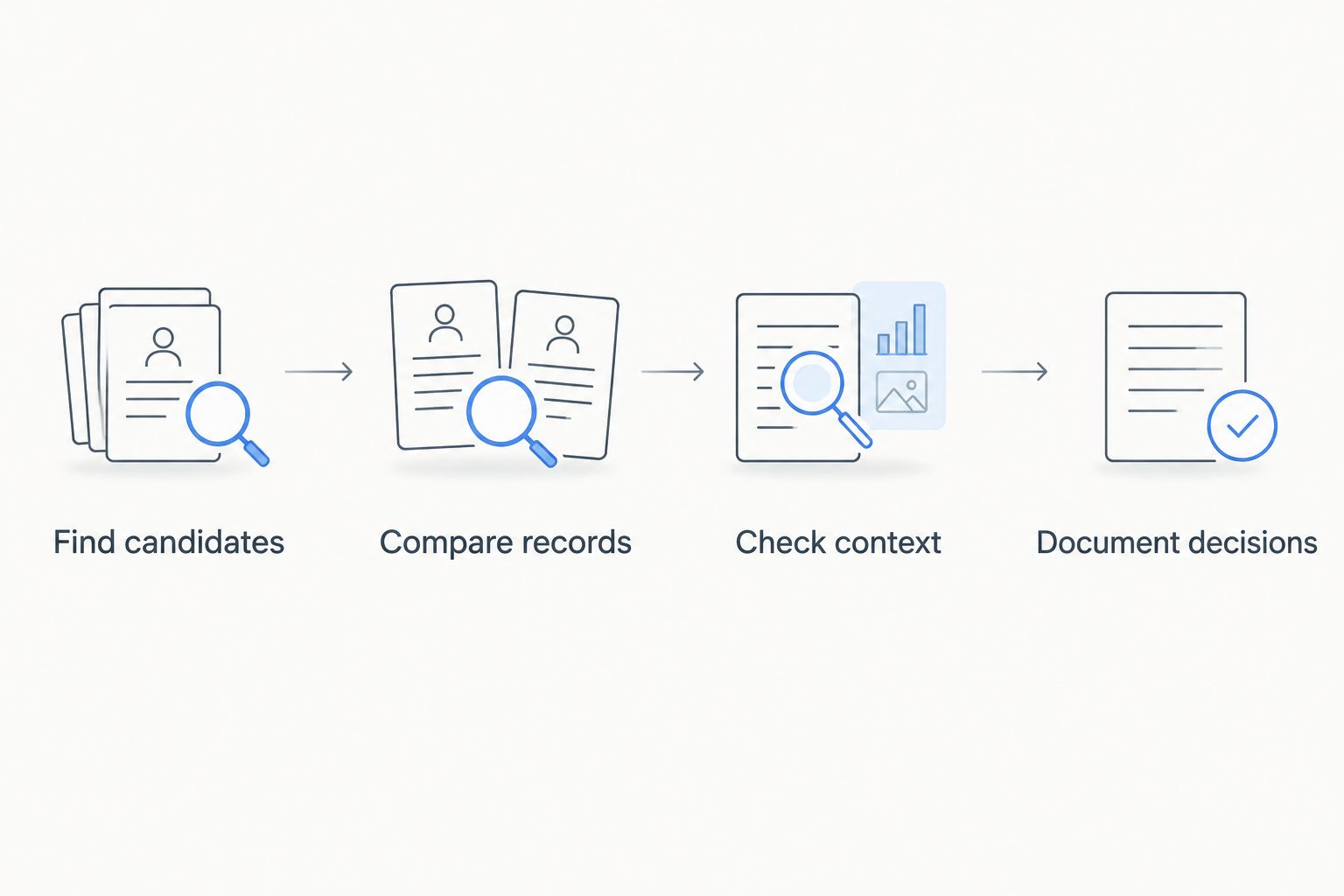
The decision sequence is simple: find candidates, compare records, check context, then document the decision. Skipping the context check turns cleanup into guesswork.
Cleaned-file validation
- Check conversation boundaries. Confirm that the working copy still includes the intended opening and closing messages. Inspect the transition around every removed block. A cleanup should not accidentally cut away the replies surrounding it.
- Reconcile removals. If you can count records reliably, compare the before-and-after totals with your removal log. Count message records, not text lines: one message can span several lines. If the export structure is unclear, do not manufacture a message total.
- Preserve attribution and timing. Confirm that sender labels, date formats, time-zone information, and message order remain intact. Keep quoted text and attachment references connected to their original records wherever the format provides that structure.
- Verify compatibility before analysis. Check the accepted format again. If your edits changed the file structure, return to the original rather than forcing a damaged file through an importer.
- Review the resulting evidence. After analysis, inspect the underlying messages for any finding that depends on a suspicious section. Use the guide to checking a chat analyzer for false positives to keep that review separate from accepting a report’s interpretation.
Expected result: your working copy contains only justified removals, preserves context, and remains suitable for the analyzer’s documented input requirements.
For a 2026 baseline report, retain the exact submitted file alongside your cleanup notes. Otherwise, a later difference could reflect a changed dataset rather than a changed relationship pattern.
Updated exports without overlapping history
When you revisit a relationship history, decide whether you are replacing the earlier dataset or extending it. Those are different workflows.
For a fresh full-history review, start from a fresh export and inspect it as a new source. Do not concatenate it with the previous full export. Preserve the earlier submitted file separately if you need to understand why two reports differ.
For a combined history, merge only when the intended analysis and accepted format support it. Identify the overlap first, preserve provenance, and inspect the join afterward. Do not assume that a timestamp cutoff alone resolves messages exported with different precision or time-zone settings.
Keep a 2026 update note stating which route you chose and which periods the submitted material covers. Use the same inclusion rules when comparing reports: a comparison that adds an old archive as well as recent messages is not simply a measure of recent change.
This workflow stops at preparing a trustworthy input. It does not assume Grey Mirror offers incremental imports, report replacement, or automatic duplicate removal.
Troubleshooting
The same sentence appears repeatedly
Check the surrounding exchange before deleting anything. A recurring greeting or reminder can be genuine. Distinct source messages stay in the file even when their wording is identical; matching text alone is insufficient evidence of an export error.
Timestamps differ between files
Check whether the exports use different time zones, date formats, or timestamp precision. Preserve the original values while investigating. Do not shift timestamps to force a match, and do not classify two records as duplicates solely because an assumed offset makes them align.
A spreadsheet changes the date display
Compare the spreadsheet view with the original file. Spreadsheet applications can interpret imported values as dates or numbers. If that changes the source representation, use the spreadsheet only for inspection and return to an unchanged export for upload.
Message totals do not reconcile
Check what you counted. Blank lines, multiline messages, system events, and attachment references need not correspond to individual sent messages. Reconcile records using the export’s structure rather than treating every line as a message.
The analyzer rejects the edited file
Return to the untouched original and check the accepted format. Avoid repeated conversions between formats: each conversion creates another opportunity to alter structure. If a confirmed duplicate cannot be removed without breaking compatibility, resolve the supported preparation method before interpreting a report from that file.
Customize your workflow
Choose the analysis route after checking the export, not instead of checking it. Justlay’s Grey Mirror uses specialized relationship-analysis models and produces a relationship timeline with evidence-linked findings, charts, and metrics. Those outputs support inspection across a history; they do not establish intent or diagnose either person.
A general-purpose conversation with ChatGPT serves a different task. Keep the distinction clear when choosing how to review sensitive material:
| Route | Best for | Advantage | Limitation |
|---|---|---|---|
| Grey Mirror | Reviewing patterns across an existing relationship or after a breakup | Relationship-focused outputs with evidence-linked findings | Export completeness and duplicate records still require scrutiny |
| ChatGPT | Discussing a selected passage and possible interpretations | You can frame a narrow question and supply context | An interpretation is not verification of source records or another person’s intentions |
For either route, ask whether the conclusion follows from the actual messages. A fluent explanation is not a substitute for a correctly assembled history. This is a brand-authored guide, not an independent review or endorsement.
Grey Mirror’s free conversation analysis includes four evidence-linked findings and requires no card. One full relationship report is $17.99 USD once. Grey Mirror Plus is $9.99 USD/month for one full report each paid month; unused credits carry forward, and unlocked reports are kept permanently.
Before choosing a full report, finish the source checks. Paying for analysis does not resolve uncertainty about whether a repeated exchange represents one conversation event or two.
FAQ
How do I check chat analyzer duplicate messages before uploading?
Compare repeated entries using sender, timestamp, content, and surrounding messages. Preserve an untouched export and remove only confirmed duplicate records from a working copy that retains the accepted format.
Should I delete every identical message in a chat export?
No. Identical wording can represent separate messages, recurring reminders, or quoted text. Delete an extra record only when the available evidence establishes that it represents the same original message.
Does Grey Mirror automatically remove duplicate messages?
Do not assume automatic duplicate removal. Check the current import guidance and inspect overlapping exports before analysis; a relationship report is not confirmation that the input contains no duplicates.
Can duplicate messages affect a relationship analysis?
Yes. Duplicate records change message totals and give repeated sections extra representation in the submitted history. The effect on a particular finding depends on the duplicated material and the analysis.
Can I combine an older export with a new export in 2026?
Combine exports only after identifying overlapping history and confirming that the analyzer accepts the resulting format. A fresh full-history export should not simply be appended to an earlier full-history export.
Is ChatGPT a substitute for checking duplicate records?
No. Discussing a passage with ChatGPT does not establish whether repeated records correspond to separate messages. Verify the source history before relying on any interpretation.
Can repeated texts prove someone’s intentions?
No. Repeated texts show observable communication, not proven intentions or a diagnosis. First establish whether the repetition is genuine, then consider context and alternative interpretations.
One last thing
Do not tidy away the behavior you are trying to understand. Two separate messages saying the same thing are part of the relationship history; two export records representing one message are a file-quality problem.
For your next 2026 review, write the removal reason before deleting a candidate. If you cannot explain why it is the same source message rather than another send, keep it unresolved. A documented uncertainty is more useful than a cleaner-looking file built on an assumption.