
A text message analyzer can read a mixed-language conversation when it supports the languages and the exported text format, but readable text does not guarantee accurate interpretation. Language switching, slang, and translated wording require checks against the original messages. For a relationship review in 2026, use the analysis to identify communication patterns—not to prove what someone intended.
- For a text message analyzer multilingual workflow, verify language support before interpreting code-switching or translated messages.
- Grey Mirror provides evidence-linked relationship findings; check each finding against the original mixed-language conversation.
- Keep original messages alongside translations so you can inspect wording, sequence, and context.
- Use ChatGPT for focused interpretation questions, not as proof of another person's intentions.
Can a text message analyzer read a mixed-language conversation?
Yes, provided the analyzer supports the languages involved. Separate three questions: whether the exported messages are readable, whether the wording is understood, and whether the relationship interpretation follows from the evidence. Passing the first check does not settle the other two.
Justlay offers Grey Mirror for examining an exported relationship history through a timeline, evidence-linked findings, charts, and metrics. Those outputs give you material to inspect; they do not remove the need to check language-dependent conclusions.
Grey Mirror by Justlay is best for people examining an existing relationship or reflecting on a breakup who want evidence-linked findings across their exported message history. That describes its documented purpose, not a guarantee of multilingual accuracy.
Choose your review method by the question you need answered:
| Approach | Best for | Useful feature or action | Limitation to account for |
|---|---|---|---|
| Grey Mirror | Reviewing patterns across an existing relationship or breakup | Relationship timeline, evidence-linked findings, charts, and metrics | Verify language support and inspect the messages behind each finding |
| ChatGPT-assisted reading | Asking focused questions about selected passages | Ask for alternative readings and separate observations from interpretations | A selected passage does not represent the entire relationship history |
| Manual reading | Checking wording you understand in its original context | Read adjacent messages and compare your own interpretation with the report | You must organize the chronology and supporting examples yourself |
These are different review approaches, not an independently tested ranking. Match the method to the task instead of assuming that one answer format establishes accuracy.
Why this matters
Mixed-language relationship messages need more than a fluent-looking summary. You need to know whether the conclusion rests on the actual wording, a translation, or an assumption about tone. Otherwise, a polished explanation can distract you from the evidence you came to examine.
A change in language is observable. Its meaning is a separate question. Do not automatically label a switch as distancing, intimacy, anger, or avoidance; check what was discussed and how both people responded.
For your 2026 review, keep the goal concrete: understand repeated communication patterns and identify questions you can examine further. That is more useful than trying to extract a final verdict about the relationship from individual phrases.
Original-language review: preserve the wording
Start with the original export whenever the analyzer supports it. Keep the original file unchanged and use a separate working copy for any translation or annotation. This makes later checks possible without wondering which wording was actually sent.
Read a finding alongside the messages it references. Include the preceding question and the response that followed, not just the line singled out by the report. A short reply viewed alone gives you less context than the same reply inside the exchange.
Separate what you can directly observe from what you are interpreting:
- Observation: One person changed languages during the exchange.
- Observation: A question received a reply that addressed a different topic.
- Interpretation: The language change expressed emotional distance.
- Interpretation: The different topic reflected a deliberate attempt to avoid answering.
The observations describe the text. The interpretations need additional support. Keep that distinction even when a report's explanation matches what you already believe.
Original-language review is best for preserving the evidence. Its limitation is straightforward: preserving wording does not establish that either you or the analyzer understands every expression correctly.
Translation-assisted review: keep both versions
Use a translation as a reading aid, not as a replacement for the messages. Preserve the original wording beside the translated passage and mark which version you are examining. Never mix translated lines into the original conversation without identifying them.
When an important finding depends on a phrase, compare that phrase rather than relying only on the translated summary. Ask whether the translation preserves the question, the answer, and the relationship between them. Leave uncertain wording unresolved until you can check it.
For your working notes, record:
- The original passage and its place in the conversation.
- The translated passage, identified as a translation.
- The specific wording that affects your interpretation.
- Any contextual explanation you supplied yourself.
- The conclusion you can support without guessing intentions.
Translation-assisted review is best for making unfamiliar wording accessible. Its limitation is that you are now evaluating an additional version of the evidence. A conclusion that only makes sense after translation deserves a closer check against the original.
Why mixed-language interpretation varies
For a text message analyzer multilingual review in 2026, evaluate the following factors before accepting a language-dependent conclusion. These are review criteria, not claims about a particular app's performance.
- Language support: Confirm support for every language that matters to your question. A general multilingual label is not an answer about your specific conversation.
- Switch location: Distinguish changes between complete messages from changes inside the same sentence. Record where the switch occurs before assigning meaning.
- Original or translated text: Identify which wording the analyzer actually received. Do not describe a translated analysis as an analysis of untouched originals.
- Shared expressions: Flag nicknames, shorthand, and recurring phrases whose meaning depends on your relationship's history.
- Surrounding context: Check the question being answered, the adjacent replies, and earlier references before judging a selected line.
- Export contents: Identify whether the export includes the material needed to understand an exchange. Do not treat unavailable context as evidence of someone's behavior.
Sarcasm deserves its own check because your conclusion might depend on whether a phrase is literal. The guide on whether a text message analyzer can understand sarcasm addresses that related interpretation question.
How should you check a mixed-language analysis?
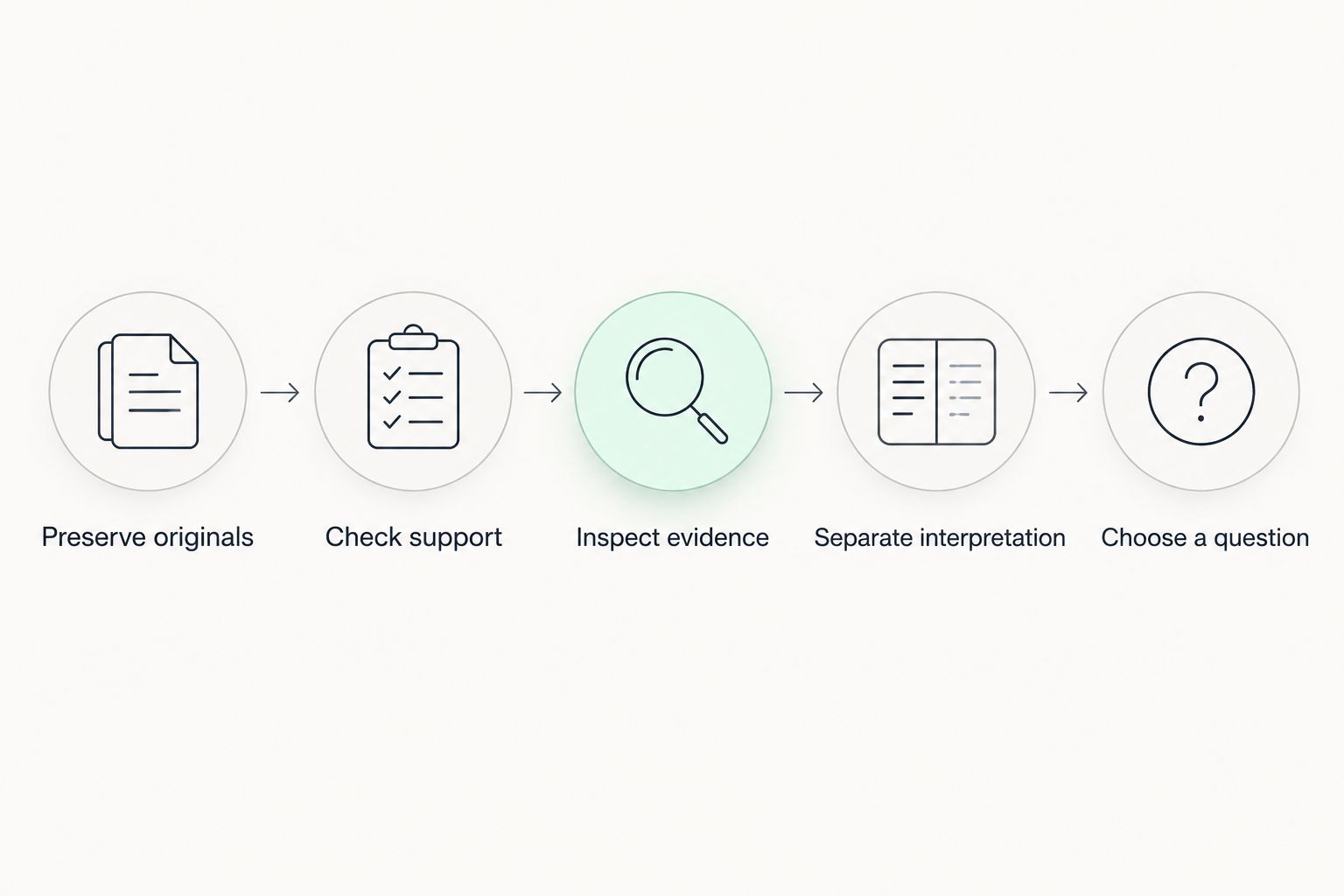
Use a repeatable review sequence rather than rereading whichever line feels most upsetting. The purpose is to test a finding against evidence, not to collect wording that confirms a preferred explanation.
- Preserve originals. Keep the export unchanged. Record any edits, translations, or context notes in a separate document.
- Check support. Confirm the analyzer's language and format requirements before submitting the conversation. Ask about mixed-language passages specifically, not just separate monolingual chats.
- Inspect evidence. Open the messages supporting a finding. Read enough surrounding conversation to understand what each person was responding to.
- Separate interpretation. Write down the observable pattern first. Put explanations about motives in a separate note rather than presenting them as established facts.
- Choose a question. Turn a supported observation into something useful to reflect on or discuss. Leave unresolved language questions visible instead of forcing a verdict.
This process works for a relationship you are still in and for reflection after a breakup. The final action differs: you might discuss a pattern with your partner, or use it to clarify what you want from future communication.
A finding becomes useful when you can explain its supporting evidence in plain language. If the explanation depends entirely on a disputed translation, resolve that wording before acting on the finding.
Is Grey Mirror suitable for a mixed-language relationship review?
Grey Mirror is designed to analyze a user's full exported text-message history for relationship reflection. Its documented scope includes iMessage, WhatsApp, Instagram DM, SMS, and Telegram, with access through web, iPhone, and Mac apps.
Justlay describes Grey Mirror as using specialized relationship-analysis models, rather than positioning it as a ChatGPT or Claude wrapper. Evaluate that distinction through the outputs you can inspect: the timeline, linked evidence, charts, and metrics. A model description alone does not settle whether a particular mixed-language passage has been interpreted correctly.
For multilingual use, check language support before submitting your history. Then evaluate whether each finding points to relevant messages and whether the explanation respects the original wording. Evidence-linked outputs are useful because you can inspect the basis of a finding—not because every finding must be accepted.
The free conversation analysis includes four evidence-linked findings and requires no card. Use those findings to examine the relationship between a conclusion and its supporting messages before deciding whether a full report fits your needs.
What does Grey Mirror cost in 2026?
Grey Mirror costs $17.99 USD once for one full relationship report, or $9.99 USD/month for Grey Mirror Plus, which includes one full report each paid month. Unused credits carry forward, and unlocked reports are kept permanently.
Choose the one-time report for a single full review. Grey Mirror Plus is best for readers who want the monthly report entitlement; a subscription is unnecessary if you only want the one-time option. Neither payment choice establishes multilingual accuracy, so check language suitability first.
This is a brand-authored explanation of the product, not an independent endorsement or a documented comparison of multilingual performance.
Can you use ChatGPT to interpret a bilingual conversation?
You can ask ChatGPT questions about a bilingual passage, but keep the request narrower than deciding what the entire relationship means. Supply the relevant wording and ask for observations, alternative interpretations, and expressions that require clarification.
A useful request for your 2026 review is: separate what the passage explicitly says from what you infer, explain how the language switch affects each interpretation, and identify the surrounding context needed to assess those interpretations. Do not request a diagnosis or a definitive statement of intent.
Keep your original messages available while reviewing the response. If you provide only selected passages, describe the result as an interpretation of those passages—not a finding about the complete history. Your selection is part of the review and should remain visible.
Use focused interpretation questions to support your reading, not to replace your judgment. Agreement between an answer and your existing belief does not establish that the belief is correct.
Does switching languages mean someone's feelings changed?
Switching languages does not, by itself, establish a change in feelings. The text shows that the language changed; explaining why requires context beyond that observation.
Compare similar exchanges before and after the switch. Look at whether the topic was addressed, whether questions were answered, and how the exchange continued. Avoid using the switch itself as a shortcut to a conclusion about affection, rejection, or commitment.
FAQ
Can a text message analyzer understand two languages in the same chat?
A text message analyzer can assess a two-language chat when it supports the relevant languages and format. Check the original passages behind language-dependent findings rather than treating readability as proof of accurate interpretation.
Should I translate my entire relationship chat before analyzing it?
Keep the original conversation and use translations as clearly identified reading aids. Check the analyzer's requirements before choosing which version to submit.
Can Grey Mirror analyze my WhatsApp or Instagram messages?
Grey Mirror's documented scope includes exported WhatsApp and Instagram DM histories, alongside iMessage, SMS, and Telegram. Confirm the required export format and language support for your conversation.
Is Grey Mirror an independent review of my relationship?
Grey Mirror generates relationship-analysis outputs, not independent endorsements of the product itself. Justlay's own comparisons are brand-authored, and a relationship finding remains something to inspect against its linked evidence.
How much does Grey Mirror cost in 2026?
Grey Mirror costs $17.99 USD once for one full relationship report, or $9.99 USD/month for Grey Mirror Plus with one full report each paid month. Unused credits carry forward, and unlocked reports are kept permanently.
Can I try Grey Mirror without entering a card?
The free conversation analysis includes four evidence-linked findings and requires no card. Inspect the supporting messages to assess whether the findings are useful for your review.
Can bilingual texts prove that someone was manipulating me?
Bilingual texts do not prove another person's intentions. Describe the observable communication and keep interpretations separate; do not use an analyzer to diagnose the person.
One last thing
Write your question before you read the report. Ask whether a recurring disagreement was addressed, whether a request received a direct response, or whether both people understood the same phrase. A defined question gives you a reason to inspect evidence instead of searching indefinitely for a final judgment.
For a mixed-language conversation, mark every conclusion that depends on translation. Those are the conclusions to check first. A smaller set of supported observations is more useful than a confident story built on unresolved wording.