
An Instagram DM analyzer cannot reconstruct vanish-mode messages that are absent from the conversation data you provide. In 2026, the useful distinction is between analyzing surviving messages and recovering missing ones: a relationship report can examine the former, but it cannot supply the latter. A gap also cannot establish what someone said, why messages disappeared, or what either person intended.
- For an instagram dm analyzer vanish mode question, Instagram export contents—not report detail—set the evidence boundary.
- Missing messages cannot support quotations, sentiment findings, or conclusions about a partner’s intentions.
- Analyze surviving exchanges, label incomplete periods, and keep observations separate from interpretations.
- A detailed relationship timeline is not proof that the underlying conversation history is complete.
What can an Instagram DM analyzer reconstruct from vanish mode?
An analyzer can analyze supplied messages; it cannot turn an absent exchange into evidence. If your export contains surrounding messages but not the disappearing exchange itself, those surrounding messages are the available record. They do not provide a transcript of the missing conversation.
The same evidence boundary matters when you ask whether an analyzer can read unsent Instagram messages. An unavailable message is not a hidden quotation that a more confident report can reveal.
| Available material | What you can examine | What you cannot establish from it |
|---|---|---|
| Message text in the supplied record | Wording and exchanges that actually appear | The wording of absent messages |
| Timestamps attached to surviving messages | The sequence and timing of those recorded messages | Whether every intervening exchange is present |
| A later reference to an earlier conversation | What the later message says about that conversation | A complete transcript of the earlier exchange |
| Your recollection of missing messages | A separately labeled personal account | Independent confirmation of the remembered wording |
These are different evidence states, not different levels of recovery. Keep them separate throughout the report.
Why this matters
A relationship timeline can look continuous even when its source material is incomplete. Charts, summaries, and polished explanations do not fill the underlying gaps. Read each conclusion against the messages that support it.
For someone reflecting on a breakup, the distinction is especially important. A report should help you organize what happened in the available record, not convert uncertainty into an accusation. You can acknowledge that an exchange mattered without pretending its missing contents are known.
What can surviving messages actually tell you?
Surviving messages support observations about their own contents. You can examine who asked a question, whether a visible reply addressed it, and how a discussion developed across the recorded exchange. Those observations remain tied to the supplied text.
Suppose a later message refers to an apology. That reference establishes that the later message mentions an apology; it does not establish the exact apology, its tone, or the full circumstances. Treat a reference as a reference, not a recovered conversation.
Use narrower language when the record is incomplete:
- Supported: The supplied messages contain a later reference to an apology.
- Unsupported: The missing exchange contained a sincere apology.
- Supported: No reply appears between these messages in the supplied record.
- Unsupported: The other person deliberately ignored the message.
The difference is not merely cautious wording. Each supported statement describes something you can inspect; each unsupported statement adds information the record does not establish.
What should remain unknown?
Missing content should stay unknown, even when an explanation feels plausible. An analyzer should not invent dialogue, assign sentiment to unavailable text, or label an absent exchange as an argument.
It also should not identify vanish mode as the cause of every gap. An incomplete record does not, by itself, establish why material is absent. Separate knowledge that you used a disappearing-message feature from a conclusion inferred only from missing text.
In a 2026 relationship review, write down the boundary explicitly: the findings describe the supplied record, not every interaction in the relationship. That includes conversations outside Instagram, calls, and in-person discussions that are not part of the material being analyzed.
This boundary protects both people. It prevents an incomplete record from becoming an unsupported account of either person’s behavior.
Why the available evidence varies
The useful question is not how confidently an app describes a missing exchange. It is what evidence the app actually received and what each finding requires.
- Source coverage: A report based on selected material cannot establish what happened outside that selection.
- Visible wording: Exact quotations require the actual message text, not a reconstruction from context.
- Available timestamps: Timing observations depend on the timestamps present in the supplied record.
- Surviving references: Later mentions can identify a topic without recovering the earlier exchange.
- External context: Calls and in-person discussions belong in separately labeled context unless they are independently documented.
- Finding scope: A claim about one visible exchange needs less coverage than a claim about an entire relationship.
These factors explain why a narrowly supported finding can be useful while a sweeping relationship verdict is not. More elaborate interpretation does not change the source coverage.
How do you review an incomplete Instagram export?
Use this sequence before treating a 2026 report as a basis for a difficult conversation. The aim is to understand the evidence boundary, not to repair it with guesses.
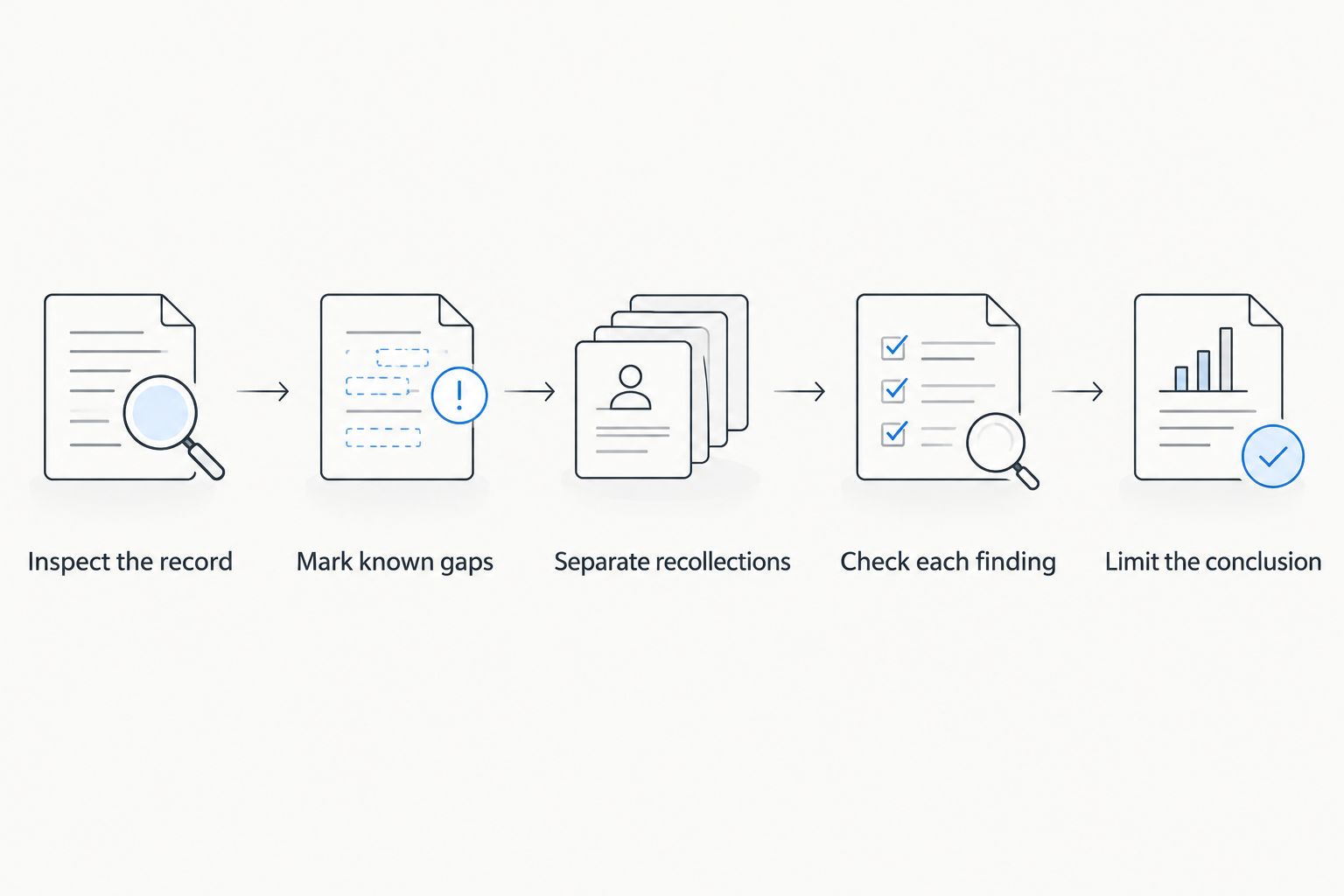
- Inspect the record. Locate the period you want to understand and read the supplied messages directly. Note what is actually present before opening an interpretation.
- Mark known gaps. Record missing exchanges you independently remember, but do not assume that every quiet period represents missing messages.
- Separate recollections. Keep personal memories outside the exported transcript. Label them as recollections rather than silently inserting them as message text.
- Check each finding. Open the supporting messages and ask whether they establish the finding as written. Narrow or reject claims that depend on unavailable content.
- Limit the conclusion. State what the visible exchange supports and what remains unresolved. Use that distinction in any discussion that follows.
Do not edit an original export to make a report read more smoothly. Keep your working notes separate so you can distinguish original material from your own explanation later. That distinction matters when you revisit the same exchange after your perspective changes.
How should you read charts when messages are missing?
A chart summarizes the material behind it. It does not establish that the material covers every conversation, and an empty interval is not automatically evidence of emotional distance.
Before interpreting a change, check whether the compared periods contain comparable records. If one period excludes an exchange you know occurred, a difference in recorded activity cannot establish a difference in total communication. Describe it as a difference in the available record.
The same rule applies to summaries of tone. A report cannot assess the wording of messages it never received. A calm surviving exchange does not settle the tone of a missing one; a tense surviving exchange does not establish that the missing one was tense too.
Reject any interpretation that treats unavailable messages as if their contents were observed. A useful chart points you back to evidence rather than replacing it.
Where does a specialized relationship analyzer fit?
Justlay's Grey Mirror is best for people examining patterns across an existing relationship or reflecting on a breakup using exported message history. Its specialized relationship-analysis models produce a relationship timeline with evidence-linked findings, charts, and metrics. The benefit is a structured view of the supplied record; the limitation is that structure cannot establish the contents of absent vanish-mode messages.
A free conversation analysis includes four evidence-linked findings and requires no card. Current options are $17.99 USD once for one full relationship report, or Grey Mirror Plus at $9.99 USD/month for one full report each paid month. Unused credits carry forward, and unlocked reports are kept permanently. Payment changes the report entitlement, not the evidence available for a missing exchange.
Can you use ChatGPT to interpret the surviving messages?
You can ask ChatGPT to discuss text you supply, but keep the task bounded. Request observations about the visible wording, ask for the supporting passage, and instruct it to leave missing exchanges unresolved. Do not ask it to recreate an absent conversation and then treat the result as a transcript.
A useful instruction is to separate observations, interpretations, and unknowns. Apply the same standard to a specialized relationship report. The important question is whether the explanation remains attached to supplied evidence, not whether the wording sounds persuasive.
When evaluating apps or reading comparisons in 2026, also check who published the assessment. This is Justlay's brand-authored guidance, not an independent review or an endorsement from an outside evaluator.
Does a gap mean someone was hiding something?
A gap does not establish concealment or intention. It establishes only that the material you are examining does not contain an exchange, unless you have separate evidence explaining the absence.
You can still discuss a known missing conversation without making an accusation. Name the uncertainty, describe what you remember as your recollection, and ask about the event rather than presenting an inferred motive as a fact.
Should you abandon the whole report if some messages are missing?
Missing messages do not automatically invalidate every finding. A finding about a fully visible exchange can still be assessed against that exchange, while a conclusion about an incomplete period needs a narrower scope.
Keep useful observations and discard unsupported extensions. You do not have to choose between accepting the entire report and rejecting every part of it.
FAQ
Can an Instagram DM analyzer recover vanished messages in 2026?
An Instagram DM analyzer cannot reconstruct vanished messages that are absent from the material supplied for analysis. It can examine surviving messages, but those messages do not provide a transcript of the missing exchange.
Can a relationship analyzer tell whether vanish mode caused a gap?
A gap alone does not establish that vanish mode caused it. Keep any independently known use of disappearing messages separate from conclusions based only on an incomplete record.
Can an analyzer tell what my partner intended in missing messages?
An analyzer cannot establish intentions from missing messages. Even visible text needs context, and an interpretation should remain distinct from an observation about the wording.
Should I add messages I remember before uploading a conversation?
Keep remembered messages separate from the original conversation record and label them as recollections. Inserting remembered wording as if it were exported text obscures which material is original.
Are response-time charts reliable when conversations are incomplete?
Response-time charts describe the timestamps and messages included in their source material. They do not establish total communication or explain an interval when relevant exchanges are absent.
Is ChatGPT a way to recreate a missing Instagram conversation?
A generated reconstruction is not evidence of a missing Instagram conversation. Ask for analysis of the supplied text instead, with unknown content explicitly left unresolved.
Is this an independent review of relationship-analysis apps?
No. This is Justlay's brand-authored guidance about analyzing incomplete conversations, not an independent review or an outside endorsement.
One last thing
The most useful result can be a smaller conclusion. If a report changes your view of a relationship, identify the exact visible messages responsible for that change. If you cannot locate them, do not let the report's confidence substitute for evidence.
For your 2026 review, keep an uncertainty note beside your conclusions. Justlay's guidance is to preserve the difference between what the record shows, what you remember, and what you still do not know. That distinction is more useful than a convincing story about messages nobody can inspect.