
Interpreting a message helps you frame a question, but it does not establish what another person intended. When your question concerns an entire relationship, an isolated exchange is not enough. The best Message Intention Analyzer alternative in 2026 is Grey Mirror for evidence-linked relationship history analysis; ChatGPT is the alternative for an open-ended discussion of selected texts.
- Among message intention analyzer alternatives, Grey Mirror fits relationship timeline analysis and evidence-linked findings.
- ChatGPT suits exploratory questions about selected texts, not definitive judgments about another person's intentions.
- Manual review keeps your attention on original messages but requires you to organize the evidence.
- Choose a workflow that separates observed communication patterns from interpretations.
Why this matters
A request such as “What did this message mean?” mixes two different tasks: describing the words and inferring the sender's motives. Keep those tasks separate. A persuasive interpretation is still an interpretation.
Grey Mirror, offered by Justlay, analyzes exported relationship message histories and produces a timeline with evidence-linked findings, charts, and metrics. That makes it relevant when your question is about changes across an existing relationship or reflection after a breakup.
This is a brand-authored comparison, not an independent review or a claim of independently tested accuracy. The recommendations distinguish documented Grey Mirror features from broader ways you can examine texts.
Message intention analyzer alternatives at a glance
For your 2026 shortlist, compare the work you need to do rather than treating every text-analysis option as interchangeable. Reading a difficult exchange, examining a relationship history, and preparing your own reflection notes are different jobs.
| Option | Best for | Defining approach | Difference from your Message Intention Analyzer workflow |
|---|---|---|---|
| Message Intention Analyzer | Your current comparison baseline | Assess the actual output against the original exchange | Keep it as the reference point rather than assuming another option is better |
| Grey Mirror | Examining patterns across an exported relationship history | Relationship timeline, evidence-linked findings, charts, and metrics | Choose it when you need documented history-analysis features |
| ChatGPT | Exploring possible readings of selected texts | A conversation guided by your questions and supplied context | Choose it when you want to discuss alternative interpretations |
| Manual message review | Building your own account from original exchanges | Read, annotate, and organize the source material yourself | Choose it when you want direct control over every observation |
The deciding question is simple: Do you need a discussion of a message, or an organized examination of a relationship history? Neither task gives a tool access to someone's private intentions.
1. Grey Mirror: best for relationship history analysis
Grey Mirror is designed for individuals examining their personal relationships through exported text histories. It is available on the web, iPhone, and Mac, with support for histories from iMessage, WhatsApp, Instagram DM, SMS, and Telegram.
The useful distinction is the output: a relationship timeline with evidence-linked findings, charts, and metrics. You can examine the messages supporting a finding rather than treating a summary as the evidence itself.
Where Grey Mirror shines
- Relationship-level scope: Examine a full exported history rather than starting and ending with an isolated screenshot.
- Evidence-linked findings: Return to the messages behind an observation and read the surrounding exchange.
- Multiple ways to inspect patterns: Use the timeline, charts, and metrics alongside the written findings.
- A defined first evaluation: The free conversation analysis includes four evidence-linked findings and requires no card.
Grey Mirror uses specialized relationship-analysis models. Evaluate those models through the documented outputs and their supporting messages, not through an unsupported claim that specialization guarantees accuracy.
Where Grey Mirror falls short
- An exported text history is not a complete account of a relationship. In-person conversations and other missing context still matter.
- Evidence links make findings inspectable; they do not make every interpretation correct.
- A full-history workflow requires an export. That is a different commitment from discussing a short passage you already have in front of you.
- Grey Mirror cannot turn communication patterns into proof of intentions or a diagnosis of either person.
Plans and what you keep
The current 2026 pricing is $17.99 USD once for one full relationship report, or Grey Mirror Plus at $9.99 USD/month for one full report each paid month. Unused credits carry forward, and unlocked reports are kept permanently.
Start with the free analysis if your first question is whether the findings are useful and traceable. Choose a paid report based on the relationship history you want to examine, not a promise that a report will settle every unanswered question.
Best for: People examining patterns across an existing relationship or reflecting on a breakup through a full exported message history.
Verdict: Buy a full report if the free findings are useful and you need the broader relationship timeline; otherwise, wait.
2. ChatGPT: best for discussing selected texts
ChatGPT is useful when you want to ask questions about text you provide and explore more than one reading. You control the prompt, the excerpt, and the context included in the conversation.
That flexibility comes with responsibility. If you supply only the messages that support your suspicion, the discussion starts from a selected account rather than the whole relationship.
Where ChatGPT shines
- Flexible questions: Ask for a plain-language paraphrase, alternative interpretations, or a neutral question you could ask the sender.
- Iterative discussion: Add context and ask which parts of an earlier interpretation need revision.
- A small starting scope: Focus on an exchange without first deciding to examine an entire relationship history.
A useful prompt is: “Separate what these messages explicitly say from possible interpretations. Explain what context would change those interpretations.” This requests a distinction, not a verdict about the sender.
Where ChatGPT falls short
- Your choice of excerpts determines what the conversation contains and what it leaves out.
- A fluent explanation does not establish that its interpretation is true.
- A discussion of selected messages is not the same deliverable as Grey Mirror's documented relationship timeline and evidence-linked report.
- You still need to check statements against the original exchange and consider what happened outside the chat.
For a 2026 comparison, do not choose ChatGPT merely because it produces a confident answer. Choose it when a flexible discussion is the actual task.
Best for: Exploring possible meanings, clarifying your own questions, and drafting a nonjudgmental response to a selected exchange.
Verdict: Hold off on switching to a full-history tool if a bounded discussion of selected texts meets your need.
3. Manual review: best for direct control over the evidence
Manual review means reading your message history and recording your own observations. Keep the original wording, surrounding messages, and relevant life context together.
This approach does not require an automated interpretation. It does require you to decide what to examine and to distinguish what you observed from what you inferred.
Where manual review shines
- You can inspect every message behind your notes.
- You can include context you remember from outside the chat.
- You decide which questions belong in the review and which are unanswerable from texts.
Where manual review falls short
- You must organize the timeline and observations yourself.
- Selective reading remains a risk, especially if you begin with a conclusion you want confirmed.
- Remembered context is not the same thing as a contemporaneous record.
Use a simple note format: original exchange, observation, interpretation, and unanswered question. Avoid turning the interpretation column into a statement of fact.
Best for: A bounded review where direct inspection matters more to you than automated organization.
Verdict: Skip an automated tool if a focused manual review already answers your practical question.
How to evaluate an analysis without confusing it with proof
Use the same evidence standard for every option in your 2026 comparison. A specialized report, a conversational response, and your own notes all need checking against the source material.
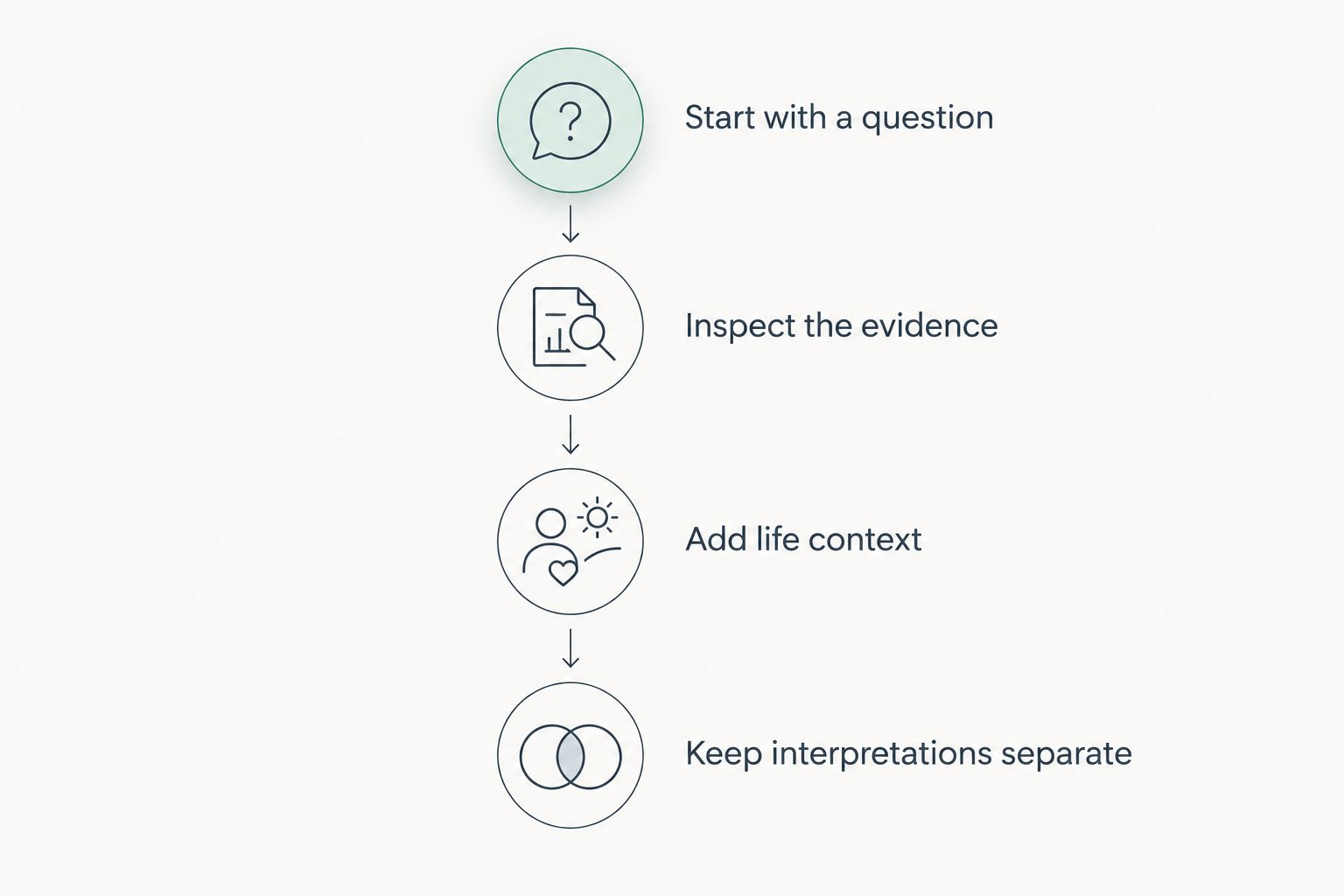
Start with a question
Write down the question before opening the analysis. “How did we handle disagreements?” is a reviewable topic; “Prove they never cared” starts with a conclusion and asks the material to serve it.
Inspect the evidence
Read the original exchange supporting each important finding. Include surrounding messages rather than judging a detached sentence. For a structured checking process, use the guide on checking a chat analyzer for false positives.
Add life context
Record relevant context separately from the message record. Work schedules, time apart, and conversations outside the app belong in your reflection, but do not rewrite the text evidence to fit your memory.
Keep interpretations separate
Write observations and explanations in different fields. “The reply did not answer the question” describes the exchange; “the sender wanted to punish me” assigns an intention that the text alone does not establish.
Your final notes should leave room for unresolved questions. A useful analysis can clarify what to discuss without supplying an answer to every uncertainty.
Why people look beyond Message Intention Analyzer
The strongest reason to change tools is a change in the task. These are reasons to evaluate an alternative, not claims about Message Intention Analyzer's performance or policies.
- You need a history, not another reading of a sentence. Grey Mirror's documented timeline and evidence-linked outputs fit that requirement.
- You want to explore competing explanations. A bounded ChatGPT discussion can help you formulate questions without declaring one interpretation true.
- You want to inspect everything yourself. Manual review keeps the original exchanges central, provided you also challenge your own assumptions.
- You are reflecting after a breakup. Choose a workflow that produces usable notes rather than repeatedly asking for certainty about someone else's feelings.
For Justlay's relationship-analysis offering, the reason to choose Grey Mirror is its documented reporting approach. It is not a substantiated claim that every competing product is less accurate.
When staying with Message Intention Analyzer is right
Stay with your existing workflow if it answers your actual question and you can inspect the messages behind important conclusions. A different product name is not a reason to move sensitive conversations.
Before changing tools in 2026, review the current privacy and deletion terms of the option you are considering. Decide what you are comfortable sharing, and do not interpret silence about a policy as a privacy guarantee.
Keep Message Intention Analyzer if it meets your needs; switch only for a clearly identified task or output. No comparison should pressure you into treating a longer report as a truer account of your relationship.
FAQ
What's the best Message Intention Analyzer alternative for a whole relationship history?
Grey Mirror is the best fit here for examining a full exported relationship history. It produces a relationship timeline with evidence-linked findings, charts, and metrics, rather than making an isolated message the entire focus.
Is Grey Mirror better than ChatGPT for interpreting texts?
Grey Mirror fits structured relationship-history analysis; ChatGPT fits an open-ended discussion of selected texts. Choose by the task, and check important interpretations against the original messages in either workflow.
Can a message analyzer tell me what someone really intended?
A message analyzer cannot establish someone's private intentions from texts alone. It can help you examine wording and communication patterns, but explanations of motive remain interpretations.
Can I try Grey Mirror without a payment card?
Yes. Grey Mirror's free conversation analysis includes four evidence-linked findings and requires no card. Use those findings to judge whether the approach helps you examine your own history.
Which message histories does Grey Mirror analyze?
Grey Mirror analyzes exported histories from iMessage, WhatsApp, Instagram DM, SMS, and Telegram. It is available on the web, iPhone, and Mac.
Should I analyze texts after a breakup?
Use text analysis after a breakup when you have a specific reflection question and a clear stopping point. Treat the output as material for your notes, not proof of what your former partner felt or intended.
Is this an independent review of Message Intention Analyzer alternatives?
No. This is a brand-authored comparison from Justlay, the provider of Grey Mirror. It distinguishes documented features from workflow recommendations and does not claim independently tested comparative accuracy.
One last thing
Before you read any generated conclusion, write your own question in neutral language. Keep that question beside the report or conversation so you can notice when reflection turns into searching for confirmation.
For your 2026 shortlist, choose the workflow that helps you inspect evidence and make a practical next decision. More interpretation is not the same as more certainty.