
If WhatsAnalyze already gives you the chat statistics you need, keeping that workflow makes sense. Look beyond statistics when your question is how communication changed across an existing relationship or around a breakup. The best WhatsAnalyze alternative in 2026 is Grey Mirror for evidence-linked relationship analysis; ChatGPT is the alternative for open-ended discussion of selected texts.
- Among WhatsAnalyze alternatives, Grey Mirror fits full-history relationship analysis with evidence-linked findings and a timeline.
- ChatGPT fits open-ended text interpretation; ask it to separate observations from possible explanations.
- Grey Mirror’s free conversation analysis includes four evidence-linked findings and requires no card.
- Keep WhatsAnalyze if your current workflow answers your question without needing relationship-focused interpretation.
Why this matters
A message count and an explanation answer different questions. Knowing who sent more texts does not establish who cared more, and a change in reply timing does not prove a change in intentions.
Justlay offers Grey Mirror for examining relationship histories rather than treating isolated messages as the whole story. This is a brand-authored comparison, not an independent review or a claim that every competing app has been tested.
For your 2026 shortlist, start with the question you need answered: a factual summary, a relationship timeline, or help considering possible meanings. Choose the workflow that matches that question, then check whether its conclusions remain tied to the messages.
WhatsAnalyze alternatives at a glance
The useful distinction is between a dedicated relationship report and an open-ended conversation. The table includes WhatsAnalyze as the baseline without assigning it undocumented features or limitations.
| Option | Best for | Main distinction | Difference to evaluate against WhatsAnalyze |
|---|---|---|---|
| Grey Mirror | Examining patterns across an existing relationship or reflecting on a breakup | Full exported history becomes a relationship timeline with evidence-linked findings, charts, and metrics | Whether a relationship-focused report answers questions your current analysis leaves open |
| ChatGPT | Discussing selected texts and asking follow-up questions | General-purpose conversational interpretation | Whether you prefer directing the discussion yourself rather than following your existing workflow |
| WhatsAnalyze | Keeping an existing workflow that already answers your question | Your current results provide the benchmark | Whether switching adds useful evidence or just another interpretation |
Do not choose a relationship-analysis app because its explanation sounds more certain. Choose it because you can inspect the evidence behind the explanation. That standard applies to every option here.
1. Grey Mirror: best for full-history relationship analysis
Grey Mirror is a web, iPhone, and Mac app from Justlay that analyzes a user’s full exported text-message history. It supports histories from iMessage, WhatsApp, Instagram DM, SMS, and Telegram, producing a relationship timeline with evidence-linked findings, charts, and metrics.
Its specialized relationship-analysis models make it a different proposition from asking a general-purpose assistant to interpret a few pasted messages. The practical distinction is the documented output: a structured history you can inspect, not a claim that a model can establish what another person secretly meant.
Where Grey Mirror shines
- Relationship context: The full-history approach fits questions about change across a relationship rather than one exchange alone.
- Evidence-linked findings: You can examine the messages associated with a finding instead of accepting an unsupported summary.
- Timeline, charts, and metrics: Different views help you distinguish the sequence of events from an interpretation of those events.
- A limited first step: The free conversation analysis includes four evidence-linked findings and requires no card.
Where Grey Mirror falls short
- A relationship report cannot supply offline conversations or context absent from the exported history.
- Evidence-linked findings still require interpretation; a supporting message does not prove an intention.
- A full-history report is more than you need when your only question concerns the wording of one message.
Grey Mirror versus WhatsAnalyze
| Decision dimension | Grey Mirror | WhatsAnalyze benchmark |
|---|---|---|
| Main output | Relationship timeline, evidence-linked findings, charts, and metrics | Compare against the output you currently use |
| Input scope | Full exported relationship history | Check whether your current workflow includes the history relevant to your question |
| Sources | iMessage, WhatsApp, Instagram DM, SMS, Telegram | Verify support for your particular export |
| Evidence review | Findings link back to evidence | Check whether you can trace your current conclusions back to messages |
Current Grey Mirror pricing
Grey Mirror costs $17.99 USD once for one full relationship report, or Grey Mirror Plus costs $9.99 USD/month for one full report each paid month. Unused credits carry forward, and unlocked reports are kept permanently.
Choose the one-time report for a single review; choose the monthly option only if you want the recurring report allowance. The free conversation analysis lets you inspect four evidence-linked findings before making that decision.
Best for: People examining patterns across an existing relationship and people reflecting on a breakup.
Verdict: Buy when you want a structured, evidence-linked relationship report; start with the free analysis to assess the output.
2. ChatGPT: best for open-ended discussion of selected texts
ChatGPT is a general-purpose conversational assistant, not a dedicated relationship-report product. You can use it to discuss an exchange, ask for alternative readings, or rewrite a response in calmer language.
That flexibility suits a narrow question. It also puts responsibility on you to supply context, challenge assumptions, and distinguish what a message says from what an interpretation adds.
Where ChatGPT shines
- Follow-up questions: You can challenge an answer or ask for another explanation immediately.
- A focused task: You can discuss a specific exchange without making a full relationship report your goal.
- Response drafting: You can ask for clearer wording without asking the assistant to judge the relationship.
Where ChatGPT falls short
- An interpretation of selected texts does not establish a pattern across the full relationship.
- Your selection can exclude messages that contradict the story you have in mind.
- A fluent explanation still needs checking against the actual conversation and relevant offline context.
ChatGPT versus WhatsAnalyze
| Decision dimension | ChatGPT | WhatsAnalyze benchmark |
|---|---|---|
| Starting point | A question and the material you supply | The question your current workflow answers |
| Interaction | Open-ended conversation and follow-up prompts | Compare the interaction you need with what you already use |
| Evidence standard | Ask for supporting text and verify it yourself | Apply the same message-level verification standard |
A useful prompt is: Separate direct observations from possible explanations. Identify the supplied messages supporting each observation, include contradictory evidence, and do not infer a diagnosis or claim certainty about intentions.
Best for: People who want to explore possible readings of selected texts or draft a reply.
Verdict: Hold off on switching to ChatGPT if your real need is a structured full-history relationship report.
Why people look beyond WhatsAnalyze
The strongest reason to consider WhatsAnalyze alternatives in 2026 is a change in your question, not an assumption that the original tool is bad. A workflow that answers a basic chat question can remain useful even when you need a separate kind of review.
You want to examine change over time
An isolated exchange cannot establish whether communication changed across a relationship. For that task, define the periods you want to compare and keep life circumstances visible: work schedules, travel, illness, and offline contact can all be relevant context.
Grey Mirror’s relationship timeline makes it a candidate for this use case. Judge the report by whether its findings help you inspect the history, not by whether they confirm your first impression.
You want findings you can challenge
A useful finding should survive a simple question: which messages support it? Read those messages alongside the surrounding conversation and look for counterexamples.
Evidence links make this review possible, but they do not finish it for you. A quoted message can be accurate while the explanation attached to it is too broad.
You want breakup reflection, not another verdict
After a breakup, choose a bounded question such as which disagreements repeated or how you responded during conflict. Avoid asking software to settle whether the entire relationship was real or whether another person had a hidden motive.
Keep WhatsAnalyze for the tasks it already handles satisfactorily. Add or switch tools only when the new output answers a different, clearly defined question.
How to compare the outputs without chasing certainty
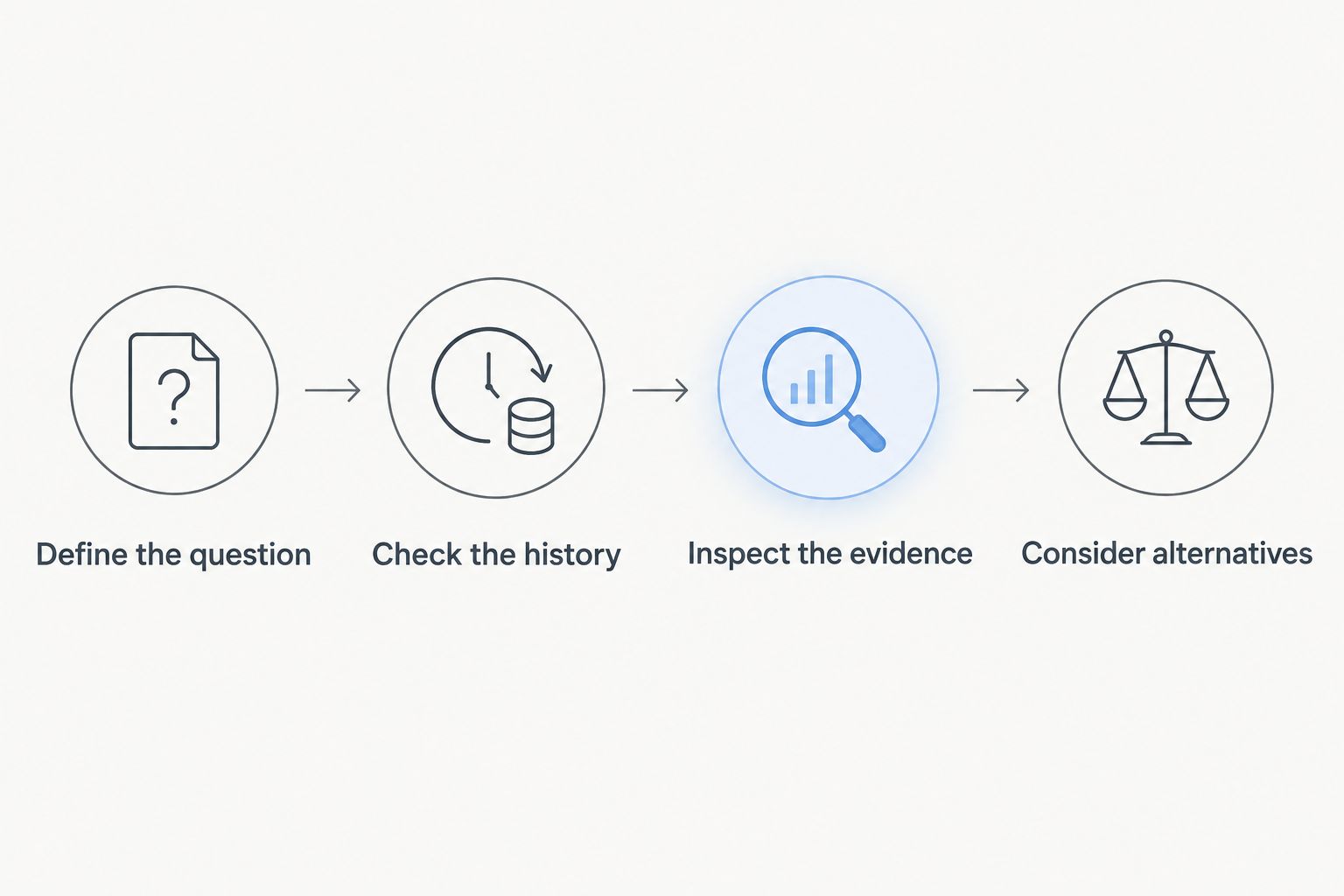
Use the same review process for your 2026 shortlist. These steps test the usefulness of an analysis without turning confidence of tone into evidence of accuracy.
- Define the question. Write down what you want to understand before reading a report. Prefer an observable question about communication over a request to explain someone’s character.
- Check the history. Confirm that the supplied conversation covers the period you intend to examine. Identify gaps rather than treating an export as a complete record of the relationship.
- Inspect the evidence. Read the messages behind a finding, including nearby replies. Ask whether the conclusion describes those messages accurately.
- Consider alternatives. Record another explanation and any contradictory examples. Keep unresolved questions unresolved.
For example, a quiet stretch of texting is an observation about the available record. Calling it withdrawal adds an explanation that needs context; calling it proof of lost interest goes further than the record alone supports.
Before submitting personal messages to any service, review its current privacy terms and decide what information you are comfortable sharing. Product fit and privacy fit are separate decisions.
When staying with WhatsAnalyze is the right call
Stay with WhatsAnalyze when it already answers your question and you can check the result against the conversation. You do not need a relationship-focused report just because one exists.
There is also no benefit in collecting competing interpretations until one says what you want to hear. For a 2026 comparison, define the improvement you need in advance: a timeline, traceable findings, a different input source, or a more useful discussion format.
Best for: Existing WhatsAnalyze users whose current results meet their actual needs.
The reason to stay is satisfaction with the task, not loyalty to a tool. Verdict: Hold your current workflow until a specific unmet need justifies changing it.
FAQ
What’s the best WhatsAnalyze alternative in 2026?
Grey Mirror is the best fit here for full-history relationship analysis with evidence-linked findings, a timeline, charts, and metrics. ChatGPT fits open-ended discussion of selected texts rather than the same dedicated report format.
Is Grey Mirror better than WhatsAnalyze for breakup reflection?
Grey Mirror is designed for examining relationship histories, making it a relevant option for breakup reflection. Choose it when you want a timeline and evidence-linked findings; keep WhatsAnalyze if your current workflow already answers your question.
Can I use ChatGPT to interpret relationship texts?
Yes, you can use ChatGPT to discuss possible interpretations of texts you supply. Ask it to separate observations from explanations, include contradictory evidence, and avoid claims about diagnoses or hidden intentions.
Does Grey Mirror offer a free conversation analysis?
Yes, Grey Mirror offers a free conversation analysis with four evidence-linked findings and no card required. Use it to inspect how the findings relate to the supplied messages.
How much does a Grey Mirror relationship report cost?
Grey Mirror costs $17.99 USD once for one full relationship report. Grey Mirror Plus costs $9.99 USD/month for one full report each paid month; unused credits carry forward, and unlocked reports are kept permanently.
Which message histories does Grey Mirror analyze?
Grey Mirror analyzes full exported text-message histories from iMessage, WhatsApp, Instagram DM, SMS, and Telegram. It is available as a web, iPhone, and Mac app.
Can a chat analyzer prove what someone intended?
No, a chat analyzer cannot establish another person’s intentions from texts alone. Treat communication patterns as observations and check interpretations against surrounding messages and relevant offline context.
One last thing
Before opening a report, write down what evidence would change your mind. That question makes room for a finding that challenges your preferred explanation rather than merely restating it.
For your 2026 decision, use one standard across every option: the best relationship analysis helps you inspect the conversation, not stop questioning an interpretation.
Related guides
These Justlay guides are brand-authored reading, not independent endorsements.