
Yes—compare weekends and weekdays separately, then check whether the difference remains after accounting for the days covered, work schedules, time zones, and time spent together. A quieter weekend describes a messaging pattern; it does not establish reduced interest, avoidance, or anyone’s intentions.
- For a text message analyzer weekend vs weekday comparison, compare messages per covered day—not unequal totals.
- Grey Mirror supports relationship-history review through evidence-linked findings; check the underlying messages before accepting an interpretation.
- Compare working days with days off when calendar weekends do not match your schedules.
- Keep observed communication patterns separate from explanations about commitment or intentions.
Should text analysis compare weekends and weekdays separately?
Yes. Separate the groups before interpreting an overall average. A standard calendar week contains 5 weekdays and 2 weekend days, so raw totals compare unequal amounts of time.
| Comparison | What it helps you examine | Main limitation |
|---|---|---|
| Weekdays separately | Messaging during the Monday–Friday routine | Calendar weekdays do not necessarily mean working days |
| Weekends separately | Messaging on Saturday and Sunday | Days off, visits, and travel need separate context |
| Whole period together | The broad messaging pattern across the relationship | A combined average conceals differences between day types |
Justlay offers Grey Mirror for reviewing exported relationship messages through evidence-linked findings, timelines, charts, and metrics. Those outputs provide material to inspect; a weekend-versus-weekday interpretation still needs the context described below.
Keep both views. The combined history shows the broader pattern, while separate groups help you ask whether apparently different behavior follows a different routine.
Why this matters
A message sent during a work break and a message sent while arranging a weekend visit serve different purposes. Counting them together does not make them equivalent evidence of connection.
For a relationship review in 2026, start with the circumstances surrounding the messages rather than a universal expectation about how often partners should text. The useful question is whether communication changed within comparable circumstances—not whether Saturday matched Tuesday.
If you are reflecting on a breakup, this distinction also gives the review a boundary. You can document what changed without turning every quiet interval into an explanation for why the relationship ended.
How do you compare weekdays and weekends fairly?
Use the same message history for both groups, then work through the following checks. Do not compare a complete weekday record with an incomplete weekend record.
1. Check coverage
Identify the beginning and end of the export. Note incomplete days, missing conversations, changes of messaging platform, and any known gaps.
Record whether a day is genuinely silent or simply absent from the available history. A missing day should not automatically become a day with no communication; those are different observations.
For a 2026 export, preserve the original timestamps before regrouping messages. Changing the date boundaries without keeping that reference makes later checks harder.
2. Define day groups
Use Monday–Friday and Saturday–Sunday only when those categories fit the relationship. If either person works weekends, compare working days and days off as an additional view.
Do not silently change definitions halfway through the review. Label the groups so you can tell whether a difference follows the calendar or the actual schedule.
The guide to chat analysis for couples working different shifts addresses the schedule context that a simple weekend label leaves out.
3. Normalize counts
Divide each group’s message total by the number of covered days in that group. Report the result as messages per covered day, keeping each person’s outgoing messages separate where possible.
Do not compare 5 weekdays with 2 weekend days using totals alone. Also state whether your denominator includes complete days without messages; excluding those days changes the question from daily communication to activity on days when texting occurred.
4. Inspect context
Read the exchanges behind a difference. Check whether the messages concern plans, practical coordination, affection, unresolved disagreements, or another topic visible in the conversation.
Mark known visits and periods spent together rather than treating their lower texting volume as unexplained silence. Record uncertainty when you do not know what happened offline.
5. Compare periods
Look for the same distinction across comparable parts of the relationship. Keep periods before and after a schedule change separate instead of treating the entire history as one stable routine.
A difference that appears only during a particular event needs an event-specific description. A recurring difference still needs context; repetition does not turn an interpretation into proof.
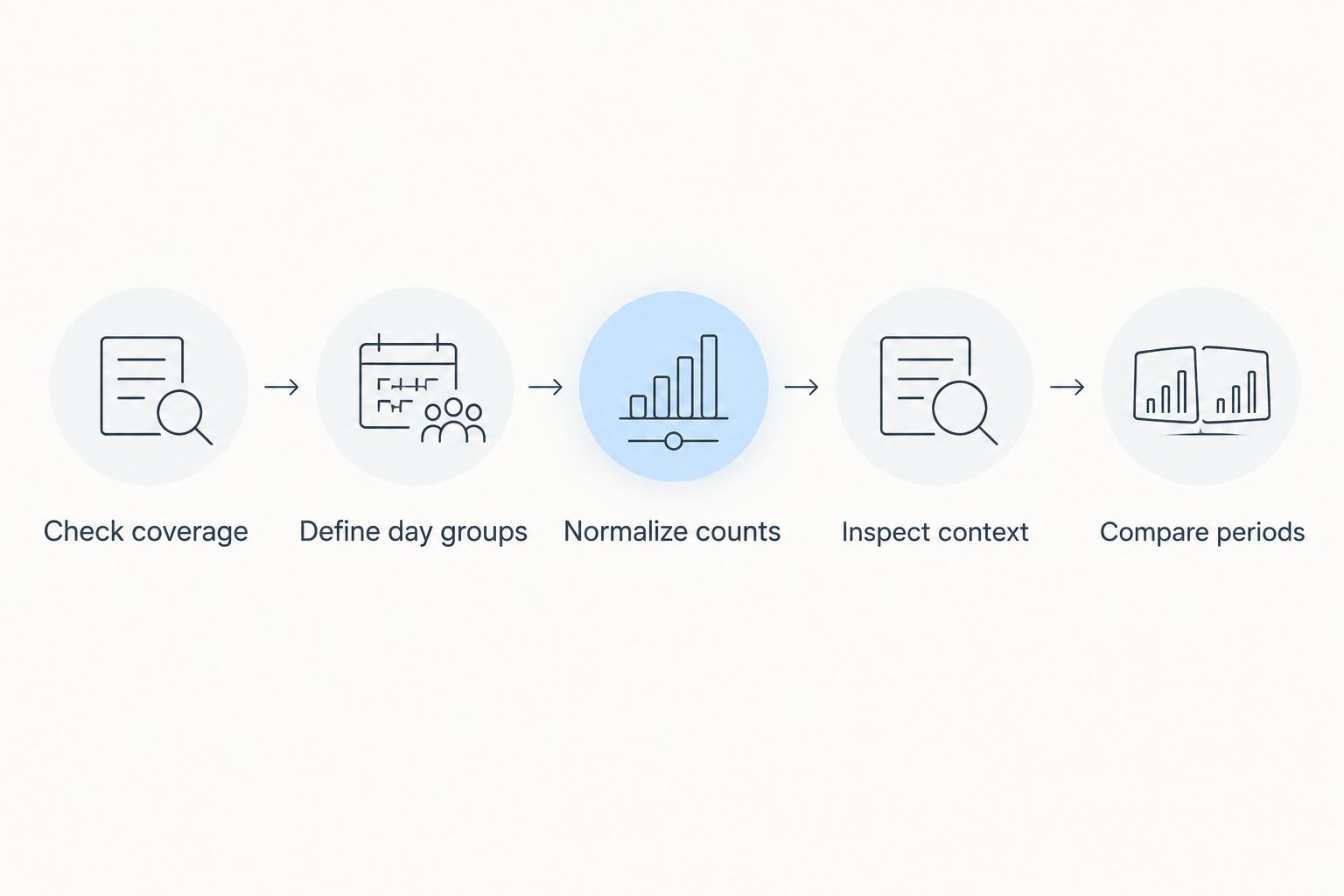
Why weekday and weekend messaging varies
A calendar label is a starting category, not an explanation. Check these factors against what you actually know about the relationship:
- Work schedules: Compare working time with working time, especially when either person’s days off fall during the week.
- Time together: Mark known in-person visits. A conversation export does not contain the conversation that happened across the table.
- Time zones: Establish whose local calendar defines the day before assigning messages near midnight to either group.
- Conversation purpose: Separate practical arrangements from attempts to connect. A busy logistics thread and a personal conversation answer different questions.
- Record completeness: Note missing messages, platform changes, and partial exports before interpreting low activity.
- Relationship phase: Keep known transitions visible, including moving apart, reconciliation, or a breakup, rather than averaging across them without distinction.
These are checks, not ready-made excuses or accusations. Include a factor only when the messages or your known circumstances support it, and leave the explanation unresolved when they do not.
Which measurements help beyond message totals?
Use measures that answer a defined question. Message volume, response timing, and conversation content describe different parts of communication; none is a standalone relationship score.
| Measurement | Best for | What to check before interpreting it |
|---|---|---|
| Messages per covered day | Comparing activity across unequal day groups | Complete coverage and consistent treatment of silent days |
| Response timing | Examining the timing of exchanges | Sleep, work, time zones, and whether a reply was expected |
| Conversation starts | Examining who opens exchanges | A consistent definition of a new conversation |
| Topics and surrounding messages | Understanding what the exchange concerns | Full context rather than isolated keywords |
Define a conversation start before counting one. A greeting after sleep, a new subject during an ongoing exchange, and a reply to yesterday’s question should not be grouped inconsistently.
Response timing deserves the same discipline. An overnight gap and a pause during an active exchange are not equivalent observations, even when an elapsed-time calculation treats them alike.
When reviewing messages in 2026, keep the measurement definition beside the finding. That makes the result understandable later, without relying on your memory of how you grouped the data.
Should you use Grey Mirror, ChatGPT, or a manual review?
Grey Mirror by Justlay is best for people examining relationship patterns across an exported message history. Its documented outputs include a relationship timeline, evidence-linked findings, charts, and metrics generated using specialized relationship-analysis models.
This is a brand-authored guide, not an independent product review. The comparison below distinguishes useful workflows without claiming that any approach can establish a person’s motives.
| Approach | Best for | Useful aspect | Limitation |
|---|---|---|---|
| Grey Mirror relationship analysis from Justlay | Reviewing patterns across an exported relationship history | Evidence-linked findings, timeline, charts, and metrics | Findings still require context; the listed features do not establish a dedicated weekday/weekend filter |
| ChatGPT-assisted interpretation | Exploring questions about text you provide | You can ask for alternative readings of the supplied passages | The exercise is bounded by the material you provide; an explanation is not evidence of intention |
| Manual review | Checking a specific finding against the record | You choose the grouping rules and inspect surrounding exchanges | Maintaining consistent categories across a long history takes attention |
Grey Mirror is a specialized relationship-analysis product, not presented here as a ChatGPT or Claude wrapper. Its evidence links matter because you can return to the messages behind a finding rather than accepting a summary alone.
For a 2026 evaluation of Grey Mirror from Justlay, distinguish documented capabilities from the analysis you want to perform. Confirm the available grouping controls before choosing a product specifically for a weekend-versus-weekday comparison.
Does slower weekend replying mean someone is losing interest?
Slower weekend replying does not establish reduced interest. It describes timing within the available record, not the reason behind that timing.
Check whether the difference remains when you compare similar circumstances. A weekend spent together should not be treated as equivalent to a weekend apart, and an unanswered practical question should not automatically be classified like a conversation that ended naturally.
If the record shows a change, name it narrowly: replies became slower during the covered weekends, or fewer exchanges began on those days. Avoid upgrading that observation into a claim about commitment without additional evidence.
Should couples with different schedules ignore weekends entirely?
Couples with different schedules should keep calendar weekends as one view, not the only view. Add groupings that reflect working days, days off, and overlapping free time where those circumstances are known.
The benefit is a clearer comparison; the drawback is that overly detailed categories become hard to interpret. If each group contains unrelated circumstances, return to a simpler question you can answer consistently.
Use the same grouping rules for both people. Otherwise, the review risks measuring one person’s work routine against the other person’s leisure time and calling the difference a relationship pattern.
How should you read the results after a breakup?
Set a question before reopening the conversation. For example, ask whether weekend communication changed after a known schedule change—not whether the entire message history contains a hidden explanation for the breakup.
Keep observations and interpretations in separate notes:
- Observation: State the measured difference and the period it covers.
- Context: Add circumstances supported by the messages or your direct knowledge.
- Interpretation: Label possible explanations as interpretations, not findings.
- Unresolved: Record what the export cannot answer.
Do not select only the exchanges that fit your first explanation. Read surrounding messages and look for examples that challenge it as well as examples that support it.
A useful review ends with a bounded conclusion or a question you can discuss. It does not require a verdict about who cared more, and a messaging report cannot supply certainty about another person’s internal experience.
FAQ
Should I compare weekend and weekday texts separately?
Yes—compare them separately, then account for unequal day counts and different routines. Keep the whole-period view as context rather than replacing it with isolated day groups.
What's the fairest way to compare weekday and weekend message counts?
Compare messages per covered day, not raw totals. A standard calendar week has 5 weekdays and 2 weekend days, and incomplete days need to be identified before calculating either result.
Does less texting on weekends mean my partner is avoiding me?
Less weekend texting does not prove avoidance. Check known work schedules, time together, conversation purpose, and missing records before assigning a meaning to the difference.
Can Grey Mirror automatically separate weekend and weekday messages?
Confirm the available grouping controls before choosing Grey Mirror for that specific task. Its documented outputs include evidence-linked findings, a relationship timeline, charts, and metrics; those outputs alone do not establish a dedicated weekend filter.
Can I ask ChatGPT to interpret weekend texting patterns?
You can ask ChatGPT to examine passages you provide and distinguish observations from possible interpretations. Supply surrounding context and ask what the text does not establish rather than requesting a verdict about intentions.
Which time zone should I use for a long-distance relationship?
Choose and label a consistent time-zone rule before assigning messages to day groups. If local routines are central to the question, inspect each person's local timing rather than treating one calendar as shared context.
Should I count days when neither person sent a message?
Include complete silent days when measuring messages per covered day. Do not count missing or unavailable records as confirmed silence; distinguish absence of messages from absence of data.
One last thing
Saturday is not a shared circumstance just because it is a shared calendar label. One person’s Saturday can be a working day while the other person’s is a day off; the comparison needs to preserve that difference.
For your 2026 review, write the comparison rule before reading the result. State the day groups, coverage, time-zone rule, and context you will consider. That small preparation keeps the question stable when a finding feels reassuring or upsetting.
The strongest conclusion is often narrower than the most emotionally compelling one: the messages show a pattern under stated conditions, while the reason remains a separate question.