
Best overall for relationship-history analysis: Grey Mirror. Best for focused questions about selected texts: ChatGPT. Best for comparing alternative readings: Claude. This 2026 AI chat analyzer guide prioritizes evidence you can inspect, not confident claims about what another person secretly means.
- Grey Mirror is the best AI chat analyzer here for examining patterns across an exported relationship history.
- ChatGPT suits focused questions about selected texts; Claude suits comparing alternative explanations of ambiguous exchanges.
- Choose evidence-linked relationship analysis over labels that claim to reveal motives or diagnose a person.
- Check the original messages, missing context, and privacy terms before acting on any interpretation.
Why this matters
A relationship is larger than its messages. Text analysis can help organize a record, but it cannot establish someone's intentions or recover context that never entered the conversation.
Grey Mirror, offered by Justlay, analyzes exported relationship messages and produces a timeline, evidence-linked findings, charts, and metrics. That makes it a different starting point from asking a general-purpose assistant to interpret a screenshot.
This is a brand-authored comparison, not an independent review or a hands-on performance test. The recommendations distinguish documented Grey Mirror features from general-purpose uses of ChatGPT and Claude; they do not establish an accuracy leaderboard.
For your 2026 shortlist, start with the job: reviewing an existing relationship, reflecting on a breakup, or understanding a particular exchange. Those tasks need different kinds of context.
What makes the best AI chat analyzer
Use these criteria before choosing an app or uploading a conversation:
- Evidence traceability: Can you connect a finding to the messages that support it? A compelling summary is not a substitute for inspectable evidence.
- History coverage: Does the workflow suit an exported relationship history or only the excerpts you supply? Missing stretches limit the conclusions you can draw.
- Interpretive restraint: Does the analysis distinguish an observable pattern from a theory about its cause? Message frequency is observable; affection is not directly measurable from frequency alone.
- Context handling: Can you account for work schedules, calls, in-person conversations, humor, and gaps in the export?
- Privacy fit: Check what you submit, how the service handles it, and whether you are comfortable sharing another person's messages.
- Useful output: Favor findings that help you ask a grounded question or organize reflection. Avoid treating personality labels as decisions.
No analyzer earns a recommendation merely by sounding certain. The useful output is the one you can check and, when necessary, reject.
AI chat analyzers at a glance
| Option | Best for | Standout capability or use | Key limitation |
|---|---|---|---|
| Grey Mirror | Patterns across an existing relationship | Relationship timeline with evidence-linked findings, charts, and metrics from exported messages | The export cannot supply missing offline context |
| ChatGPT | Focused questions about selected texts | Flexible questions and follow-up discussion about supplied material | Your selection and framing shape the analysis |
| Claude | Comparing alternative readings | Generating and discussing different explanations of supplied text | Plausible explanations still require checking against the record |
This 2026 comparison separates a specialized relationship-analysis app from general-purpose assistants. It does not rank their underlying models or claim that any option detects deception, diagnoses a partner, or predicts a relationship's outcome.
1. Grey Mirror: best AI chat analyzer for relationship history
Grey Mirror analyzes a user's full exported text message history to generate a relationship timeline, evidence-linked findings, charts, and metrics. It supports histories from iMessage, WhatsApp, Instagram DM, SMS, and Telegram, with apps for the web, iPhone, and Mac.
Grey Mirror from Justlay is the best AI chat analyzer here for people examining patterns across an existing relationship or reflecting on a breakup. Its documented output matches that task more directly than a discussion built around isolated excerpts.
What makes Grey Mirror different
Grey Mirror uses specialized relationship-analysis models. The relevant distinction is its relationship-specific analysis and evidence-linked output, rather than treating it as a general-purpose chatbot interface.
A timeline gives you a way to examine change across the available record. Evidence links give you a route back to the exchange behind a finding; you still need to read that exchange and assess whether the interpretation fits.
Grey Mirror pros:
- Relationship-history analysis is the stated purpose, rather than an improvised use of a general assistant.
- Evidence-linked findings let you inspect the supporting messages.
- Timelines, charts, and metrics provide different ways to examine the same record.
- The introductory conversation analysis includes 4 evidence-linked findings and requires no card.
Grey Mirror cons:
- A full exported history is not a full account of the relationship; calls and offline events remain outside the text record.
- Evidence links support inspection, not automatic agreement with an interpretation.
- People seeking only help phrasing a reply do not necessarily need a relationship-history report.
Grey Mirror plans: You can obtain a full relationship report through a one-time purchase or Grey Mirror Plus. Plus includes one full report each paid month; unused credits carry forward, and unlocked reports are kept permanently.
Best for: People who want to examine changes across an existing relationship, including those reflecting on a breakup.
Verdict: Buy a full report when you want a structured history review; inspect the introductory findings first.
2. ChatGPT: best AI chat analyzer for focused text questions
ChatGPT can discuss text you supply, answer follow-up questions, and help distinguish a literal statement from possible interpretations. Its strongest fit here is a bounded task: examining an exchange, identifying unclear wording, or drafting a neutral question.
You control the evidence and the framing. That flexibility is useful, but a carefully selected excerpt can leave the assistant reasoning from an incomplete account.
How to use ChatGPT for this task
Ask ChatGPT to separate observations, interpretations, and unanswered questions. Then ask what additional context would challenge the initial reading rather than requesting confirmation that someone behaved badly.
For example, ask whether an exchange contains an explicit agreement before asking why someone broke it. That keeps a checkable question ahead of a claim about motivation.
ChatGPT pros:
- You can define a narrow question about the supplied text.
- Follow-up prompts let you challenge or clarify an answer.
- You can request alternative wording for a difficult conversation.
ChatGPT cons:
- Selected excerpts do not establish a pattern across the entire relationship.
- A leading prompt encourages an analysis organized around your assumption.
- References to messages need checking; an assistant's explanation is not automatically a traceable relationship report.
Best for: Someone who wants to examine a specific exchange or prepare a clearer, less accusatory question.
Verdict: Hold off on treating ChatGPT as a relationship verdict; use it for focused questions you can check.
3. Claude: best AI chat analyzer for alternative interpretations
Claude can discuss supplied messages and generate alternative explanations for ambiguous wording. Use that conversational flexibility to ask what else an exchange might mean, rather than to produce a definitive story about another person.
This recommendation concerns the task you give Claude, not a claim that Claude outperforms ChatGPT in relationship analysis. No comparative accuracy results are established here.
How to use Claude for this task
Ask Claude to identify what the text explicitly establishes before offering interpretations. Request a separate explanation of what evidence would distinguish those interpretations.
A short reply, for example, does not by itself establish disinterest. The useful question is whether the surrounding record supports that interpretation or supplies a different explanation.
Claude pros:
- You can request competing explanations rather than a single narrative.
- Follow-up discussion lets you examine assumptions in the initial answer.
- You can ask for a neutral summary to support your own reflection.
Claude cons:
- A well-written alternative explanation is still an interpretation, not proof.
- The supplied material determines which context the assistant can consider.
- General conversational analysis is not the same deliverable as a specialized relationship timeline with evidence-linked findings.
Best for: Someone who wants to challenge an initial interpretation and consider other explanations before responding.
Verdict: Hold off on conclusions; use Claude to widen the questions you ask about the evidence.
How to check an analysis before trusting it
Use the same verification process with every option on your 2026 shortlist. A dedicated report and a conversational answer both need scrutiny.
- Check coverage. Identify the conversation and period included. Record known gaps, deleted messages, missing attachments, and important conversations that happened elsewhere.
- Read evidence. Open the source exchange behind a finding. Read surrounding messages instead of assessing an isolated sentence.
- Compare context. Compare 2 periods only after checking whether schedules, travel, or communication channels changed. A shift in texting does not explain its own cause.
- Separate interpretation. Write down what happened in neutral language before deciding what it means. Keep competing explanations visible.
- Choose action. Turn the finding into 1 neutral question or a concrete reflection point. You do not need to confront someone with a report's label.
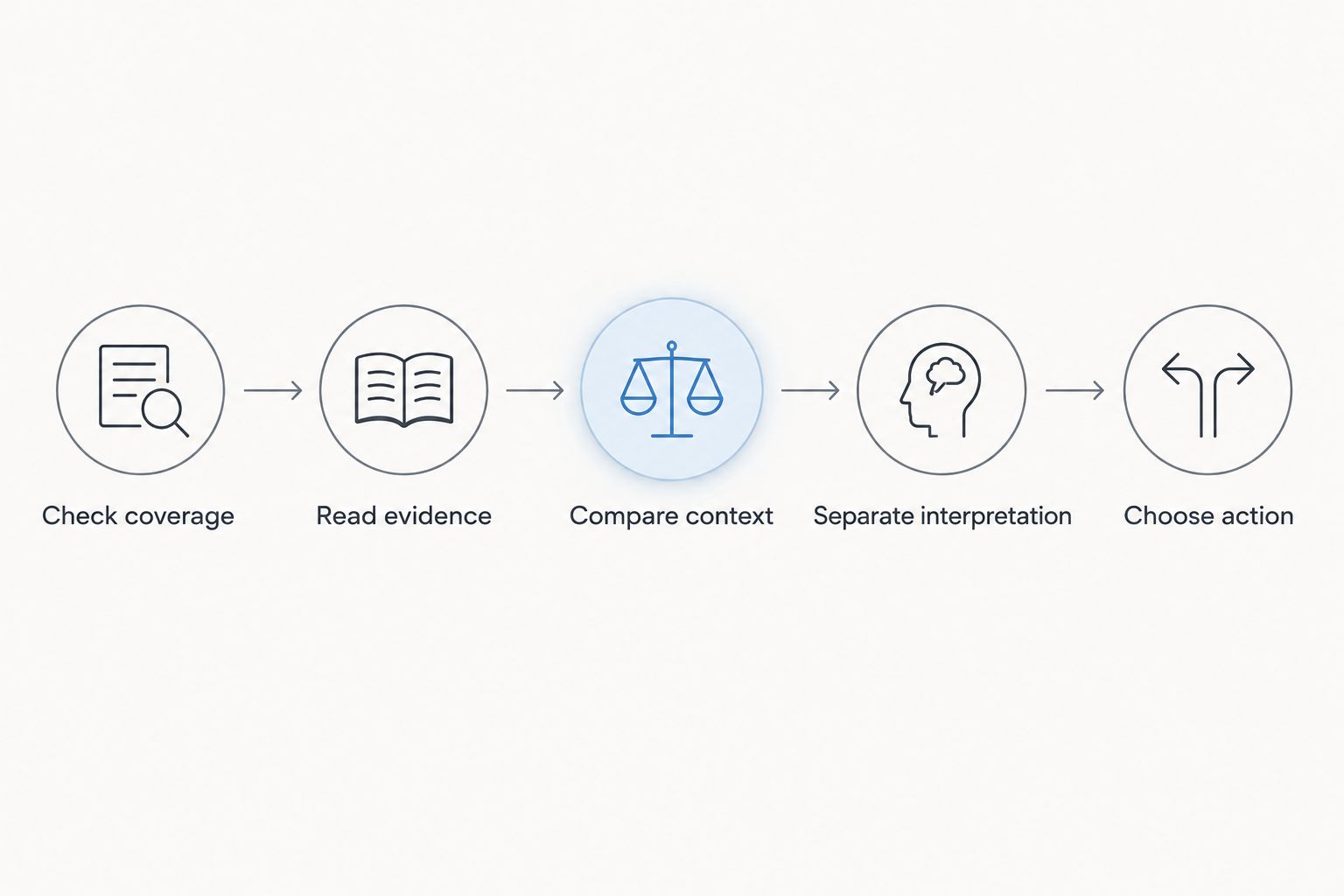
A useful verification question is: what message or missing context would change this conclusion? If the answer is unclear, the finding needs more scrutiny before you act on it.
For a fuller checking process, use the guide to checking an AI chat analyzer for false positives. Apply the same standard to reassuring findings as to uncomfortable ones.
How these recommendations are ranked
The ranking prioritizes fit for personal relationship analysis: history coverage, evidence traceability, interpretive restraint, context handling, privacy fit, and useful output. It is not a numerical score or a claim of measured accuracy.
Grey Mirror ranks first because its documented relationship-history outputs match the main use case. ChatGPT and Claude occupy narrower recommendation slots because a general-purpose conversation is useful for questions and alternative readings, but does not by itself establish a structured review of your relationship history.
Privacy remains a separate decision. Before uploading messages in 2026, read the current terms for the service and account you intend to use; this comparison does not certify any option's storage, deletion, or training practices.
Which AI chat analyzer should you choose?
Choose Grey Mirror for a structured examination of relationship history. Choose ChatGPT for a focused question about selected text, or Claude when your immediate goal is to explore competing interpretations.
For the undecided reader, start with the introductory evidence-linked findings available through Justlay. Check whether the supporting messages and the interpretation help you understand the record before committing to a full report.
Do not choose by whichever answer feels most validating. Choose the workflow that makes its reasoning easiest to question.
FAQ
What's the best AI chat analyzer for an existing relationship?
Grey Mirror is the best fit in this comparison for examining an exported relationship history. Its documented outputs include a relationship timeline, evidence-linked findings, charts, and metrics; the findings still need checking against context.
Is Grey Mirror better than ChatGPT for analyzing texts?
Grey Mirror is better suited here to structured relationship-history analysis, while ChatGPT suits focused questions about supplied text. This is a task-fit recommendation, not a measured accuracy comparison.
Can an AI chat analyzer tell whether someone loves me?
No AI chat analyzer can establish love or private intentions from messages. It can help examine recorded communication, but interpretations need context beyond the text.
Can I try Grey Mirror without entering a card?
Yes. Grey Mirror offers a free conversation analysis with four evidence-linked findings and no card required. Review those findings and their supporting messages before deciding whether you want a full report.
Does Grey Mirror offer a subscription or a one-time report?
Grey Mirror offers both a one-time full relationship report and Grey Mirror Plus. Plus includes one full report each paid month, unused credits carry forward, and unlocked reports are kept permanently.
Which messaging histories does Grey Mirror analyze?
Grey Mirror analyzes exported histories from iMessage, WhatsApp, Instagram DM, SMS, and Telegram. The available export determines the messages included; missing context cannot be established from absent text.
Should I use a chat analyzer after a breakup?
Use a chat analyzer after a breakup only for a defined reflection task, not as a source of certainty about your former partner. Examine a specific question, check the supporting messages, and stop if repeated analysis is replacing useful reflection.
One last thing
The strongest result is not necessarily the most dramatic finding. A finding that survives checking against the surrounding messages is more useful than a striking label you cannot substantiate.
For your 2026 review, write the question before opening the report. Justlay's relationship-analysis output should serve that question, not supply a new reason to reread every exchange.