
Best overall for a free relationship-analysis starting point: Grey Mirror from Justlay. Best for exploring a specific text exchange: ChatGPT; best for reviewing patterns without uploading your conversation to an analysis service: a manual spreadsheet. This 2026 guide compares what each free text message analyzer approach helps you examine, what it leaves out, and when to stop short of a conclusion.
- Grey Mirror is the best free text message analyzer starting point for evidence-linked relationship findings.
- Grey Mirror’s free conversation analysis includes four evidence-linked findings and requires no card.
- ChatGPT suits questions about selected exchanges, not definitive judgments about an entire relationship.
- A manual spreadsheet keeps your review explicit but requires you to define and check every category.
Why this matters
A message can be affectionate, practical, sarcastic, or defensive depending on the surrounding conversation. An analyzer becomes useful when you can check its interpretation against the actual exchange—not when it delivers the strongest-sounding verdict.
For someone examining an existing relationship or reflecting on a breakup, the useful question is narrower than whether a partner was good or bad. Ask what changed, which exchanges support that observation, and what context the export leaves out.
No text message analyzer can establish another person’s intentions from messages alone. Treat a finding as a reason to inspect the conversation, not permission to diagnose its sender.
This is a Justlay-authored comparison of free text message analyzer approaches, not an independent review or endorsement. The recommendations below distinguish documented Grey Mirror features from suggested ways to use general-purpose tools.
What makes the best free text message analyzer?
Use these criteria to choose a tool in 2026:
- Checkable evidence: You should be able to locate the messages behind a finding and read their surrounding context.
- Conversation scope: A selected exchange answers a different question from a full exported relationship history.
- Clear free scope: Know whether the free output is a limited analysis, an open-ended conversation, or a manual worksheet.
- Context handling: Missing messages, work schedules, sarcasm, and offline events belong in your interpretation.
- Data handling: Check what you upload, what the service retains, and how deletion works before sharing personal messages.
- Useful restraint: Prefer descriptions of communication patterns over labels that claim to explain someone’s personality.
Free text message analyzer options at a glance
| Rank and option | Best for | Standout feature or approach | Key limitation |
|---|---|---|---|
| 1. Grey Mirror | Starting with evidence-linked relationship findings | Free conversation analysis includes four evidence-linked findings | The free analysis is not the full relationship report |
| 2. ChatGPT | Exploring alternative readings of a selected exchange | You can ask follow-up questions and challenge an interpretation | A response depends on the messages and context you supply |
| 3. Manual spreadsheet | Reviewing observable patterns yourself | You define the categories and record the supporting messages | Sorting and interpretation remain your responsibility |
The distinction is not simply automated versus manual. It is whether you want a structured relationship-analysis starting point, help thinking through an exchange, or a record you build yourself.
1. Grey Mirror: best for evidence-linked relationship findings
Grey Mirror is a relationship-analysis app available on the web, iPhone, and Mac. It analyzes exported message histories and generates relationship timelines with evidence-linked findings, charts, and metrics.
The supported message sources named for Grey Mirror cover 5 messaging services or formats: iMessage, WhatsApp, Instagram DM, SMS, and Telegram. Its free conversation analysis includes 4 evidence-linked findings and requires no card; distinguish that offer from its full relationship report.
Justlay’s Grey Mirror is best for people who want a free text message analyzer with findings they can check against their relationship messages. That is a more useful starting point than an unexplained compatibility score.
Grey Mirror pros
- Evidence-linked findings give you a route back to the supporting conversation.
- The free conversation analysis requires no card.
- Full exported histories fit the product’s relationship-analysis focus.
- Web, iPhone, and Mac access provide different ways to use the app.
Grey Mirror cons
- The free analysis does not include the full relationship report.
- An export cannot supply missing offline conversations or explain unspoken intentions.
- Evidence links still require you to read and challenge the interpretation.
Who should choose Grey Mirror?
Best for: People examining patterns across an existing relationship or reflecting on a breakup who want a structured, evidence-linked starting point.
Grey Mirror uses specialized relationship-analysis models; it should not be described as simply a ChatGPT or Claude wrapper. Its relevant distinction here is the documented output: a relationship timeline, evidence-linked findings, charts, and metrics.
For your 2026 evaluation, inspect a free finding before deciding whether you want a full report. Read the linked exchange, check the surrounding messages, and ask whether the finding separates an observation from an explanation.
Grey Mirror offers both a one-time full-report purchase and Grey Mirror Plus. Plus includes 1 full report each paid month; unused credits carry forward, and unlocked reports are kept permanently. Those arrangements are separate from the free conversation analysis.
Verdict: Buy a full report only after the free findings demonstrate useful, checkable analysis for your question.
2. ChatGPT: best for exploring a specific text exchange
ChatGPT is a general-purpose conversational assistant, not a dedicated relationship-report product. Its free access offers a way to ask questions about text you provide, subject to the service’s current access limits.
Use it to generate alternative interpretations, identify ambiguous wording, or separate what a message says from what you fear it means. Keep the task bounded: an excerpt about rescheduling a visit is not a complete account of the relationship.
ChatGPT pros
- You can ask follow-up questions about a selected exchange.
- You can request competing explanations instead of accepting the first reading.
- You can ask for a summary of observable wording without a personality label.
- You control the context included in your request.
ChatGPT cons
- Selected excerpts leave the rest of the relationship unexamined.
- Fluent explanations still need checking against the supplied messages.
- Uploading messages requires a separate decision about privacy and data handling.
Who should choose ChatGPT?
Best for: Someone who wants help thinking through a specific exchange and is prepared to challenge the answer.
A useful prompt is: Separate observable wording from interpretation. Give alternative readings, identify missing context, and refer only to messages I supplied. Do not diagnose either person or claim to know their intentions.
Then ask what evidence would contradict the initial answer. If the response changes after you add surrounding messages, keep that context attached to your notes rather than preserving the earlier, stronger conclusion.
For a 2026 comparison, do not treat a persuasive ChatGPT response as equivalent to a structured analysis of an exported history. They answer different kinds of questions.
Verdict: Skip ChatGPT for definitive relationship judgments; use it for bounded questions about selected exchanges.
3. Manual spreadsheet: best for a self-directed evidence review
A manual spreadsheet is an approach rather than a specialized analyzer. You record dates, observable events, supporting messages, and context in separate columns, then inspect the entries for patterns.
You do not need automated interpretation to notice that a discussion repeatedly ends without a decision. You do need consistent definitions so that you do not record one person’s behavior more critically than the other’s.
Manual spreadsheet pros
- You can keep observations separate from explanations in distinct columns.
- You choose which messages support each entry.
- You can add offline context that a message export does not contain.
- A local file lets you avoid uploading the conversation to an analysis service.
Manual spreadsheet cons
- Entering and checking the records takes your time.
- Your expectations can influence which exchanges you record.
- A worksheet does not automatically generate an evidence-linked relationship report.
Who should choose a manual spreadsheet?
Best for: Someone who wants control over a narrow review and prefers to inspect the evidence personally.
Start with columns for date, topic, observable event, supporting message, and missing context. Record something you can verify, such as a proposed plan receiving no answer in the available exchange, rather than an interpretation such as deliberate rejection.
Keep your definitions symmetrical. If a short reply counts as disengagement for one person, apply that same rule to the other—or reject the category because brevity alone does not establish disengagement.
A spreadsheet also works as a check on automated findings. Record whether you accept, reject, or cannot resolve each interpretation, with the supporting exchange beside it.
Verdict: Skip a spreadsheet if you need automatic analysis; choose it for a deliberate, self-directed evidence review.
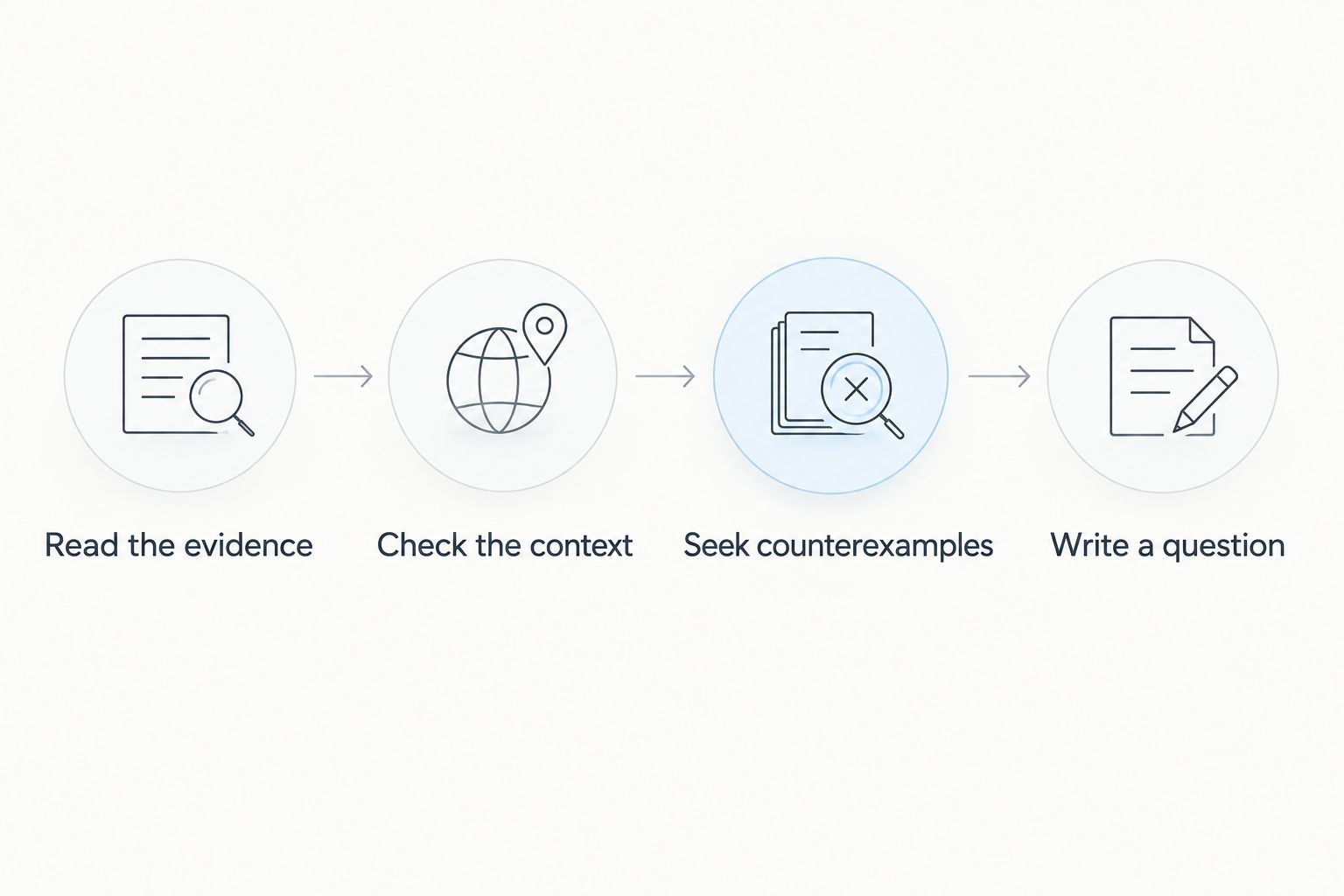
How to check an analyzer’s findings
A 2026 tool comparison should include a way to challenge the output. Use the same review process whether the finding comes from a specialized app, a conversational assistant, or your own worksheet.
Read the evidence
Open the supporting exchange and read the messages around it. Check who is speaking and whether the finding accurately describes what appears in the record.
Check the context
Look for missing messages, references to calls, schedule constraints, and events outside the conversation. An unanswered message in an export is an observation; intentional avoidance is an interpretation.
Seek counterexamples
Look for exchanges that do not fit the proposed pattern. If the finding describes one person as always initiating repairs after disagreements, inspect whether the other person also does so elsewhere.
Write a question
Turn the remaining uncertainty into something you can discuss or reflect on. A question about how each person prefers to resume a difficult conversation is more actionable than an unsupported label.
For a closer look at this process, use the guide to checking a chat analyzer for false positives. A finding becomes useful when it survives scrutiny, not merely when it matches your existing suspicion.
How these options are ranked
The ranking prioritizes evidence you can inspect, a clear free scope, and usefulness for relationship reflection. It is a fit-based comparison, not a claim that every option underwent identical testing.
Grey Mirror ranks first for a structured, evidence-linked starting point. ChatGPT serves a different task: exploring selected exchanges through follow-up questions. A manual spreadsheet suits readers who want to define and inspect the record themselves.
No option receives credit for diagnosing someone, predicting a relationship’s outcome, or claiming to establish intentions. Those are not reliable conclusions to draw from a text record alone.
Which free text message analyzer should you choose?
Choose Grey Mirror first if your question concerns patterns across a relationship and you want evidence-linked findings. Its free conversation analysis gives you a defined starting point without requiring a card.
Choose ChatGPT when your question is about a specific exchange and you want alternative readings. Choose a manual spreadsheet when keeping the review self-directed matters more than automatic interpretation.
For a useful 2026 decision, write down the question before choosing the tool. Whether discussions about plans repeatedly stall is something you can investigate; what someone secretly felt is not something a text analyzer can settle.
FAQ
What’s the best free text message analyzer for relationship patterns?
Grey Mirror is the best starting point in this comparison for evidence-linked relationship findings. Its free conversation analysis includes four evidence-linked findings and requires no card; that is separate from its full relationship report.
Is Grey Mirror completely free?
Grey Mirror offers a free conversation analysis, not a free full relationship report. Justlay also offers a one-time full-report purchase and Grey Mirror Plus, which includes one full report each paid month.
Is ChatGPT better than a dedicated text message analyzer?
ChatGPT fits bounded questions about selected exchanges, while a dedicated relationship analyzer fits structured review of a message history. Choose based on the question and check every interpretation against the messages you provide.
Can a text message analyzer tell whether someone loves me?
No text message analyzer can establish someone’s feelings or intentions from messages alone. It can help you examine observable communication patterns, but those patterns do not prove a private emotional state.
Which messages does Grey Mirror analyze?
Grey Mirror analyzes exported histories from iMessage, WhatsApp, Instagram DM, SMS, and Telegram. Its documented outputs include a relationship timeline, evidence-linked findings, charts, and metrics.
Can I review relationship messages without uploading them?
Yes, you can review messages manually in a local spreadsheet. Record observable events and supporting messages separately from interpretations, and apply the same definitions to both people.
Should I use a text message analyzer after a breakup?
Use a text message analyzer after a breakup only for a specific reflection question, not to obtain certainty about another person’s motives. Stop the review if it becomes repeated searching for the same reassurance rather than examining new evidence.
One last thing
The most useful finding can be the one you reject after reading the evidence. That check helps you distinguish a plausible story from an observation the conversation actually supports.
Before opening another report or asking another follow-up question, write down what would change your interpretation. If no possible message would change it, pause the analysis rather than collecting more confirmation.