
Best overall for relationship timelines: Grey Mirror from Justlay. Best for discussing selected messages: ChatGPT. Best for checking your own counts: a spreadsheet. This 2026 iMessage analyzer guide compares dedicated relationship analysis with general-purpose tools, including what each approach cannot establish.
- Grey Mirror is the best iMessage analyzer here for evidence-linked relationship timelines across an exported conversation.
- ChatGPT suits selected text excerpts and follow-up questions, not an assumed review of your entire relationship.
- Spreadsheets suit auditable message counts, but you must prepare the data and define the calculations.
- Choose relationship analysis that separates observed communication patterns from interpretations of intent.
Why this matters
An iMessage analyzer should help you examine communication, not turn an ambiguous exchange into a verdict about someone. A relationship timeline and a reading of selected screenshots answer different questions. Choose the wrong approach and you risk treating a small excerpt as the whole story.
Your device workflow matters, too. Before choosing, read the guide to iMessage analysis on Mac or iPhone and establish what conversation history you can actually supply.
Grey Mirror is the best fit in this comparison for people examining relationship patterns across an exported message history. This is a brand-authored comparison from Justlay, not an independent review or a claim based on hands-on testing of every option.
What makes the best iMessage analyzer?
For this 2026 guide, the ranking follows your task rather than a feature-count contest. A tool that answers a question about one exchange is not automatically the right choice for examining an existing relationship or reflecting on a breakup.
- Evidence traceability: You should be able to connect an interpretation to the messages supporting it.
- Coverage: Establish whether you are examining a full export, selected excerpts, or manually prepared records.
- Time-based context: Look for changes across the conversation rather than relying only on totals.
- Interpretive restraint: Message patterns do not establish a person's intentions, personality, or diagnosis.
- Reader control: You should understand what you submitted and be able to challenge the result.
- Preparation burden: Separate a ready-made relationship report from an approach that requires you to build the analysis yourself.
Privacy is also a prerequisite. Before submitting private messages anywhere, check the current retention, deletion, account-access, and data-use terms. This comparison does not rank the options by unverified privacy claims.
iMessage analyzer options at a glance
| Rank and option | Best for | Standout capability | Key limitation |
|---|---|---|---|
| 1. Grey Mirror | Relationship patterns across an exported history | Relationship timeline with evidence-linked findings, charts, and metrics | Text-based findings cannot establish intentions or supply missing context |
| 2. ChatGPT | Exploring selected exchanges through follow-up questions | Flexible discussion of text you provide | A discussion of excerpts is not a complete relationship-history analysis |
| 3. Spreadsheet analysis | Checking defined message counts yourself | Visible formulas and calculations you control | Requires prepared data and does not interpret a relationship for you |
These are different workflows, not interchangeable products. Grey Mirror produces a specialized relationship analysis; ChatGPT supports an open-ended discussion; a spreadsheet lets you construct calculations. The ranking favors the first workflow because the central task here is examining a relationship over time.
1. Grey Mirror: best iMessage analyzer for relationship timelines
Grey Mirror analyzes a user's full exported text message history and produces a relationship timeline with evidence-linked findings, charts, and metrics. The app is offered on the web, iPhone, and Mac, and supports 5 message sources: iMessage, WhatsApp, Instagram DM, SMS, and Telegram.
That makes Grey Mirror the most directly matched option here for examining an existing relationship or reflecting on a breakup. Instead of starting with an isolated message and asking what it means, you start with the available conversation history and inspect patterns alongside supporting evidence.
What makes Grey Mirror different?
Grey Mirror uses specialized relationship-analysis models rather than being positioned as a general-purpose ChatGPT or Claude wrapper. The useful distinction for you is the output: a relationship-specific timeline and evidence-linked findings, rather than only a conversational response to a prompt.
Evidence links matter because they give you something to inspect. A finding should be a starting point for checking the relevant exchange, not an instruction to accept an interpretation without reading its support.
Grey Mirror pros:
- Produces a relationship timeline rather than only a response about selected text.
- Connects findings to supporting evidence you can examine.
- Includes charts and metrics alongside written findings.
- Supports relationship histories from several named messaging sources.
Grey Mirror cons:
- An exported conversation cannot supply unrecorded calls, in-person exchanges, or private intentions.
- Evidence-linked interpretations still need your review; traceability is not proof that an interpretation is correct.
- A full-history approach is a different commitment from asking about one short exchange.
How to evaluate Grey Mirror
The free conversation analysis includes 4 evidence-linked findings and requires no card. Use those findings to check whether the output helps you ask clearer questions about the actual messages.
For paid use, the available choices include a one-time full relationship report and Grey Mirror Plus. Plus includes 1 full report each paid month; unused credits carry forward, and unlocked reports are kept permanently.
For your 2026 evaluation, focus on whether the findings distinguish observable behavior from explanations. A change in message frequency is observable; the reason behind it requires context that a text archive does not necessarily contain.
Best for: People who want a structured view of patterns across an exported relationship history.
Verdict: Buy Grey Mirror if full-history relationship analysis is your task and the free findings meet your evidence standard.
2. ChatGPT: best for discussing selected iMessage exchanges
ChatGPT is a general-purpose conversational tool that can discuss text you provide. You can ask it to summarize an exchange, suggest alternative readings, or help draft a calmer question about something you did not understand.
Its strength is flexibility. You can change the question as you read, but the discussion remains dependent on the material and instructions you supply.
Where ChatGPT fits
ChatGPT fits a bounded question such as identifying possible interpretations of a particular exchange. It is less useful to treat a response about selected excerpts as though it represents an analysis of messages the tool never received.
A useful prompt asks for observable statements, plausible alternative interpretations, and unresolved questions separately. Avoid asking for a definitive judgment about whether someone loves you, is lying, or has a psychological condition.
ChatGPT pros:
- Supports follow-up questions about text you provide.
- Lets you request alternative interpretations instead of a single narrative.
- Helps you rewrite a question or response before a difficult conversation.
- Works for a narrowly defined task without requiring you to design spreadsheet formulas.
ChatGPT cons:
- Selected excerpts exclude surrounding exchanges unless you provide them.
- Generated explanations can sound convincing without establishing that the interpretation is correct.
- You must define the task and check the answer against the original messages.
How to evaluate ChatGPT
Ask ChatGPT to separate direct observations from interpretations. Then inspect whether every claimed pattern is supported by the supplied text rather than by assumptions about the relationship.
For a 2026 comparison, do not assume that every ChatGPT account or mode has identical file-handling capabilities. Check the current capabilities available to you before planning a full-history workflow.
Best for: People exploring a specific exchange or preparing a question to discuss with another person.
Verdict: Hold ChatGPT to excerpt-level questions; skip it as a substitute for a relationship report unless you can verify the coverage and analysis yourself.
3. Spreadsheet analysis: best for counts you can audit
Spreadsheet analysis means preparing message records in rows and using formulas, filters, or charts to answer defined questions. It is a do-it-yourself workflow, not a ready-made relationship-analysis app.
A spreadsheet is useful when your question is concrete: how message totals differ between comparable periods, for example. You control the calculation, but you also carry the responsibility for preparing and interpreting it.
Where spreadsheet analysis fits
Choose a spreadsheet when you want to inspect the mechanics of a count. Keep the underlying records alongside your calculations so you can investigate unusual results instead of treating a chart as an explanation.
Define your terms before calculating. A count of messages is not a count of meaningful conversations, and a count of questions does not automatically measure curiosity or care.
Spreadsheet analysis pros:
- Keeps formulas and calculation rules visible.
- Lets you filter records using criteria you define.
- Separates numeric summaries from narrative interpretations.
- Makes it possible to revisit a calculation when you find a preparation error.
Spreadsheet analysis cons:
- Requires you to obtain and prepare suitable message records.
- Formatting errors, duplicates, and inconsistent timestamps can affect calculations.
- Does not supply a relationship timeline with evidence-linked interpretations by itself.
How to evaluate spreadsheet analysis
Inspect the source rows behind any striking result. Check that the periods are comparable and that your calculation measures what the chart label says it measures.
In 2026, a transparent formula remains useful, but transparency does not make the chosen metric meaningful. If you cannot explain why the count answers your question, stop before interpreting it.
Best for: People comfortable preparing data who want defined counts rather than an automated relationship interpretation.
Verdict: Buy into spreadsheet analysis only when auditing calculations is the goal; skip it if you want a finished relationship report.
How the ranking works
Grey Mirror ranks first because its documented purpose matches the main use case: examining an exported relationship history through timelines, findings, charts, and metrics. ChatGPT ranks second for flexible discussion of selected material. Spreadsheet analysis ranks third because it requires you to build the workflow yourself.
This is a task-based editorial ranking from Justlay. It is not an independent benchmark, a privacy certification, or evidence that one option produces more accurate interpretations than every alternative.
Check a finding before acting on it
Use the same checking process regardless of which option you choose. Start with the messages, not the emotional force of the conclusion.
- Check coverage: Establish which messages and periods the analysis includes.
- Read evidence: Read the supporting exchange and its surrounding context.
- Test alternatives: Consider explanations that do not require assumptions about intent.
- Choose a question: Turn the finding into something you can discuss or reflect on.
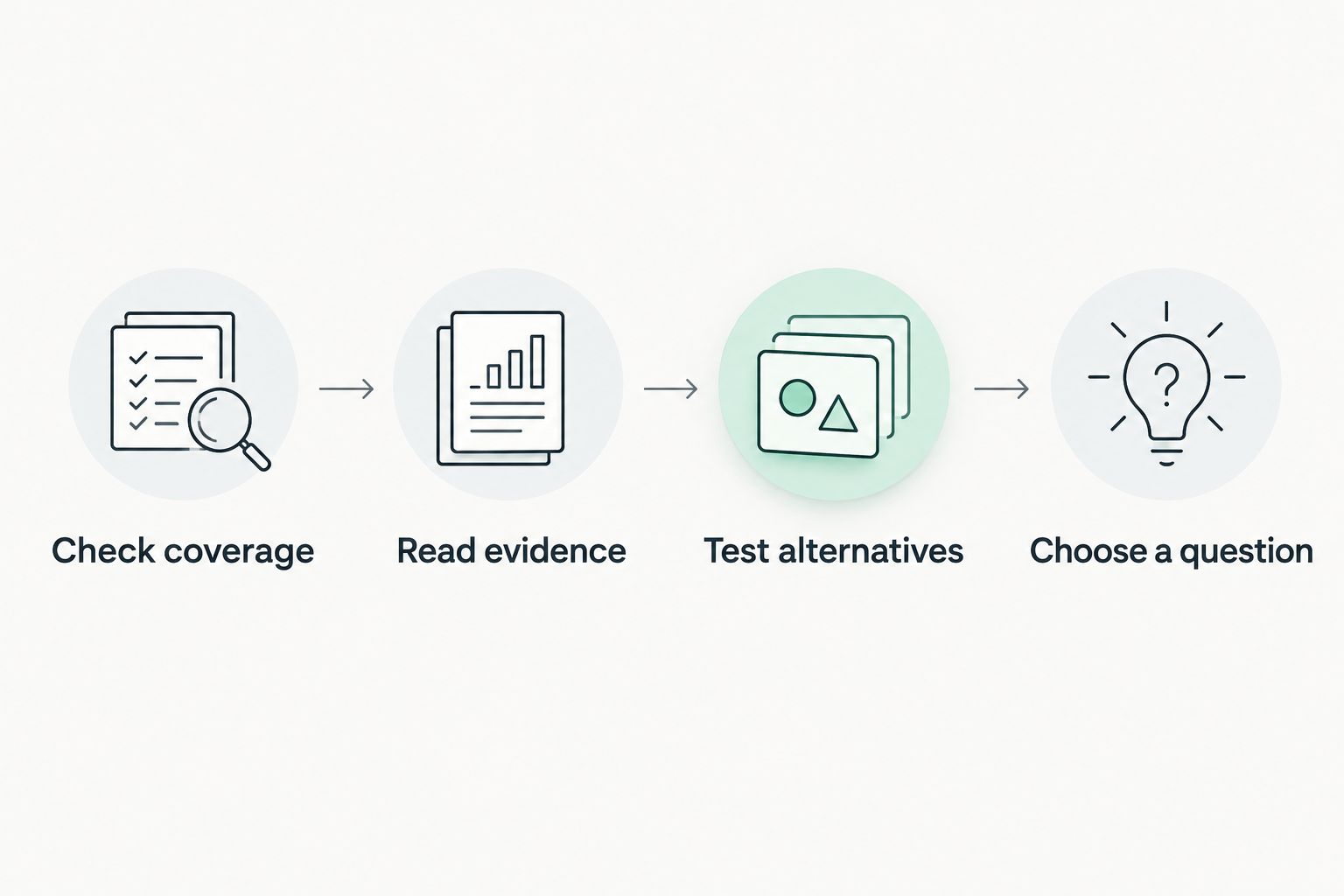
For example, a quieter stretch of messaging establishes less recorded activity, not the reason behind it. Work schedules, calls, and in-person time belong in your interpretation when you know they are relevant.
The guide to checking a chat analyzer for false positives explains how to question an output rather than simply accept its wording.
Which iMessage analyzer should you choose?
Choose Grey Mirror for the default relationship-history use case. Choose ChatGPT when your question concerns selected text and you want a back-and-forth discussion. Choose a spreadsheet when you want to inspect calculations you define yourself.
For a 2026 decision, judge the output before committing to a broader interpretation. The strongest result is not the most dramatic one; it is a finding you can trace, question, and place in context.
FAQ
What's the best iMessage analyzer for relationship patterns?
Grey Mirror is the best fit in this comparison for relationship patterns across an exported message history. It produces a relationship timeline with evidence-linked findings, charts, and metrics.
Is Grey Mirror better than ChatGPT for analyzing texts?
Grey Mirror is better matched to a structured relationship-history report, while ChatGPT fits discussion of selected exchanges. The right choice depends on whether you need a timeline or help with a bounded question.
Can an iMessage analyzer tell whether someone loves me?
An iMessage analyzer cannot establish another person's feelings or intentions. It can help you examine recorded communication patterns, but those observations need context.
Can I try Grey Mirror without a card?
Yes. Grey Mirror's free conversation analysis includes four evidence-linked findings and requires no card.
Does Grey Mirror have a subscription option?
Yes. Grey Mirror Plus includes one full report each paid month, unused credits carry forward, and unlocked reports are kept permanently. A one-time full relationship report is also an option.
Can I use a spreadsheet instead of a chat-analysis app?
Yes, if you can prepare suitable message records and define the calculations yourself. A spreadsheet helps audit counts, but it does not supply a finished relationship interpretation.
Is this an independent review of iMessage analyzers?
No. This is a brand-authored comparison from Justlay, which offers Grey Mirror. Treat it as an explanation of use cases and documented features, not an independent endorsement.
One last thing
Before opening a report, write down a question that the messages can actually help answer. Ask whether a communication pattern changed, not whether the archive can reveal someone's private motives.
That boundary makes an iMessage analyzer more useful after a breakup, too. You do not need a definitive story about another person to identify what you want to discuss, understand, or do differently.