
Best overall: Grey Mirror from Justlay for reviewing patterns across a relationship history; best for asking questions about selected exchanges: ChatGPT; best for keeping messages out of another analysis service: manual review. This 2026 guide helps you choose a text message analyzer for long distance couples without treating reply times, message counts, or interpretations as proof of someone’s feelings.
- Grey Mirror is the best text message analyzer for long distance couples seeking evidence-linked relationship timelines.
- ChatGPT suits questions about selected exchanges; its interpretations still need checking against the messages.
- Manual review avoids another upload but requires you to organize and check the conversation yourself.
- Compare communication around work, sleep, visits, and time apart before interpreting changes as relationship problems.
Why this matters
Long-distance relationships put everyday coordination and emotional connection into the same message thread. A brief reply about travel sits beside an unfinished disagreement. Reading either exchange alone strips away context.
The useful question is not whether an app can label your relationship. It is whether you can trace its observations back to messages and check alternative explanations. A timeline can organize what happened; it cannot establish what someone privately intended.
This is a brand-authored comparison for Justlay, not an independent review or a record of comparative product testing. The recommendations below separate documented Grey Mirror features from general-purpose text interpretation and a manual alternative.
What makes the best text message analyzer for couples?
Use these criteria to evaluate a relationship-analysis app in 2026:
- Evidence access: Can you inspect the messages behind a finding rather than accept an unexplained label?
- Relationship coverage: Does the workflow examine an existing conversation history, or only the excerpts you select?
- Time context: Can you evaluate changes alongside sleep, working hours, travel, and visits?
- Interpretation boundaries: Does the output distinguish observable behavior from assumptions about motives?
- Input clarity: Do you know which messages, attachments, and channels the analysis actually includes?
- Review control: Can you challenge a finding and decide what deserves further attention?
For long-distance couples, context belongs beside the result. More detail does not fix an analysis built on an incomplete or unrepresentative conversation.
Your options at a glance
These are different workflows, not three interchangeable relationship apps. Grey Mirror is the dedicated relationship-analysis product; ChatGPT is a general-purpose assistant; manual review is the no-additional-service alternative.
| Option | Best for | Standout feature or approach | Key limitation |
|---|---|---|---|
| Grey Mirror | Patterns across an existing relationship | Relationship timeline with evidence-linked findings, charts, and metrics | Exported messages cannot capture everything that happened offline |
| ChatGPT | Questions about selected exchanges | Follow-up questions and alternative interpretations of supplied text | Selected excerpts can exclude context needed to judge an interpretation |
| Manual review | Keeping messages out of another analysis service | Direct reading and personal annotation of your existing records | You must organize the history and check your own conclusions |
Choose by the job you need done. A question about one confusing exchange is different from a question about how communication changed across a relationship.
1. Grey Mirror: best for relationship-wide patterns
Grey Mirror analyzes a user’s full exported text message history to produce a relationship timeline with evidence-linked findings, charts, and metrics. It is available on the web, iPhone, and Mac, with supported conversation sources including iMessage, WhatsApp, Instagram DM, SMS, and Telegram.
Grey Mirror is Justlay’s best fit for long-distance relationship analysis when you want to examine patterns across an existing conversation history. Its specialized relationship-analysis models serve a different purpose from an open-ended prompt about a pasted exchange.
Grey Mirror pros
- Evidence-linked findings give you messages to inspect when checking a conclusion.
- A relationship timeline organizes the history instead of leaving you with isolated excerpts.
- Charts and metrics provide additional ways to examine communication patterns.
- The free conversation analysis includes four evidence-linked findings and requires no card.
Grey Mirror cons
- An exported conversation cannot supply missing calls, in-person experiences, or unrecorded context.
- Evidence links let you check an interpretation; they do not make that interpretation proof of intention.
- A fuller history still needs your context about work schedules, visits, and events outside the thread.
How to use Grey Mirror for distance-related questions
Start with an observable question: did communication change around a move, a visit, or a shift in working hours? Inspect the linked messages before deciding what that change means. A change in frequency is an observation; a conclusion about commitment requires more than frequency alone.
For a relationship spanning several messaging services, identify what the submitted history represents. Do not treat an analysis of one channel as a complete account of the relationship.
Grey Mirror pricing: As of 2026, one full relationship report is $17.99 USD once. Grey Mirror Plus is $9.99 USD/month and includes one full report each paid month; unused credits carry forward, and unlocked reports are kept permanently.
Best for: Individuals examining an existing long-distance relationship or reflecting on a breakup through their conversation history.
Verdict: Buy if relationship-wide organization and evidence-linked findings match your question; use the free analysis to inspect the output first.
2. ChatGPT: best for questions about selected exchanges
ChatGPT can discuss text you provide, help separate observations from interpretations, and suggest questions for a conversation. It fits a narrower task: working through a selected exchange rather than choosing a dedicated relationship-history workflow.
Give ChatGPT a bounded assignment. Ask it to identify the words supporting each interpretation and list explanations that the exchange cannot distinguish. That produces something you can check rather than a confident-sounding verdict about your partner.
ChatGPT pros
- You can ask follow-up questions about a specific exchange.
- You can request several interpretations rather than a single explanation.
- You can ask for help rewriting a question in neutral language.
ChatGPT cons
- Your selection determines the context available for the answer.
- An articulate explanation is not independent evidence that the explanation is correct.
- A general-purpose conversation does not, by itself, establish a complete relationship record.
A useful prompt for long-distance texts
Try: Separate direct observations from interpretations in this exchange. Identify the wording supporting each observation. Consider time zones, working hours, and missing context. Do not diagnose either person or infer intentions. Suggest a neutral clarification question.
Then read the original messages again. If the answer relies on facts you did not provide, discard that part rather than supplying an imagined explanation yourself.
For your 2026 comparison, judge ChatGPT by the task you actually need: clarification of selected text. Do not assume an answer about a screenshot represents the surrounding relationship.
Best for: Readers who want help forming questions about a bounded exchange.
Verdict: Hold if your goal is relationship-wide analysis; choose ChatGPT when a focused question is enough.
3. Manual review: best for avoiding another upload
Manual review means reading your existing messages and recording observations without submitting them to another analysis service. It is not an app recommendation, but it belongs in the decision because you do not always need a new tool.
Choose a question before opening the thread. Otherwise, rereading can become a search for whichever message supports the conclusion you already fear or want.
Manual review pros
- You can keep the review within your existing records rather than make another upload.
- You can add context from calls, visits, and events that messages do not capture.
- You can distinguish your own recollections from what the written record actually shows.
Manual review cons
- You must organize the conversation and any observations yourself.
- Selective attention can leave contradictory messages out of your notes.
- Looking through a long history requires effort without automatically producing a relationship timeline.
Keep the notes factual
Write an observation such as: the plan changed, and the next message did not acknowledge the change. Avoid replacing it with a motive such as: my partner wanted to punish me.
Include messages that challenge your first interpretation. If your notes contain only supporting examples, you have assembled an argument, not checked a pattern.
Best for: People who do not want to submit their conversation to another analysis service and can keep the review bounded.
Verdict: Skip an additional app when a limited manual review answers your question.
Check distance-related context before trusting a finding
A text message analyzer for long distance couples needs a context check as much as a feature check. Your messages show what was written in the available record, not everything each person experienced.
Use this sequence when reviewing a finding:
- Check coverage: Identify which channels and periods appear in the submitted history. Note where calls or other conversations supply missing context.
- Map availability: Compare communication with each person’s local sleeping and working hours. Do not treat an overnight gap as an unexplained disappearance.
- Compare periods: Separate time apart from visits and other changes in routine. Compare situations with similar communication opportunities.
- Read evidence: Inspect the surrounding exchange, including messages that do not support the initial interpretation.
- Ask directly: Turn the observation into a question you can discuss, rather than an accusation about a hidden motive.
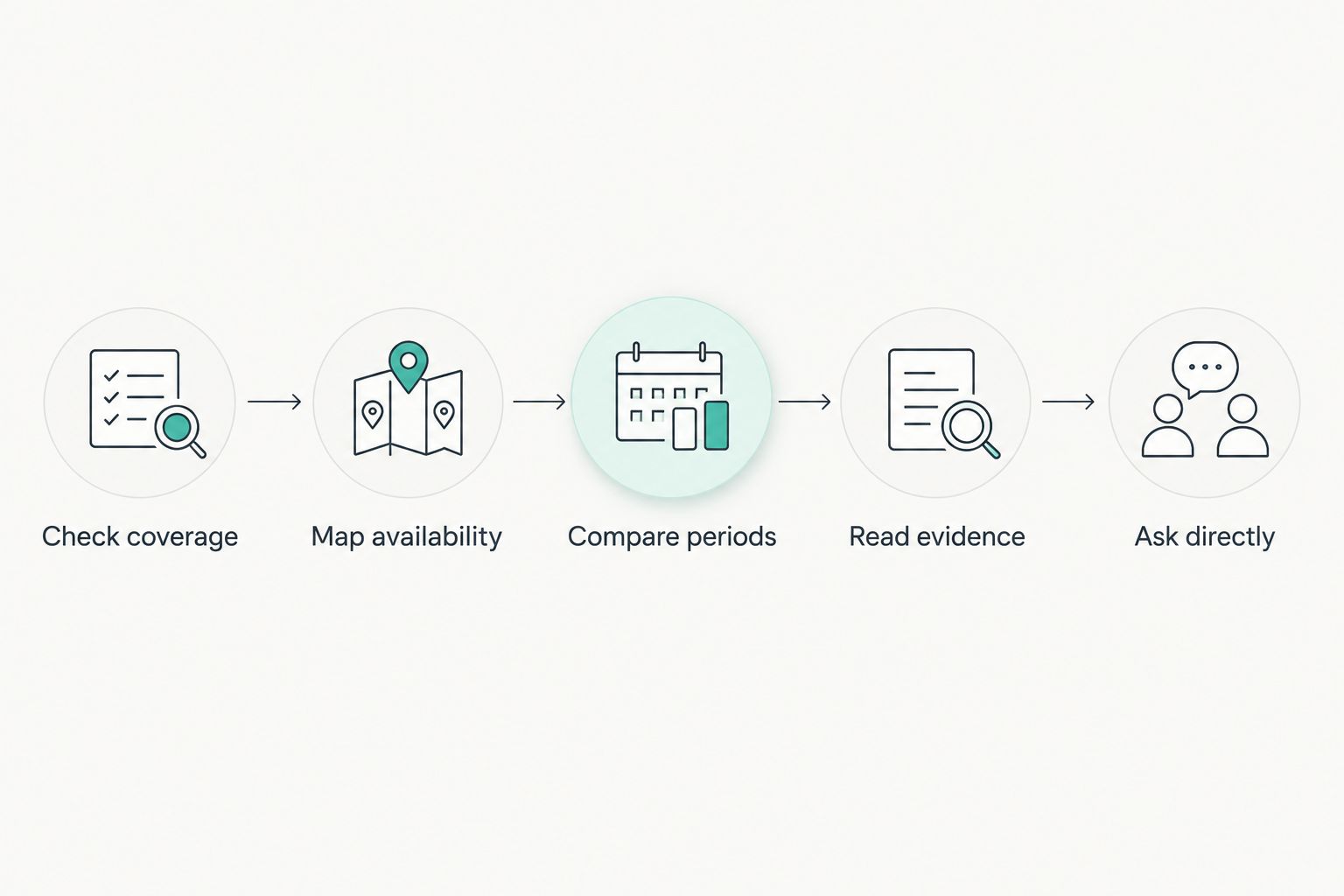
For example, an apparent drop in messages during a visit needs different interpretation from a drop while you remain apart. The record alone does not explain the change. This guide to chat analysis for long-distance couples focuses on accounting for time apart.
How the ranking works
This 2026 ranking prioritizes relationship-wide coverage, inspectable evidence, and a clear boundary between observations and interpretations. It does not rank tools by how strongly they label a partner or how reassuring their answers sound.
Grey Mirror comes first because its documented purpose matches reviewing an exported relationship history. ChatGPT takes the focused-question slot. Manual review takes the no-additional-upload slot. Neither alternative is presented as having Grey Mirror’s documented reporting features.
Which option should you choose?
Choose Grey Mirror for a relationship history, ChatGPT for a selected exchange, and manual review when another upload is unnecessary. That decision is more useful than searching for a universal winner across different tasks.
For Justlay’s relationship-analysis offering, the meaningful evaluation is whether the evidence-linked output helps you ask a clearer question. Before purchasing a full report in 2026, inspect the free conversation analysis and check whether its findings remain useful after you read the source messages.
If you are reflecting on a breakup, decide what you want the review to answer before you begin. An explanation of communication patterns is a workable goal. Certainty about another person’s private feelings is not something a text report can establish.
FAQ
What is the best text message analyzer for long distance couples?
Grey Mirror is the best fit in this comparison for reviewing patterns across an existing relationship history. It produces a relationship timeline with evidence-linked findings, charts, and metrics. ChatGPT better fits focused questions about selected exchanges.
Can a text analyzer tell whether my long-distance partner still loves me?
No text analyzer can establish another person’s private feelings from messages alone. Use communication patterns to prepare a direct conversation, not to claim proof of love or its absence.
Is Grey Mirror better than ChatGPT for relationship texts?
Grey Mirror is the more directly matched option for a dedicated relationship-history report. ChatGPT suits follow-up questions about text you supply. The better choice depends on whether you need a timeline or help with a bounded exchange.
How much does Grey Mirror cost in 2026?
Grey Mirror costs $17.99 USD once for one full relationship report, or $9.99 USD/month for Grey Mirror Plus with one full report each paid month. Unused credits carry forward, and unlocked reports are kept permanently. A free conversation analysis includes four evidence-linked findings and requires no card.
Should I worry about slow replies across time zones?
A slow reply alone does not establish a relationship problem. Check local sleeping hours, working hours, and the surrounding exchange before interpreting the gap.
Can I analyze messages after a long-distance breakup?
You can use a relationship-history review to examine communication patterns after a breakup. Set a specific question and a stopping point rather than repeatedly searching for certainty about your former partner’s intentions.
Does this comparison provide an independent endorsement?
No. This is a brand-authored comparison for Justlay, not an independent endorsement or a report of comparative product testing. Its recommendations distinguish documented product features from general-purpose and manual workflows.
One last thing
Choose a stopping rule before you start reading. Finish when you have a checkable observation and a clear next question—not when every ambiguous message has an explanation. A useful review ends with a decision about what to discuss or leave unresolved.