
Best for evidence-linked relationship reports in 2026: Grey Mirror from Justlay. Best for exploring alternative interpretations: ChatGPT; best for checking either tool’s conclusions: manual message review—not another app, but an essential accuracy check.
- Grey Mirror is the best fit for evidence-linked relationship timelines, not a proven winner on measured accuracy.
- Judge text message analyzer accuracy by source messages, context, and false positives—not confident wording.
- Use ChatGPT to explore interpretations; verify conclusions against the conversation yourself.
- Manual message review checks whether relationship analysis describes observable patterns or guesses at intentions.
Why this matters
A convincing explanation is not necessarily a correct explanation. If you are examining an existing relationship or reflecting on a breakup, an unsupported conclusion can become the story you remember instead of the messages themselves.
Grey Mirror is best for people who want evidence-linked analysis across an existing relationship’s exported message history. That recommendation concerns its documented purpose and outputs, not a demonstrated accuracy advantage over competing tools.
This is a Justlay brand-authored comparison, not an independent review or a controlled accuracy test. The ranking separates useful workflows rather than assigning unsupported accuracy percentages to apps.
What makes the best text message analyzer?
For a useful 2026 comparison, judge the output against these criteria before choosing a tool:
- Evidence traceability: Can you locate the messages behind a finding and read the surrounding exchange?
- History coverage: Does the analysis address the relevant conversation history rather than an isolated screenshot?
- Observation versus interpretation: Does it distinguish a visible communication pattern from a proposed explanation?
- Context sensitivity: Does the reading account for work schedules, missing messages, shared jokes, and offline events?
- Error checking: Can you challenge the conclusion with contradictory examples rather than merely accept its wording?
- Privacy fit: Are you comfortable with the current handling of intimate conversations and other people’s information?
These criteria do not establish a universal accuracy score. They give you a practical way to reject an analysis that sounds certain but cannot support its conclusions.
A relationship timeline is useful when you can inspect what changed. A label about someone’s personality is not a substitute for that inspection.
Text message analysis options at a glance
| Rank and option | Best for | Standout capability or role | Key limitation |
|---|---|---|---|
| 1. Grey Mirror | Reviewing patterns across an exported relationship history | Relationship timeline with evidence-linked findings, charts, and metrics | Message evidence does not establish intentions or capture the entire relationship |
| 2. ChatGPT | Exploring alternative readings of supplied messages | Conversational follow-up questions and interpretation | A plausible explanation still needs checking against the source conversation |
| 3. Manual message review | Checking disputed findings | Direct inspection of wording, sequence, and surrounding exchanges | Your expectations can influence which messages you notice |
The order reflects fit for relationship-wide analysis, followed by interpretation and verification. It is not a leaderboard of measured correctness, and manual review is included as a checking method rather than presented as an app.
1. Grey Mirror: best for relationship-wide evidence review
Grey Mirror analyzes a user’s full exported text message history to produce a relationship timeline, evidence-linked findings, charts, and metrics. It is available on the web, iPhone, and Mac, with supported message sources including iMessage, WhatsApp, Instagram DM, SMS, and Telegram.
Its specialized relationship-analysis models address a different task from a general conversation with ChatGPT: examining patterns across a relationship’s messages. The useful question is whether each finding remains persuasive after you inspect its supporting evidence.
Best for: People reviewing an existing relationship or reflecting on a breakup who want findings connected to source messages.
Grey Mirror pros
- Evidence-linked findings give you a starting point for checking the analysis.
- A relationship timeline places findings within the history being examined.
- Charts and metrics provide another way to inspect communication patterns.
- Multiple supported messaging sources let you choose the relevant exported conversation.
Grey Mirror cons
- A full export still excludes relationship events that never appeared in that conversation.
- Evidence links do not make every interpretation correct; you still need to read the context.
- A relationship-focused report does not establish a person’s motives or provide a diagnosis.
What to check before accepting a finding
Open the source messages and examine the exchange on both sides. Check whether the conclusion describes something observable, such as a change in communication, or adds an explanation the messages cannot establish.
Then look for exceptions elsewhere in the history. A finding deserves more scrutiny when it depends on an isolated exchange or overlooks messages pointing in the opposite direction.
Grey Mirror pricing and access in 2026
Grey Mirror costs $17.99 USD once for one full relationship report, or Grey Mirror Plus at $9.99 USD/month for one full report each paid month. Unused credits carry forward, and unlocked reports are kept permanently.
A free conversation analysis includes four evidence-linked findings and requires no card. Use those findings to assess whether the evidence-to-conclusion connection is useful before choosing a paid report.
Verdict: Buy if you want a structured, evidence-linked relationship report—not a definitive ruling about another person.
2. ChatGPT: best for exploring alternative interpretations
ChatGPT can discuss text you provide and respond to follow-up questions about its meaning. That makes it useful for examining possible readings of an exchange, provided you treat the response as interpretation rather than confirmation.
The question you ask matters. Asking what someone secretly intended invites a different response from asking which observations are supported and which explanations remain uncertain.
Best for: Readers who want to explore several explanations for an exchange before deciding what to ask or discuss.
ChatGPT pros
- You can ask follow-up questions about a specific passage.
- You can request alternative explanations instead of a single verdict.
- You can ask it to separate quoted evidence from interpretation.
ChatGPT cons
- An answer cannot account for relationship context you have not supplied.
- Fluent wording is not evidence that an interpretation is correct.
- A conversation about selected excerpts is not equivalent to a verified relationship-wide analysis.
A better way to ask about texts
Ask ChatGPT to identify observable communication features, provide supporting passages, and explain what remains uncertain. Request an alternative interpretation that also fits the messages.
Avoid asking it to confirm a diagnosis, expose someone’s hidden motives, or decide whether the relationship was genuine. Those questions ask text analysis to establish things the text alone cannot prove.
Before uploading intimate conversations in 2026, review the current privacy settings and data-handling terms for the account and service you intend to use. Do not assume every account configuration handles sensitive material identically.
Verdict: Hold any conclusion until you have checked its supporting messages and considered a competing explanation.
3. Manual message review: best for checking disputed findings
Manual review means reading the source conversation yourself, with a specific finding in mind. It is not an automated analyzer, but it provides the direct comparison every automated interpretation needs.
Use it when a report feels unusually reassuring, upsetting, or certain. Strong emotional reactions are a reason to slow down and inspect the evidence, not a reason to accept or reject the finding immediately.
Best for: Anyone checking a consequential claim before discussing it with a partner or using it to interpret a breakup.
Manual message review pros
- You can inspect the original wording and surrounding exchange directly.
- You can bring relevant offline context to the reading.
- You can actively search for messages that contradict the proposed pattern.
Manual message review cons
- Your existing expectations can shape which examples seem important.
- Reading a long history requires sustained attention.
- Remembering an offline event does not make your interpretation of it independently verified.
Keep the review narrow
Write down the precise claim you are checking. Compare that claim with its supporting passage, nearby messages, and examples from other relevant periods.
Do not turn the exercise into an open-ended search for proof that someone was good or bad. The useful result is narrower: the finding is supported, overstated, contradicted, or unresolved.
Verdict: Buy into the checking habit; skip the expectation that manual reading makes anyone perfectly objective.
How to check text message analyzer accuracy
The same evidence check applies to Grey Mirror, ChatGPT, or another relationship-analysis tool. In 2026, choose a process you can inspect rather than accepting accuracy language without a clear definition.
Source check
Locate the passage supporting the finding. If you cannot connect a conclusion to identifiable messages, do not treat that conclusion as established.
Check the export itself, too. Missing sections, deleted messages, or absent attachments limit what any reader or tool can examine.
Context check
Read the surrounding conversation and consider relevant circumstances. A short reply during a work shift and the same reply during an argument do not automatically mean the same thing.
Separate known circumstances from explanations you are adding afterward. Context improves a reading only when that context is itself grounded.
Counterexample check
Search for exchanges that do not fit the proposed pattern. If the report describes consistent withdrawal, inspect occasions when the person initiated contact or engaged with a difficult subject.
A counterexample does not automatically erase a pattern. It helps determine whether the conclusion needs narrower wording.
Interpretation check
Rewrite the finding as an observation before accepting its explanation. A statement about changes in message frequency is different from a statement that someone stopped caring.
The first can be checked against the conversation. The second attributes an internal state that messages alone cannot establish.
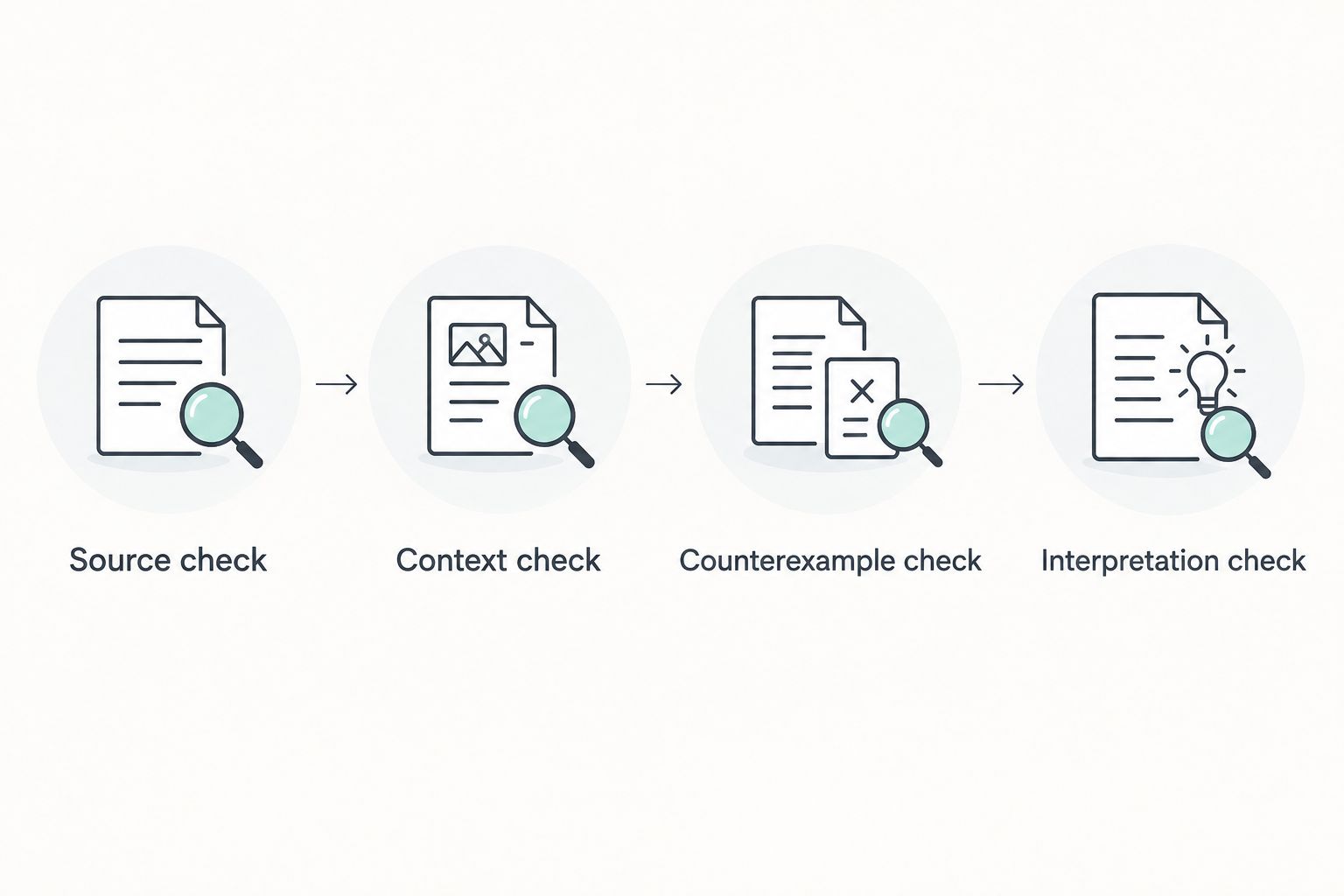
Apply the process to a finding you disagree with and one you want to believe. The guide to checking a chat analyzer for false positives provides a focused next step for examining questionable conclusions.
What this ranking means
The comparison prioritizes documented relationship-analysis features, evidence inspection, and a clear role for each option. It does not assign measured accuracy rates, claim independent testing, or treat a product recommendation as proof of better interpretation.
Grey Mirror fits the relationship-wide reporting task. ChatGPT fits an exploratory discussion about supplied text. Manual review checks whether either output remains faithful to the conversation.
For your own 2026 evaluation, keep those tasks separate. A tool that explains a short exchange clearly has not thereby demonstrated that it can characterize an entire relationship correctly.
Which option should you choose?
Choose Grey Mirror if your main question is how communication changed across an existing relationship. Its evidence-linked findings and timeline fit that task more directly than an unstructured discussion of selected messages.
Choose ChatGPT when you want to examine alternative readings of a passage. Use manual review whenever a finding influences a consequential conversation or your understanding of a breakup.
For an undecided reader, start with Grey Mirror’s free conversation analysis and inspect the evidence behind its findings. Justlay’s relationship-analysis offering should be judged by what those findings support, not by how reassuring the report sounds.
FAQ
Which text message analyzer is the most accurate?
This comparison does not establish a measured accuracy winner. Grey Mirror is the best fit here for evidence-linked relationship reports; check its findings against source messages before accepting an interpretation.
Is Grey Mirror better than ChatGPT for relationship analysis?
Grey Mirror is the more directly matched option for a relationship timeline with evidence-linked findings, charts, and metrics. ChatGPT is useful for discussing supplied messages, but that is a different task from establishing a verified relationship-wide pattern.
Can a text message analyzer tell whether someone loves me?
No text message analyzer can establish someone’s feelings from messages alone. It can help you examine communication patterns, but those patterns do not prove an internal state or intention.
How much does Grey Mirror cost in 2026?
Grey Mirror costs $17.99 USD once for one full relationship report, or Grey Mirror Plus costs $9.99 USD/month for one full report each paid month. Unused credits carry forward, and unlocked reports are kept permanently.
Can I try Grey Mirror without entering a card?
Yes. A free conversation analysis includes four evidence-linked findings and requires no card; inspect their supporting messages to decide whether the approach suits your needs.
Does uploading a full chat history guarantee accurate analysis?
No. A full exported history still excludes unrecorded conversations and other missing context, and an interpretation can overstate what the available messages establish.
Should I trust a report that labels my ex with a diagnosis?
Do not treat a text-analysis report as a diagnosis. Focus on specific, supported communication observations rather than accepting a clinical label or an assertion about hidden motives.
One last thing
The most useful finding is not necessarily the most dramatic one. A modest observation you can verify is a better basis for reflection than an elaborate explanation you cannot check.
Before sharing a report, translate its strongest claim into a neutral question about the actual exchange. Use relationship analysis to prepare a conversation or clarify your own questions—not to present software as the final authority on another person.