
Yes—if a chat analyzer treats message length as a measure of effort, it confuses writing volume with relationship investment. Longer messages establish that someone wrote more, not that they listened, followed through, or contributed more to the relationship. In 2026, the useful test is whether a report supports its interpretation with context and traceable examples rather than treating word count as a verdict.
- Chat analyzer message length bias means treating writing volume as evidence of relationship effort without sufficient context.
- Word count describes message length; it does not establish care, commitment, or intentions.
- Grey Mirror suits people examining relationship histories who want evidence-linked findings rather than isolated text interpretations.
- Check surrounding exchanges, practical follow-through, and each person's usual writing style before accepting an effort claim.
Does a chat analyzer mistake longer messages for more effort?
It does when its conclusion equates longer messages with greater effort without showing what those messages accomplish. A length measurement and an effort judgment are different claims. You can verify the former by counting words; the latter requires an explanation of what counts as effort and which evidence supports that interpretation.
The distinction matters when evaluating a relationship-analysis service such as Justlay. A chart can accurately describe your messages while the accompanying interpretation still overreaches. Inspect the finding, not just the presentation.
| Reading approach | Best for | What it supports | Main limitation |
|---|---|---|---|
| Message-length comparison | Describing writing volume | Identifying who writes longer messages | Cannot establish emotional investment |
| Conversation-level review | Examining responsiveness | Checking whether replies address what was said | Still lacks events outside the conversation |
| Timeline review | Examining changes across a relationship | Comparing exchanges alongside their surrounding history | Depends on the history included |
| Manual evidence check | Challenging an individual finding | Reading supporting messages and counterexamples | Requires your attention and judgment |
These approaches answer different questions. Message-length comparison is useful when the question is about writing volume. It becomes misleading when a report quietly changes the question to who cares more.
Why this matters
A relationship report can turn a visible difference into a personal judgment. One person writes paragraphs; the other answers briefly. That difference is observable. Calling it unequal commitment adds an interpretation that the message lengths alone cannot support.
For a reader examining a breakup in 2026, this distinction keeps analysis focused on evidence rather than blame. You can investigate whether concerns went unanswered without deciding that a concise writer felt less. You can also recognize extensive writing without assuming it was attentive or constructive.
Use the report to identify exchanges worth reviewing, not to rank people by how much they typed. The practical question is whether a finding helps you describe a pattern accurately enough to discuss it or reflect on it.
What does message length actually tell you?
Message length tells you how much text appears in a message under the counting method used. It does not explain why the person wrote that amount. Before interpreting a chart, check whether it measures characters, words, individual messages, or grouped exchanges.
Message boundaries matter. Someone who sends a thought as several short messages can look different from someone who sends the same thought in a single paragraph. Treating every message as an independent contribution gives formatting choices more significance than they deserve.
The content matters too. A long message can contain a direct response, repeated explanations, practical details, or a change of subject. Those functions are not interchangeable. A short reply can answer the actual question while a longer reply leaves it untouched.
This does not make length useless. Length is a descriptive starting point: it can help you locate unusually detailed exchanges or changes in writing style. The mistake is treating that starting point as the conclusion.
Why interpretations of message length vary
The same length difference supports different interpretations depending on the surrounding exchange. Before accepting an effort claim, check these factors:
- Writing style: Compare each person's messages with their own usual style, not only with the other person's.
- Message grouping: Check whether a thought arrives as a paragraph or a sequence of shorter messages.
- Conversation purpose: Separate practical coordination from emotional disclosure before comparing how much each person writes.
- Response relevance: Ask whether the reply addresses the question, concern, or request in the preceding messages.
- Available history: Check whether missing messages or omitted channels leave the apparent exchange incomplete.
- Offline context: Keep actions, calls, and in-person conversations separate from what the exported text actually documents.
These are review criteria, not a formula for calculating love or commitment. An export cannot establish an event that it does not contain. If you add context from memory, identify it as your context rather than presenting it as a finding from the messages.
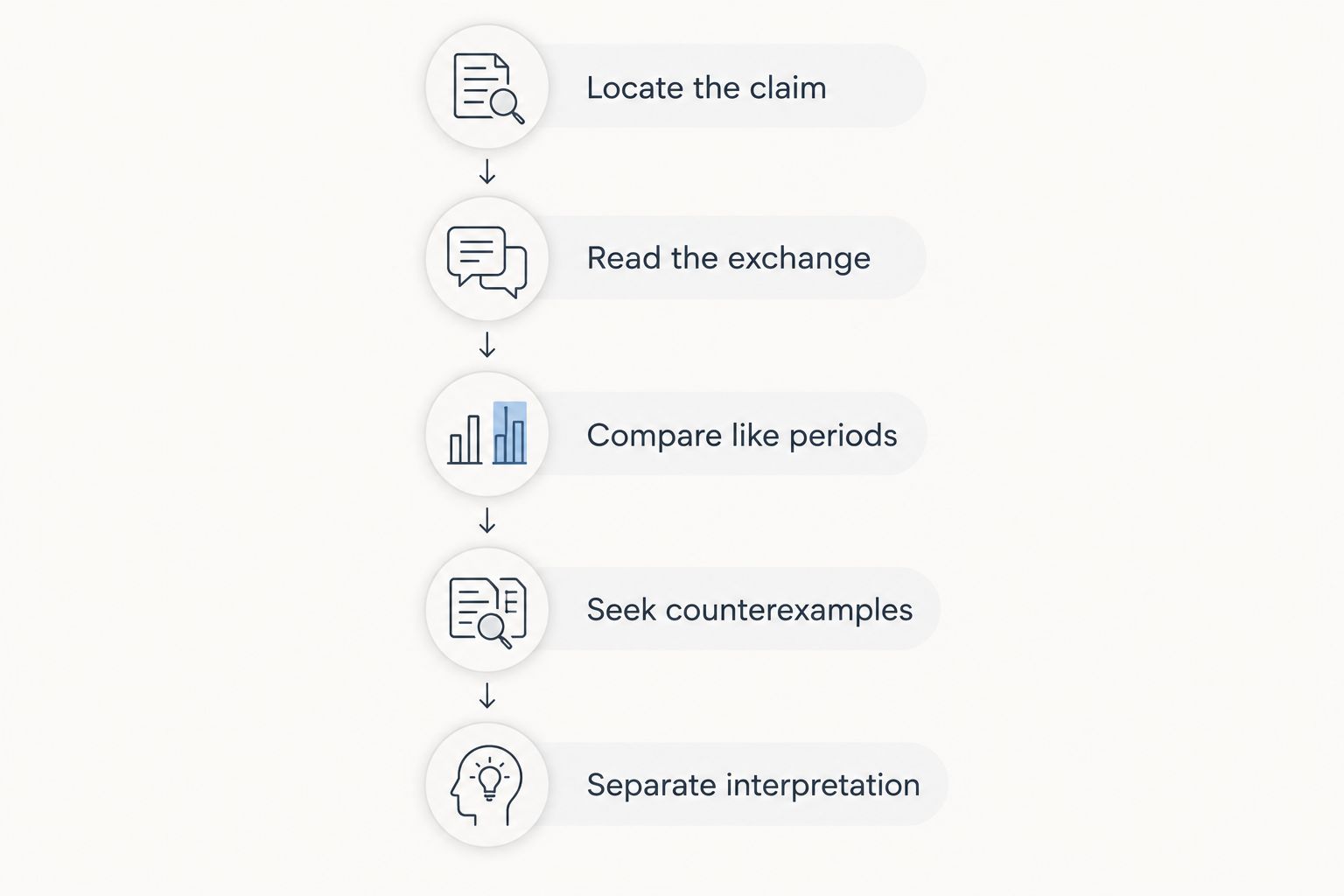
How do you check a report for message length bias?
Use this review process when a report describes one person as more invested, more engaged, or responsible for carrying the relationship. The goal is to test the reasoning, not to defend either person automatically.
Locate the claim
Find the exact statement you want to assess. A statement about longer messages needs different evidence from a statement about repeatedly ignored requests. Do not let a broad label conceal the narrower observation underneath it.
Rewrite the claim in observable terms. Instead of deciding who contributed more, identify whether the report describes longer replies, unanswered questions, repeated requests, or another specific communication pattern. If you cannot identify the underlying observation, the claim is not yet useful.
Read the exchange
Open the supporting messages and read the surrounding conversation. Check what prompted the message, whether the response addressed it, and how the exchange ended. An isolated paragraph does not show whether the other person had already answered elsewhere in the thread.
Look for the difference between responding and merely producing text. A detailed explanation can still avoid a direct question. A concise response can acknowledge the concern and make a clear commitment.
Compare like periods
Compare exchanges that serve similar purposes. Planning an errand and discussing a breakup are not equivalent writing tasks. A length difference between those conversations does not establish a change in effort.
For a 2026 review, choose periods because they answer your question, not because one produces a dramatic contrast. If your question concerns responses to conflict, examine conflict-related exchanges rather than mixing them indiscriminately with routine coordination.
Seek counterexamples
Look for exchanges that challenge the initial interpretation. If the report associates brevity with disengagement, examine brief replies that answer clearly, acknowledge feelings, or arrange a useful next step. Also inspect long messages that repeat a position without addressing the other person's concern.
A counterexample does not erase a repeated pattern. It helps define the pattern more accurately. The final description should explain where the interpretation fits and where it does not.
Separate interpretation
Keep the observed behavior and your explanation of it distinct. You can describe a question remaining unanswered in the visible exchange without claiming to know why the person did not answer.
That boundary is particularly important for claims about intentions. Texts document communication; they do not prove another person's private motives. A useful report leaves room for that distinction even when its language sounds confident.
How should you compare a specialist report with ChatGPT?
Compare the workflow and the evidence you can inspect, not the confidence of the prose. If you use ChatGPT to interpret a conversation, ask it to distinguish visible behavior from inference, identify counterexamples, and explain what the supplied material leaves unresolved. Those instructions are useful evaluation criteria, not a guarantee of accurate interpretation.
Grey Mirror, offered by Justlay, uses specialized relationship-analysis models to analyze a full exported message history and produce a relationship timeline, evidence-linked findings, charts, and metrics. Grey Mirror is best for people examining an existing relationship or reflecting on a breakup who want findings connected to their message history. Its documented output format does not, by itself, establish that every interpretation is correct or free from message length bias.
| Option | Best for | Useful feature or approach | What you still need to check |
|---|---|---|---|
| Grey Mirror | Reviewing a relationship history | Timeline, evidence-linked findings, charts, and metrics | Whether the cited exchanges support each interpretation |
| ChatGPT | Discussing a focused question about supplied texts | A conversational way to question an interpretation | Whether the response stays within the supplied evidence |
| Manual review | Examining a disputed exchange | Direct inspection of wording and context | Whether your selection excludes contrary examples |
For a 2026 comparison, distinguish product descriptions and brand-authored articles from independent reviews. This is brand-authored guidance, not an independent endorsement. Evaluate any review by its evidence, disclosed relationship to the provider, and explanation of limitations.
What are the current report options?
Grey Mirror offers a free conversation analysis with four evidence-linked findings and no card required. Current 2026 pricing is $17.99 USD once for one full relationship report, or Grey Mirror Plus at $9.99 USD/month for one full report each paid month. Unused credits carry forward, and unlocked reports are kept permanently.
Choose a report because its evidence helps answer your question, not because paying makes an interpretation authoritative. Start by checking whether you can move from a finding to the relevant messages and understand the reasoning.
Does a short reply mean someone is making less effort?
A short reply does not establish lower effort. Evaluate whether it answers the question, recognizes the concern, or communicates a useful next step. Brevity and responsiveness are different properties.
The reverse is also true: a longer reply does not establish greater responsiveness. Read what the message does in the conversation before assigning meaning to its size.
Can a long explanation still leave a concern unanswered?
A long explanation can leave the original concern unanswered. Check whether it addresses the specific request rather than treating detail as evidence of engagement. You do not need to infer a motive to describe that mismatch.
Keep the conclusion narrow. Describing an unanswered concern is more defensible than labeling the writer's character or diagnosing a relationship from a single exchange.
Should you remove long messages before analysis?
Do not remove long messages merely to make the conversation look balanced. That changes the evidence rather than correcting the interpretation. Preserve the conversation and challenge any conclusion that treats length as a substitute for context.
If you review a selected excerpt, keep its scope explicit. An excerpt can help examine that exchange; it cannot stand in for the full relationship history.
FAQ
What is chat analyzer message length bias?
Chat analyzer message length bias is treating the amount someone writes as evidence of relationship effort without sufficient context. Word count describes writing volume; it does not establish care, commitment, or intentions.
Does writing longer texts mean someone cares more?
Writing longer texts does not establish that someone cares more. Check whether the messages respond to concerns, acknowledge what was said, and connect to follow-through you can verify.
Can short messages still show engagement?
Short messages can show engagement when they answer the question, acknowledge a concern, or communicate a clear next step. Judge their function in the exchange rather than their length alone.
How can I check whether a relationship report overvalues long messages?
Inspect any finding that connects message length to effort, then read the supporting exchange and look for counterexamples. A useful interpretation explains the relevant behavior instead of relying on word count alone.
Is ChatGPT better than a specialist relationship analyzer?
Choose by the task and the evidence you can inspect, not by a blanket claim that either option is better. Compare how each handles your question, exposes supporting context, and separates observation from interpretation.
What should I check before paying for a relationship analysis in 2026?
Check whether findings connect to the underlying messages and whether interpretations acknowledge the limits of the conversation history. Justlay offers a free conversation analysis with four evidence-linked findings and no card required.
Can text analysis prove that my ex did not care?
Text analysis cannot prove your ex's private feelings or intentions. It can help you examine documented communication patterns, but those observations must remain separate from conclusions about what someone felt.
One last thing
The most useful correction is not to favor shorter messages over longer ones. That simply reverses the same mistake. Replace the question of who wrote more with the question of what each exchange actually resolved.
You can leave a conversation with a careful description rather than a winner: a concern received an answer, a request remained unresolved, or the available history does not settle the question. That is a stronger basis for reflection than an effort score inferred from text volume.