
Time zones affect text message analysis by changing which local hour and calendar day a message belongs to; inconsistent timestamp handling can also distort calculated reply gaps. Before interpreting late-night contact, slow responses, or changes after a breakup, check whether the export records UTC, explicit offsets, or local times without a zone—and keep timing observations separate from conclusions about intentions.
- Text message analyzer time zones checks should come before interpreting response times or late-night messaging.
- Justlay’s relationship analysis suits individuals examining patterns across an existing relationship or reflecting on a breakup.
- Use a shared time reference for elapsed time and each person’s local time for daily routines.
- A timestamp without an offset does not establish where either person was when messaging.
How do time zones affect a text message analysis?
Time zones change the meaning of a displayed clock time. They do not change the elapsed time between correctly recorded instants, but an export or calculation that mixes incompatible time references can produce misleading results.
Use a shared time reference to calculate reply gaps; use local time to interpret routines. These are different questions, and a useful analysis keeps them separate.
Consider this hypothetical exchange on June 15, 2026. One person sends a message at 20:00 UTC, and the other replies at 20:30 UTC. The elapsed gap is 30 minutes, regardless of the local clocks displayed on their devices.
| View of the same exchange | Message sent | Reply received | What it tells you |
|---|---|---|---|
| Shared UTC reference | 20:00 UTC | 20:30 UTC | The reply gap is 30 minutes |
| Sender at UTC+00:00 | 20:00 local | 20:30 local | The exchange occurred during the sender’s evening |
| Recipient at UTC+02:00 | 22:00 local | 22:30 local | The exchange occurred later in the recipient’s evening |
Neither local view is wrong. The mistake is treating the sender’s 20:00 and the recipient’s 22:30 as directly comparable clock readings without accounting for their offsets.
For relationship context beyond timestamps, the guide to chat analysis for long-distance couples addresses time apart. A time-zone correction establishes when messages happened, not whether either person felt supported.
Why this matters
A label such as late-night messaging depends on whose night you mean. An exchange during your afternoon can fall during the other person’s sleeping hours, while a conversation crossing midnight can appear under different calendar dates.
This matters when you examine an existing relationship or revisit messages after a breakup. If you start with a conclusion and then inspect the timeline, a clock discrepancy can become apparent evidence for a story the messages do not establish.
Treat a 2026 relationship review as an examination of records, not a reconstruction of someone’s private motives. A delayed reply is an observed interval, not proof of avoidance, dishonesty, or reduced affection.
What different timestamp formats tell you
An export’s timestamp format determines what you can calculate directly and what requires additional context. A readable date is not necessarily a complete record of an instant.
UTC timestamps: a shared reference
UTC provides a common reference for ordering messages and calculating elapsed time. In ISO 8601-style timestamps, a trailing Z denotes UTC.
For example, 2026-06-15T20:00:00Z identifies an instant without requiring you to guess a local zone. To interpret whether that instant fell during someone’s morning or evening, you still need the relevant local zone.
UTC helps with arithmetic; it does not supply personal context. A UTC timestamp cannot tell you whether someone was working, sleeping, traveling, or deliberately postponing a response.
Offset timestamps: local time with an explicit difference
An explicit offset states the difference between a recorded local time and UTC. The timestamps 2026-06-15T22:00:00+02:00 and 2026-06-15T20:00:00Z represent the same instant.
The offset makes conversion possible, but it does not uniquely identify a geographic location. Different places can share an offset, and a fixed offset does not describe a region’s daylight saving rules throughout the year.
Local timestamps: readable but potentially ambiguous
A timestamp such as 2026-06-15 22:00 has no visible offset. On its own, it does not establish which time zone the exporter used.
Do not silently label it UTC or assume it matches the sender’s location. Check the export documentation and compare it with messages whose displayed times you can verify in the original conversation.
How should you check timestamps before interpreting a report?
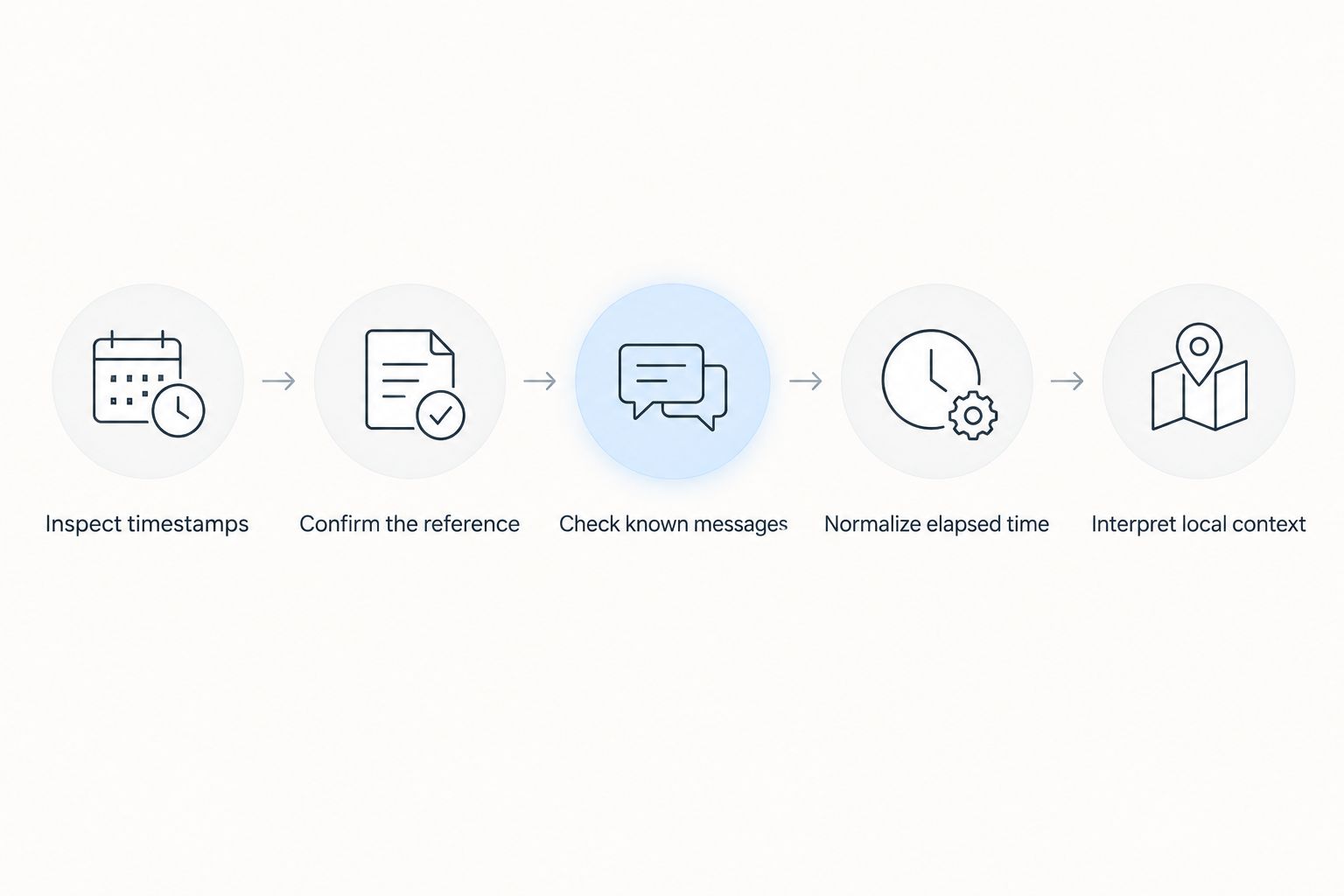
Use this sequence before treating timing metrics as relationship evidence. Keep the original export unchanged so you can distinguish source records from any adjustments you make.
- Inspect timestamps. Find the date format, time format, offset, and any indication of UTC. Check whether sent and received messages use the same structure.
- Confirm the reference. Establish what the export’s clock represents. Consult documentation rather than inferring a rule from the filename or the app’s name.
- Check known messages. Compare an identifiable exchange with its presentation in the original conversation. A remembered event helps orient you, but memory alone is not timestamp documentation.
- Normalize elapsed time. When the timestamps contain enough information, convert them to a shared reference before subtracting them. Do not subtract unmatched local clock readings.
- Interpret local context. Examine daily patterns using the relevant person’s local time where it is known. Keep unresolved location or zone changes visible in your notes.
A successful spot check supports the conversion you checked; it does not establish that every period uses identical rules. Inspect additional periods around travel, clock changes, or changes in export format.
Why timing results vary
Differences between timing summaries do not automatically mean someone changed their communication. First check whether the summaries describe the same records using the same rules.
- Time reference. UTC, offset-bearing timestamps, and unspecified local times require different handling. Mixing them undermines direct comparisons.
- Daylight saving changes. Local clocks can move forward or repeat an hour. A calculation based only on displayed clock times can misstate elapsed time across a transition.
- Travel and relocation. Someone’s relevant local zone can change during a relationship. Do not apply a known current location to the entire history without supporting information.
- Calendar boundaries. A single exchange can fall on different local dates. Daily message totals depend on the zone used to group messages.
- Export representation. A readable timestamp and an underlying stored timestamp are not necessarily presented in the same form. Check the documented export behavior before converting anything.
- Comparison rules. A report grouped by your local day answers a different question from one grouped by the other person’s local day. Use consistent definitions when comparing periods.
Keep these technical issues separate from ordinary availability. Even a perfectly converted timestamp does not establish whether someone had an opportunity to respond.
Which analysis approach fits your question?
Choose an approach based on the task, not on how confident its wording sounds. For a 2026 review, ask whether you need relationship-wide findings, help interpreting a timestamp format, or a reproducible calculation you can inspect yourself.
This is Justlay-authored guidance, not an independent review or an independent endorsement. The comparison below separates the intended uses from the checks you still need to make.
| Approach | Best for | Useful capability | Limitation or required check |
|---|---|---|---|
| Justlay, which offers Grey Mirror | Individuals examining an existing relationship or reflecting on a breakup | Specialized relationship-analysis models produce a timeline, evidence-linked findings, charts, and metrics from exported messages | Confirm how the report handles time zones; those handling details are not established here |
| ChatGPT | Exploring a clearly stated interpretation question | You can supply timestamp examples, explain assumptions, and request alternative readings | A generated explanation is not verification of the export’s actual time reference |
| Manual spreadsheet review | Checking specific timestamp calculations | Explicit conversion rules make individual calculations inspectable | You must supply correct zone information and handle clock changes correctly |
Justlay’s relationship analysis is best suited to individuals reviewing patterns across their own relationship history. That fit does not establish how any particular timing metric is calculated, and a timeline still needs to be checked against its underlying evidence.
For any approach, request the same distinctions: the original timestamp, the conversion rule, the resulting elapsed interval, and the contextual interpretation. If a result does not expose those distinctions, do not treat its timing conclusion as settled.
Can time zones make someone look slower to reply?
A correctly recorded 30-minute reply gap remains 30 minutes after time-zone conversion. Apparent differences arise when local clock readings are compared without their offsets, or when local-hour patterns are mistaken for elapsed-time measurements.
There is a separate contextual issue: the recipient might be asleep during your daytime. Accurate elapsed time describes the wait, while known routines help you discuss whether that wait was expected.
When comparing periods, inspect similar circumstances. A workday exchange and an overnight exchange do not support the same interpretation merely because both have measurable reply gaps.
Does daylight saving time change message analysis?
Daylight saving time changes local clock readings, not the actual passage of time. Offset-aware timestamps preserve the distinction; local timestamps without offsets can become ambiguous around a repeated hour.
For a hypothetical clock change from UTC+02:00 to UTC+01:00, 02:30 occurs at two different instants. A record containing only the local date and 02:30 cannot distinguish those instants without additional information.
Do not repair an ambiguous record by choosing the interpretation that best matches your expectations. Mark the interval unresolved unless the source record or export documentation resolves it.
Should you use your time zone or the other person’s?
Use a shared reference for elapsed-time calculations and each person’s relevant local zone for questions about routines. There is no single local view that answers both questions.
If you ask when you usually initiate conversations, your local time is relevant. If you ask whether a message arrived during the other person’s night, their local time is relevant—and you need evidence of that zone for the period concerned.
For a relationship spanning travel or relocation, divide the history into documented periods rather than imposing one present-day zone on every message. Leave uncertain periods uncertain.
FAQ
Can a text message analyzer tell which time zone someone was in?
A timestamp alone does not necessarily identify someone’s time zone or location. An explicit offset supports conversion to UTC, but multiple locations can share that offset.
Do time zones change the actual time between two texts?
Time zones do not change the actual elapsed time between two texts. Incorrectly comparing local timestamps without accounting for offsets can produce an incorrect calculated gap.
Why does my exported chat show messages on a different day?
A time-zone conversion can move a message across midnight and therefore change its displayed date. Check the export’s time reference before treating the date difference as an error.
Should I convert all my messages to UTC before uploading them?
Follow the analyzer’s documented input requirements rather than rewriting timestamps automatically. Keep the original export unchanged, because an unnecessary conversion can introduce errors or remove useful context.
Can ChatGPT correctly interpret time zones in an exported conversation?
A ChatGPT explanation should be checked against the export format and explicit timestamp information. Ask it to separate recorded facts, conversion assumptions, and interpretations rather than infer a zone from conversational clues.
Does Justlay’s relationship analysis prove why someone replied late?
Justlay’s relationship analysis does not make a delayed reply proof of someone’s intentions. Review evidence-linked findings alongside the original messages, known routines, and unresolved timestamp questions.
What should I check before comparing messaging patterns in 2026?
Check timestamp formats, offsets, daylight saving changes, and the local-day definition used for each comparison. Then compare similar periods and keep any unresolved timing assumptions visible.
One last thing
A technically correct timeline can still support an unfair comparison. Converting every timestamp to UTC fixes a reference problem; it does not make an overnight wait equivalent to a pause during an active conversation.
Before interpreting a reply gap, write down the narrow observation first: the recorded interval, the relevant local hours, and any uncertainty. Then ask what context is missing. That separation gives you a clearer question to discuss without turning a chart into an accusation.