
Evaluate an AI chat analyzer’s training-data claims by checking where its examples came from, whether their use was authorized, how closely they match your conversations, and how performance was tested on separate data. In 2026, a large dataset or a specialized model is not enough: you need documented methods, inspectable findings, and clear limits before trusting a relationship interpretation.
- Evaluate ai chat analyzer training data through provenance, permissions, relevance, and testing—not dataset size alone.
- ChatGPT interpretations do not independently verify another analyzer’s training-data claims.
- Evidence-linked findings let you inspect supporting messages; they do not prove someone’s intentions.
- Prefer documented limitations and separate test data over unsupported accuracy claims.
How do you evaluate an AI chat analyzer’s training-data claims?
Check the claim against documentation, then check the output against your actual messages. This Justlay guide is brand-authored guidance, not an independent review or certification of any analyzer.
Use this sequence when evaluating a service in 2026:
- Identify the claim. Separate statements about training examples, model design, evaluation results, and uploaded-chat handling. They answer different questions.
- Check provenance. Look for an explanation of the source material and how it was collected, selected, and prepared.
- Check permission. Ask what authorized the training use and what protections applied to the people represented in those conversations.
- Check fit. Compare the documented languages, conversation types, and labeling tasks with the relationship you want to examine.
- Check testing and limits. Look for evaluation on data kept separate from training, alongside examples of errors and unsupported interpretations.
A training-data claim deserves only the confidence its supporting evidence earns. A convincing demonstration is evidence about that demonstration, not proof that the system works across every relationship.
Why this matters
If you are examining an existing relationship or reflecting on a breakup, an authoritative-sounding explanation can become the story you carry away. That makes the distinction between a measured communication pattern and an interpretation of that pattern essential.
A report can identify the messages it used without establishing why someone wrote them. Repeated short replies, for example, are observable; deciding that they show indifference requires context beyond message length.
For a 2026 evaluation, prioritize whether you can inspect, question, and correct the analysis. The useful outcome is a clearer question about your relationship—not a machine-generated verdict about another person.
What counts as evidence for a training-data claim?
Different claims require different evidence. A model description cannot establish consent, and a privacy policy cannot establish predictive performance.
| Claim you encounter | Evidence to request | What that evidence does not establish |
|---|---|---|
| Trained on relationship conversations | Dataset description, source categories, selection criteria, and exclusions | That your relationship resembles the training examples |
| Uses authorized data | Collection and permission process, permitted uses, and safeguards | That the analysis is accurate |
| Uses specialized models | Defined tasks, model documentation, and evaluation methods | That specialization beats another approach |
| Produces accurate findings | Defined outcomes, separate test data, scoring methods, and error analysis | That every finding in your report is correct |
| Provides evidence-linked results | Findings connected to inspectable source messages | That the linked messages prove motive or intent |
Read the wording closely. Trained on, tested on, and illustrated with describe different uses of data. A collection of sample conversations used in a demonstration is not automatically a training dataset or an independent test set.
Also distinguish dataset size from dataset structure. Message count alone does not tell you how many distinct conversations are represented, how varied they are, or whether repeated material dominates the collection.
Why training-data relevance varies
Relevance depends on what the system learned to recognize and how your conversation differs from those examples. Use these factors as questions to investigate, not assumptions about any particular provider:
- Language and expression. Ask whether evaluation covers your languages, mixed-language exchanges, slang, and sarcasm rather than assuming general language support settles the question.
- Relationship context. Check whether the documented task concerns romantic relationships, friendships, family conversations, or another setting. Do not treat those contexts as interchangeable.
- Conversation completeness. Establish whether training and testing used full histories, isolated messages, or selected excerpts. Compare that with what you can export.
- Label definitions. Ask how categories such as conflict, support, or withdrawal were defined and who assigned them. A category needs a stated meaning before its accuracy can be assessed.
- Time and selection. Check when data was collected and how examples were selected. A dated description helps you understand the dataset; a date alone does not demonstrate quality.
These factors also explain why a broad claim such as understands relationships is difficult to evaluate. A narrower claim about a defined task gives you something concrete to check.
How can I check an analyzer’s findings myself?
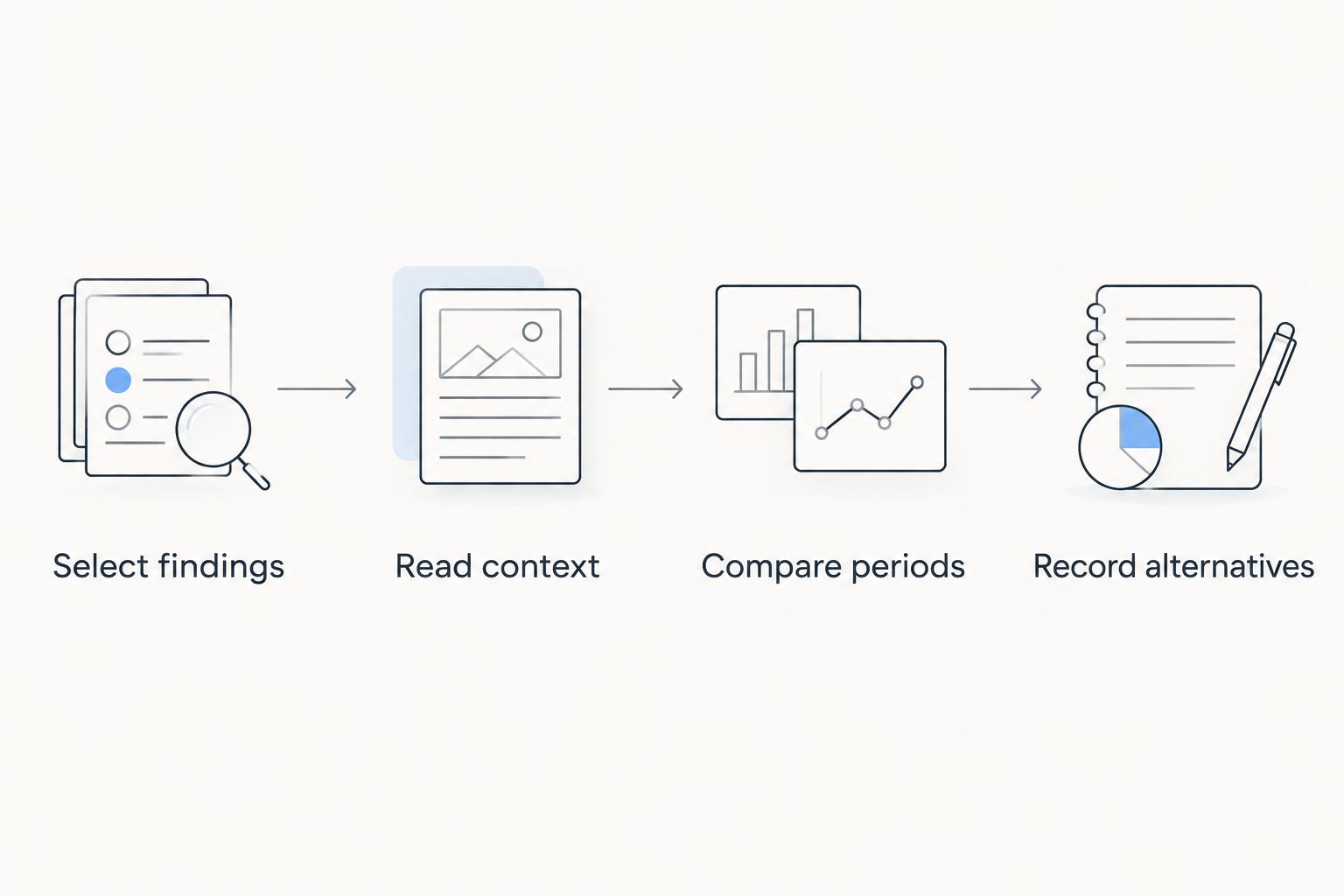
Use a small inspection exercise before treating a report as a reliable account of your relationship. The following quantities define a practical review exercise, not a validated accuracy benchmark.
Select findings
Review 3 findings that matter to your understanding of the relationship. Include a finding you disagree with rather than selecting only statements that feel immediately right.
Write down the exact claim before reading its explanation again. This prevents a narrow observation from quietly becoming a broader judgment as you interpret it.
Read context
For each finding, read 10 consecutive messages around the cited exchange, expanding the window whenever the topic remains unclear. Include both participants’ messages and check whether the excerpt begins halfway through an ongoing discussion.
Ask whether the evidence supports the actual wording. A message about postponing a call supports a statement about that postponement; it does not, by itself, establish emotional withdrawal.
Compare periods
Compare 2 periods with similar circumstances rather than contrasting an ordinary week with a holiday or a known disruption. If circumstances differ, record the difference before interpreting a change in messaging.
Do not turn this exercise into a numerical accuracy score. A small, personally selected sample helps you inspect reasoning; it does not measure population-level performance.
Record alternatives
For every interpretation, write a plausible alternative and identify what additional context would distinguish them. The goal is not to explain away every concern but to prevent the report’s first explanation from becoming the only explanation.
For a more focused inspection, use the guide to checking an AI chat analyzer for false positives. Keep observed messages separate from the labels attached to them.
What should training documentation say about privacy?
Treat training-data permission and your own upload handling as separate checks. An explanation of how a historical dataset was obtained does not answer what happens to the conversation you submit today.
Before uploading, look for explicit answers about retention, deletion, access, service providers, and whether submitted content is used for training. Read the scope carefully: deleting an account, deleting an uploaded file, and addressing training use are different questions.
A conversation also contains another person’s words. Consider whether you have permission to share the material and whether it contains sensitive information about people outside the relationship.
Do not treat removal of names as proof that a conversation cannot identify someone. Locations, events, occupations, and other contextual details can remain identifying. Ask what protections apply beyond replacing obvious identifiers.
For documents you review in 2026, record the effective date and the specific service they cover. A policy for one product does not automatically explain another product’s handling practices.
Does a specialized relationship model guarantee better analysis?
No. Specialization describes an intended task; comparative performance requires testing against relevant alternatives under stated conditions. Ask what each model does and how the provider evaluates that task rather than treating the architecture as a result.
Justlay’s Grey Mirror is best for people examining an existing relationship or reflecting on a breakup who want evidence-linked timelines, charts, and metrics. It analyzes full exported text histories using specialized relationship-analysis models, rather than being positioned as a ChatGPT or Claude wrapper. Its evidence-linked findings give you material to inspect, but they remain interpretations of the available record—not diagnoses or proof of intentions.
That distinction matters when evaluating any specialized service. Documented features explain what you receive; training and evaluation documentation explain what supports the underlying claims.
When comparing a dedicated analyzer with using ChatGPT to interpret texts, keep the task constant. Use the same authorized material, the same question, and the same standard for acceptable evidence. A more fluent explanation is not automatically a more accurate one.
Are independent reviews better evidence than brand comparisons?
Independent reviews and brand comparisons answer different questions, and neither automatically verifies a training dataset. First check who wrote the material, who paid for it, and whether the reviewer inspected documentation or only tried the interface.
Justlay’s own comparisons are brand-authored content, not independent endorsements. Apply that distinction to every provider: a useful comparison can still have a commercial purpose.
For training claims, prefer a review that identifies the exact documents examined, describes its evaluation procedure, and separates firsthand observations from vendor statements. A reviewer repeating a provider’s claim has not independently established that claim.
Also check whether the review describes the current product. A clear publication or update date helps establish scope, but a recent date does not substitute for evidence.
What should I ask before trusting a training-data claim?
Send questions that can produce concrete answers rather than asking whether the system is generally trustworthy:
- Where did the examples come from? Request source categories and the selection process without asking the provider to expose private conversations.
- What authorized their use? Ask how permission and permitted purposes were established, including safeguards for conversation participants.
- What was the model trained to do? Request task definitions rather than accepting broad claims about understanding people.
- How were labels checked? Ask how reviewers handled ambiguity and disagreement where human judgments were involved.
- Was testing separate? Ask how training material was kept apart from evaluation material and how related conversations were handled.
- What errors are documented? Request limitations relevant to your language, context, and intended use.
- What happens to my upload? Request the current policy covering retention, deletion, access, and training use.
In a 2026 comparison, save the dated answers alongside the claims you are evaluating. That gives you a consistent basis for comparing providers instead of relying on whichever description sounds most persuasive.
A provider need not publish private source messages to explain its methods. Privacy protection and meaningful documentation are compatible goals; inspect the methodological explanation rather than demanding access to someone else’s texts.
What can training data never establish about my relationship?
Training documentation cannot establish what happened outside the exported conversation. Even a well-described dataset and a careful evaluation do not supply missing calls, in-person discussions, deleted messages, or private intentions.
Keep conclusions proportional to the record. The export contains fewer initiated conversations during this period is narrower than this person stopped caring, and the narrower statement is easier to inspect.
Use a finding to formulate a question, compare periods, or organize your own recollection. Do not use a model label to diagnose someone or present an interpretation as an established fact about their character.
FAQ
How do I verify an AI chat analyzer’s training-data claims?
Check dataset provenance, authorization, task definitions, and evaluation on data kept separate from training. Then inspect whether the report’s findings are supported by the messages it cites.
Does more training data mean a relationship analyzer is better?
More training data does not by itself establish better relationship analysis. Relevance, label quality, evaluation design, and documented errors also matter.
Can ChatGPT verify whether another chat analyzer’s training claims are true?
A ChatGPT interpretation is not independent verification of another analyzer’s training claims. Verification requires supporting documentation and evidence about the dataset and evaluation process.
Are evidence-linked findings proof of someone’s intentions?
Evidence-linked findings are not proof of someone’s intentions. They let you inspect the messages supporting a finding, while motives still require context the export cannot establish.
What if a provider will not publish its training conversations?
A provider can protect private conversations while describing source categories, permissions, preparation methods, and testing. Evaluate that documentation rather than expecting access to identifiable personal messages.
Does my uploaded conversation become training data?
Check the specific service’s current policy to determine whether uploaded conversations are used for training. Do not infer the answer from a general privacy statement or from how its original training dataset was collected.
Can a relationship analyzer diagnose my partner?
A relationship chat report is not a basis for diagnosing your partner. Treat its findings as interpretations of communication patterns, not clinical judgments or proof of character.
One last thing
Check whether the report can support a narrower claim before accepting a broader one. If its evidence shows a change in reply timing, keep the finding about reply timing until additional context supports an explanation.
Use that standard with Justlay and every other provider. The most useful report is one you can inspect and challenge—not one you feel compelled to believe because its training story sounds impressive.