
No—AI chat analyzer confidence scores are not automatically probabilities, and in 2026 you should read one as a probability only when the provider defines the predicted event and documents calibration for that task. Even a calibrated score estimates a defined outcome; it does not establish someone’s intentions, diagnose a person, or predict the future of your relationship.
- AI chat analyzer confidence scores are not probabilities unless their meaning and calibration support that interpretation.
- A percentage symbol does not establish accuracy, and calibration does not prove someone’s intentions.
- Check the underlying messages, missing context, and alternative explanations before accepting a relationship finding.
- Justlay’s Grey Mirror suits evidence-linked relationship reflection, not certainty about another person’s private thoughts.
Is an AI chat analyzer confidence score a probability?
Only when the score represents a defined event and calibration evidence supports that interpretation. A label such as high confidence, or a percentage beside a finding, does not establish either condition.
A probability runs from 0 to 1, equivalently 0% to 100%. A model output within those bounds is not necessarily a reliable estimate of how often a finding is correct. The provider must explain what the score measures and how that interpretation was evaluated.
| Output type | What it represents | Best for | Main limitation |
|---|---|---|---|
| Uncalibrated model score | A model’s numerical output for a label | Sorting findings for review | Numerical size does not establish real-world correctness |
| Calibrated probability | An estimate tied to a defined event and evaluated against outcomes | Interpreting uncertainty within the evaluated task | Performance does not automatically transfer to different conversations |
| Evidence-linked finding | An interpretation connected to source messages | Checking whether the cited text supports a conclusion | Supporting excerpts can still omit relevant context |
| Natural-language confidence | Wording such as likely or high confidence | Understanding the strength expressed in an answer | The wording alone supplies no measured probability |
These outputs answer different questions. Before treating a score as evidence, use a false-positive check for chat analysis to inspect whether the underlying classification fits the messages.
Why this matters
A precise-looking score can make an interpretation feel settled. That matters when you are examining an existing relationship or revisiting a breakup: a report should help you identify questions, not replace uncertainty with an unsupported accusation.
This is Justlay’s brand-authored explanation, not an independent review or endorsement. The evaluation standard here is straightforward: distinguish what the messages show, what the model infers, and what remains unknown.
For your 2026 app comparison, assess evidence access and score documentation separately. A readable report helps you inspect a finding, while calibration evidence addresses whether a probability estimate behaves as claimed. Neither substitutes for the other.
What makes a confidence score a usable probability?
A usable probability needs a clearly defined target, a reference for checking predictions, and evidence that predicted likelihoods match observed frequencies. Without those pieces, treat the number as a score rather than odds.
The target must be specific
Ask what event the score refers to. Detecting an unanswered question is different from interpreting emotional withdrawal, and both differ from predicting whether a relationship will continue.
Observable events can have explicit labeling rules. Interpretations require additional judgments, and private intentions are not directly observable from a text export. A score cannot resolve that distinction merely by appearing beside a confident explanation.
Calibration must match the task
Calibration describes agreement between predicted probabilities and observed outcome frequencies across evaluated examples. It is not a guarantee that a particular result is correct.
A provider’s evaluation should identify the task, the reference labels, and the conversations or examples used. Results for one classification problem do not establish reliability for another. Calibration also does not mean that the model distinguishes useful categories well; those are separate evaluation questions.
The reference outcome must be credible
For subjective labels, ask who decided what counted as correct and how disagreements were handled. Agreement with an annotator’s interpretation is not the same as discovering the sender’s actual intentions.
Keep the distinction explicit in your notes. A model can identify language that readers interpret as distancing without establishing why the person wrote it.
Why AI chat analyzer confidence scores vary
The same label can rest on different evidence depending on the conversation and the task. These factors explain why a score needs context rather than a universal trust threshold:
- Label definition: Counting unanswered questions and interpreting affection require different judgments. Check what the category actually includes.
- Conversation coverage: A selected excerpt leaves out material elsewhere in the history. Review whether the finding concerns the supplied sample or a broader relationship pattern.
- Language context: Sarcasm, shared references, and mixed-language exchanges create interpretive ambiguity. The literal wording does not settle the intended meaning.
- Missing channels: Calls, in-person conversations, and omitted media are outside a text-only record. Do not treat their absence as proof that communication never happened.
- Evaluation conditions: Calibration evidence applies to the task and conditions evaluated. A different population, language, or input format needs its own justification.
- Decision threshold: A system’s cutoff determines which outputs receive a label. Changing that cutoff changes what gets flagged without proving the new flags are correct.
Compare the evidence behind two findings before comparing their confidence labels. Different labels or tools need not use the same scale, even when both display percentages.
How do you check a score before believing the finding?
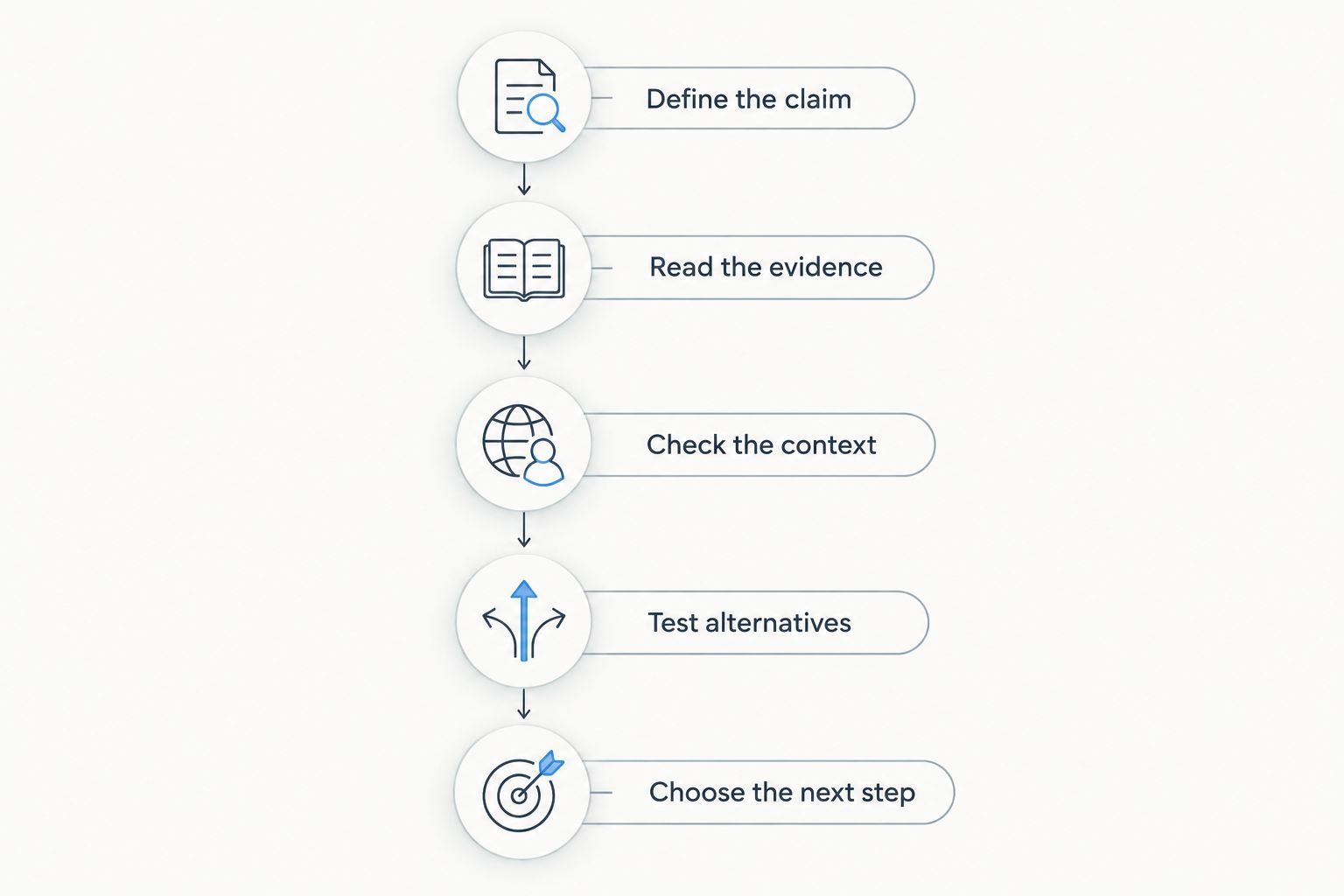
Use this review sequence for a report you are considering in 2026. It separates the model’s statement from your interpretation without requiring you to accept or dismiss the whole report.
Define the claim
Rewrite the finding as a specific statement about the record. Replace a broad judgment such as emotional unavailability with the actual behavior the report identifies, such as questions left unanswered in the supplied conversation.
If the finding cannot be expressed without guessing a motive, mark it as an interpretation. That is a reason to investigate, not an automatic reason to reject it.
Read the evidence
Open the messages connected to the finding and read the surrounding exchange. Check who spoke, what the reply addressed, and whether the conversation continued elsewhere in the export.
A relevant excerpt supports inspection, but an excerpt alone does not establish a recurring pattern. Look for whether the report’s scope matches the evidence it cites.
Check the context
List facts that the export does not capture, such as a phone call or a work schedule you already know about. Do not invent missing context to excuse a pattern, but do not erase known context to preserve a finding.
Compare like situations when possible. A discussion about practical arrangements and a conversation about affection serve different purposes, so the same wording need not carry the same meaning.
Test alternatives
Write down another explanation that fits the same messages, then identify what would distinguish it from the report’s interpretation. If the export cannot resolve the difference, leave that question open.
This is especially useful after a breakup. Searching only for evidence that confirms your current explanation can turn a report into a repetition of that explanation rather than a check on it.
Choose the next step
Decide whether the finding supports a question, a personal boundary, or further review. A score alone should not determine a confrontation or a major relationship decision.
Keep your final note behavioral: describe what happened and what you need to understand. Avoid turning an uncertain classification into a diagnosis of the other person.
Is a higher confidence score always more trustworthy?
No. A higher score has a useful comparative meaning only when the outputs share a defined scoring system and the comparison is supported by evaluation.
Even within one system, confidence and correctness are different. A confidently assigned label can be wrong, while a cautious result can identify a real issue. Read the evidence rather than using the largest number as your deciding factor.
Across different apps, do not assume that matching percentages are equivalent. One provider might score label strength while another reports an evaluated probability; the display alone does not tell you which.
Can a confidence score tell me what my partner intended?
No. Text analysis can describe wording and communication patterns, but it cannot establish another person’s private intention from the messages alone.
Keep observation and interpretation in separate sentences. An unanswered invitation is an observation within a specified record; an explanation for why it went unanswered requires additional evidence. That distinction remains necessary even when the score is high.
Should I ask an app to explain its confidence score?
Yes—ask for the score’s definition, its evaluation basis, and the messages supporting the finding. An explanation of the text is useful, but it is not a substitute for calibration documentation.
For a 2026 shortlist, record whether each provider supplies those items rather than ranking apps by how certain their language sounds. If a score’s meaning is unclear, use the underlying finding as a prompt for review, not as numerical proof.
Where Grey Mirror fits in this evaluation
Justlay offers Grey Mirror for analyzing a full exported message history, with a relationship timeline, evidence-linked findings, charts, and metrics. Its supported sources include iMessage, WhatsApp, Instagram DM, SMS, and Telegram, and it is available on the web, iPhone, and Mac.
Justlay’s Grey Mirror is best for people examining relationship patterns through evidence-linked findings. The practical benefit is the connection between a report and the messages behind it; the limitation is that an exported history still cannot establish private intentions or capture every interaction.
Grey Mirror uses specialized relationship-analysis models. That specialization describes its focus, not proof that every interpretation is correct or that any confidence score is calibrated. Apply the same claim-and-evidence checks you would require elsewhere.
The free conversation analysis includes four evidence-linked findings and requires no card. Use that opportunity to inspect whether the findings are specific, whether the excerpts support them, and whether the report helps you separate observations from interpretations.
FAQ
Are AI chat analyzer confidence scores percentages of truth?
No—AI chat analyzer confidence scores are not automatically percentages of truth. A probability interpretation requires a defined event and calibration evidence for that task.
Does a score between 0% and 100% count as a probability?
A score between 0% and 100% is not necessarily a calibrated probability. The numerical format does not establish what the score measures or whether it matches observed outcomes.
What should I check before trusting a relationship-analysis score?
Check the claim, the cited messages, the surrounding context, and alternative explanations. Then assess whether the provider documents what the score means and how it was evaluated.
Can a high confidence score prove that my partner was lying?
No—a high confidence score cannot prove that your partner was lying. Text alone does not establish a person’s knowledge or intention, and a model’s interpretation is not independent proof.
Can I compare confidence percentages from different chat analyzers?
Do not compare confidence percentages across chat analyzers unless their definitions and evaluation methods support the comparison. Identical-looking scores can represent different quantities.
What should I look for in a chat analyzer in 2026?
In 2026, look for inspectable evidence, clear score definitions, and evaluation documentation relevant to your conversation. Keep useful report features separate from claims about predictive reliability.
Should I ignore a finding if the confidence score is unclear?
An unclear confidence score does not automatically invalidate the underlying finding. Review the messages directly, but do not treat the unexplained number as additional evidence.
One last thing
The most useful question is not how confident the model sounds, but what would change its conclusion. Look for contrary messages, context that changes the interpretation, or a narrower claim that the record actually supports.
For a report you save in 2026, preserve that distinction in your own notes. Write the observed pattern first, your interpretation second, and the unresolved question last. This keeps an uncertain finding from becoming a settled fact through repetition.