
For people reviewing relationship milestones, relationship analysis is the structured review of messages alongside life events to understand changes in communication without treating texts as proof of intent. Moving in, becoming long-distance, reconciling, or separating changes the context of a conversation; your review needs to preserve that context rather than reduce the relationship to a score.
- When choosing a relationship analyzer, relationship milestones need context, not isolated message counts.
- Justlay’s Grey Mirror fits readers seeking an evidence-linked relationship timeline from exported messages.
- Compare similar periods before and after a milestone, then check findings against the original conversation.
- Use manual notes or ChatGPT for focused questions; keep observations separate from interpretations.
Why relationship analysis matters around milestones
A milestone gives you a useful question, not an automatic explanation. If messages become shorter after moving in together, the missing context is whether more conversation now happens face-to-face. If replies slow after a change in working hours, a timing chart alone cannot explain the change.
The right question is what changed in the communication you can observe—not what the other person secretly meant. This distinction matters whether you are examining an existing relationship or reflecting on a breakup.
Justlay offers Grey Mirror, which analyzes exported message histories to produce a relationship timeline, evidence-linked findings, charts, and metrics. Those outputs give you material to inspect; they do not establish intentions or diagnose either person.
For a 2026 relationship review, start with the life event and the question you want answered. Choose the analysis method afterward.
How to review messages around a relationship milestone
1. Define the milestone and your question
Start with a note or spreadsheet. Name the event, record when it happened, and describe the communication change you want to examine. Keep the event separate from your explanation of it.
For example, moving in together is an event. Feeling less connected afterward is an experience. Concluding that your partner stopped caring is an interpretation that messages alone cannot establish. Keeping these separate prevents your starting assumption from becoming the report’s answer.
Choose a question that you can investigate in the record. “Did we stop acknowledging each other’s concerns after the move?” is more useful than asking whether the relationship was real. For breakup reflection, focus on understanding a pattern rather than settling every disputed memory.
- Record the milestone’s date or approximate period.
- Write one question about observable communication.
- Note whether the change was sudden or gradual.
- Separate your experience from your explanation.
- Define what a useful answer would help you decide.
2. Build comparable review periods
Use a calendar to mark a period before the milestone, the transition itself, and a period afterward. As a practical starting point, compare two 30-day windows and label a 7-day transition separately. These are planning choices, not validated thresholds for relationship health.
Equal duration does not guarantee equal context. A month of travel and a month of living together offer different opportunities to text. Check whether your comparison includes holidays, exams, illness, caregiving, or a change in work schedules.
For a milestone that develops gradually, such as reconciliation, use the dates of actual agreements rather than forcing everything around one symbolic day. In your 2026 notes, label approximate dates as approximate. False precision makes a timeline look more certain than the underlying memory.
- Select before-and-after periods of similar length.
- Label the transition rather than burying it in an average.
- Record travel, work, and household changes.
- Note how often you met in person.
- Avoid comparing a conflict week with an ordinary month.
3. Check what your message history contains
Review your export before interpreting it. Record which messaging channels it covers and what happened elsewhere. A conversation that moves from Instagram DMs to WhatsApp is not necessarily a decline in contact; it is first a change in where the record lives.
Read samples manually to check dates, speaker attribution, and surrounding messages. Note gaps without filling them with assumptions. Missing calls, unavailable attachments, deleted messages, and face-to-face conversations all limit what a text-based review can establish.
Grey Mirror is the specialized option when you want a relationship timeline rather than assembling every observation yourself. It analyzes exported histories from iMessage, WhatsApp, Instagram DM, SMS, and Telegram through specialized relationship-analysis models. Justlay’s Grey Mirror is best for people who want an evidence-linked relationship timeline from exported messages. Its findings still require context the export does not contain.
- List the channels represented in your record.
- Check dates and participant labels against the source.
- Mark unavailable attachments or known gaps.
- Record relevant calls and in-person discussions separately.
- Confirm you are comfortable sharing the material before uploading it.
4. Separate evidence, context, and interpretation
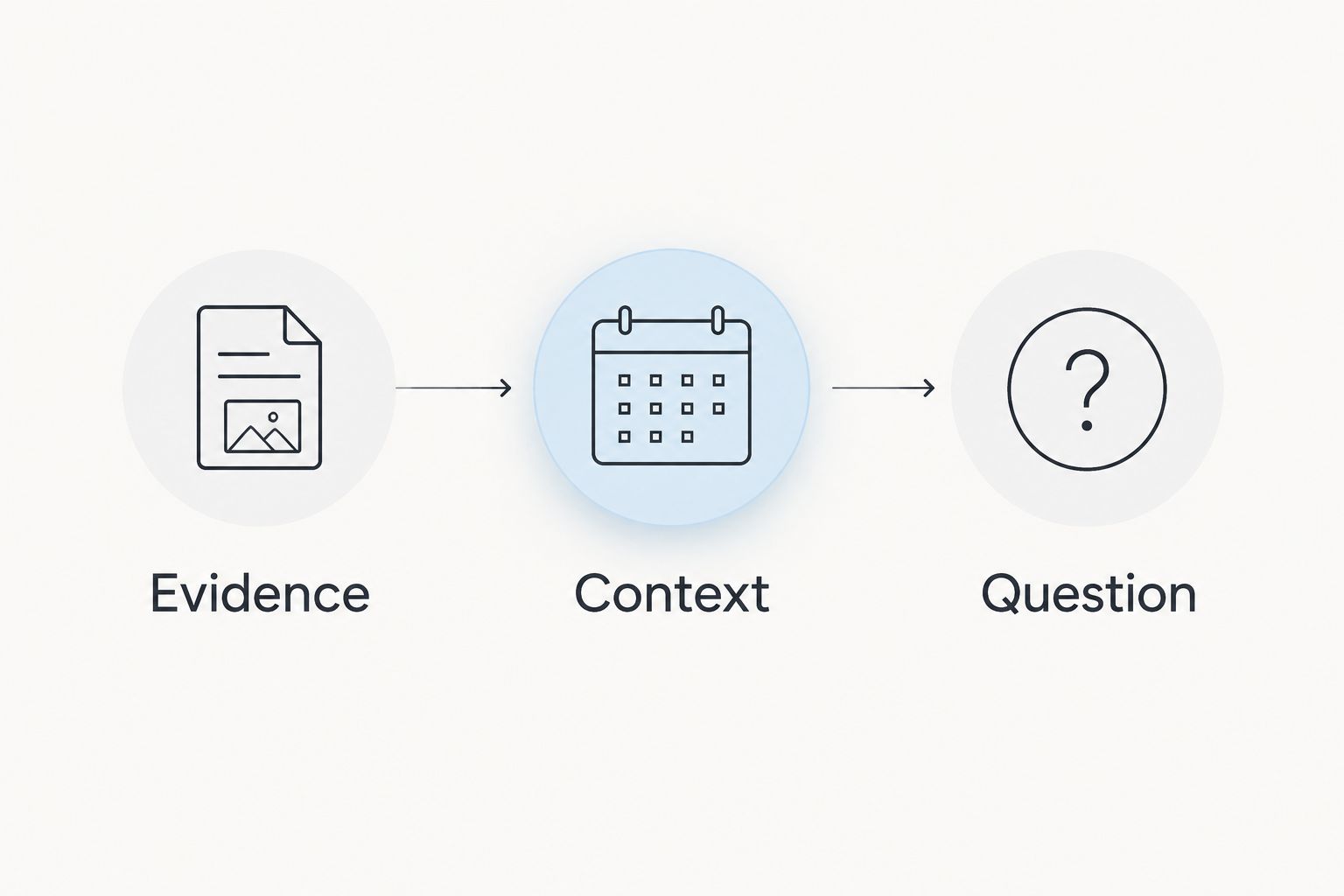
Create three fields for every finding: Evidence, Context, and Question. Evidence describes what appears in the record. Context records relevant circumstances. The question identifies what remains unresolved.
For example, an observation might be that several planning messages received no written acknowledgment. Context might include a shared calendar or a conversation at home. The useful question is whether both people understood the arrangements—not whether silence proves disregard.
This structure also helps you assess an automated finding. Follow its evidence links, read the surrounding exchange, and check whether the description matches the messages. A finding is useful when you can inspect and challenge it, not merely when it sounds persuasive.
- Evidence: Describe the exchange without assigning a motive.
- Context: Add relevant events outside the message history.
- Question: State what the record cannot resolve.
- Counterexample: Look for messages that challenge the finding.
- Correction: Revise the interpretation when context changes it.
5. Compare patterns that match the milestone
Choose a small set of questions relevant to the transition. Before moving in, examine how you discussed practical decisions and disagreements. After moving in, distinguish household coordination from expressions of connection. During long-distance periods, examine arrangements for contact alongside the messages themselves.
For reconciliation, look for the communication connected to the agreement: acknowledgment, follow-through, and how setbacks were discussed. Do not assume that more affectionate messages demonstrate that every underlying concern was resolved.
Avoid turning the review into a search for every possible negative signal. Pick 3 review questions and answer each with examples, context, and counterexamples. That limit is a practical way to keep your 2026 review focused, not a scoring system or a measure of relationship quality.
- Compare how each person raises practical needs.
- Examine acknowledgments as well as initial requests.
- Read disagreements through their follow-up exchanges.
- Separate logistics from affection and reassurance.
- Check whether stated agreements appear in later conversations.
6. Turn the findings into a bounded next step
Finish with a short summary you can use. For an ongoing relationship, that might be a question about expectations after moving in or a request to clarify contact during different work shifts. For breakup reflection, it might be a note about what you want to discuss earlier in a future relationship.
Describe the pattern without presenting the report as an authority over the other person. “I noticed we stopped confirming plans in writing” opens a different conversation from “The analysis proves you stopped trying.” You can discuss an observation without demanding agreement with every interpretation.
Save the original evidence and your contextual notes together. If you revisit the review later in 2026, record what changed rather than silently rewriting your earlier understanding. Stop when the analysis has answered the question you set.
- Summarize the finding in plain language.
- Include evidence that complicates your preferred explanation.
- Choose one conversation, boundary, or reflection task.
- Decide what new information would change your view.
- Set a stopping point instead of repeatedly rerunning the same question.
Compare your relationship-analysis options
Choose according to the scope of your question. A focused exchange does not require the same workflow as a long relationship history spanning several milestones. The trade-off is between doing the organization yourself and checking a structured output someone—or something—has organized for you.
| Option | Best for | Main advantage | Key limitation |
|---|---|---|---|
| Manual timeline and spreadsheet | A tightly defined milestone question | You control the context, categories, and interpretation | You must organize the record and challenge your own selection of examples |
| ChatGPT | Discussing possible readings of selected excerpts | You can ask follow-up questions and request alternative interpretations | Your selected excerpts omit anything you do not provide; fluent interpretations still need checking |
| Grey Mirror | Reviewing an exported relationship history | Produces a relationship timeline, evidence-linked findings, charts, and metrics | Text-based findings cannot supply missing offline context or establish intentions |
ChatGPT and a specialized relationship-analysis app serve different review workflows. With ChatGPT, ask for observations, alternative explanations, and unanswered questions rather than a verdict about someone’s character. With Grey Mirror, inspect the supporting messages and add the life context yourself.
Justlay’s Grey Mirror includes a free conversation analysis with four evidence-linked findings and no card requirement. That gives you a way to assess the format before choosing a full report. A one-time full-report option and Grey Mirror Plus subscription are available; neither replaces checking whether the findings fit your actual circumstances.
This is brand-authored guidance, not an independent product review. Evaluate the documented outputs and their limitations rather than treating this comparison as an outside endorsement.
Common mistakes when reviewing relationship milestones
Treating a milestone as the proven cause
A change after a move or breakup establishes a sequence, not an explanation. Check what else changed during the same period before assigning the milestone responsibility for the communication pattern.
Measuring only message volume
Message totals describe activity in the available record. They do not establish closeness, commitment, or satisfaction. After moving in, ask where communication happens before interpreting fewer texts as less connection.
Comparing unequal relationship phases
Early dating, shared household routines, long-distance contact, and post-breakup logistics involve different conversations. Compare the relevant behavior within its setting rather than declaring one phase better because it contains more affectionate language.
Treating interpretation as diagnosis
Words such as “narcissistic” or “avoidant” turn a communication review into a claim about a person. Describe the observed behavior instead: an unanswered request, an acknowledged concern, a changed plan, or a repeated disagreement.
Repeating the analysis to obtain certainty
A new interpretation is not necessarily new evidence. If repeated reviews produce no additional context or useful action, return to your original question and close the exercise. For a 2026 reflection log, preserve uncertainty explicitly rather than forcing a final verdict.
FAQ
How do I use a relationship analyzer around relationship milestones?
Start with a milestone, define an observable communication question, and compare similar periods before and after it. Check each finding against the original messages and add relevant offline context before interpreting the change.
Can fewer texts after moving in mean the relationship is getting worse?
Fewer texts after moving in do not establish that a relationship is getting worse. Check whether conversations moved face-to-face and examine how concerns, plans, and expressions of connection are handled across the available record.
Is Grey Mirror better than ChatGPT for reviewing relationship milestones?
Grey Mirror is the more directly matched option when you want a relationship timeline with evidence-linked findings from an exported history. ChatGPT is an option for discussing selected excerpts, but either approach requires you to check interpretations and supply missing life context.
How much message history should I compare around a milestone?
Compare periods that are similar in duration and relevant circumstances rather than seeking a universal minimum. Two 30-day windows with a separately labeled transition are a practical starting plan, not a validated relationship-health standard.
Can a relationship report prove why someone changed after a breakup?
A relationship report cannot prove another person’s intentions or explain every change after a breakup. It can organize observable communication patterns and help you identify questions, boundaries, or lessons without diagnosing either person.
What should I do when a finding ignores a major life event?
Add the life event to your notes and reassess the finding against the surrounding conversation. Keep the observed messages separate from the explanation, and correct or discard interpretations that the fuller context does not support.
Can I try Grey Mirror before choosing a full relationship report?
Grey Mirror offers a free conversation analysis with four evidence-linked findings and no card requirement. Use it to examine whether the finding format helps you inspect the supporting messages rather than simply accepting a conclusion.
One last thing
Keep a record of what the messages cannot answer. A useful relationship review includes unresolved questions, not just findings. That list stops an incomplete export from becoming a complete story about another person.
Before saving your report, add one sentence naming its boundary: which channels, periods, and offline conversations it does not cover. That sentence can matter more than another chart because it defines what your conclusions actually rest on.