
A WhatsApp chat analyzer can interpret the edited wording present in your export and its surrounding conversation, but it cannot recover earlier wording that the file does not contain. In 2026, an edited-message finding should distinguish visible text, any preserved edit marker, and interpretation—never treat an edit as proof of dishonesty or intent.
- For whatsapp chat analyzer edited messages questions, WhatsApp exports—not assumptions—set the evidence limit.
- An edited label identifies a change, not the original wording or the reason for changing it.
- Grey Mirror suits relationship reflection through evidence-linked findings, not recovery of missing message versions.
- Check the exported text before accepting claims about edits, tone, or relationship patterns.
Why this matters
An edited apology and an edited shopping list carry the same basic uncertainty: the final wording does not reveal what changed. If you are examining a difficult relationship or reflecting on a breakup, filling that gap with a suspected original message turns an unanswered question into a false conclusion.
Justlay’s Grey Mirror is best for people examining patterns across an existing relationship through evidence-linked analysis. It analyzes exported message histories to produce relationship timelines, findings, charts, and metrics. That makes checking the underlying messages central to evaluating a report; it does not make unavailable versions observable.
This is a brand-authored guide, not an independent review or endorsement. The standard below applies equally to a specialized relationship-analysis app and a conversation you paste into ChatGPT.
What can a WhatsApp analyzer tell from edited messages?
A WhatsApp analyzer can assess the message content and conversation structure actually available to it. Whether it can identify an edit depends on whether the supplied material preserves an explicit indication of editing; whether it can compare versions depends on whether those versions are supplied.
WhatsApp’s Help Center describes a 15-minute editing window and an edited label visible to recipients, without displaying an edit history. That interface behavior does not establish what your particular exported file preserves. For a 2026 analysis, inspect the file rather than assuming that everything visible in the app appears in the export.
| Evidence supplied | What an analyzer can assess | What that evidence cannot establish |
|---|---|---|
| Final message text | Wording, apparent tone, and surrounding exchanges | What the message said before editing |
| An explicit edited marker | That the supplied record identifies a message as edited | The reason for editing or the original text |
| Separately preserved versions | Differences between the supplied versions | Whether other intermediate versions existed |
| Replies around the message | How the visible conversation developed | Which wording a recipient saw before replying |
| No edit information | The conversation as supplied | Whether an unmarked message was never edited |
The absence of edit information is not evidence that no editing occurred. Equally, a visible edit is not evidence of manipulation. Those are different claims, and neither follows from final wording alone.
Final wording: useful for context, limited for reconstruction
The final text can help you examine how someone phrased a request, acknowledged a concern, or responded to a disagreement. Its strongest use is contextual: read it alongside the messages before and after it.
Its limitation is historical. A softer final message does not establish that the original was harsher, just as a blunt final message does not establish that the original was kinder. Do not ask a report to reconstruct a hidden draft from tone.
Preserved versions: useful for comparison, limited for motive
If you legitimately have both an earlier version and a later version, you can compare the wording directly. Describe the observable difference: a sentence was removed, a date changed, or an apology added.
Keep the interpretation separate. A wording change does not establish why someone made it, whether they intended harm, or whether the recipient read the earlier version. Preserve the source of each version so a comparison does not quietly mix unrelated records.
Why edited-message analysis varies
The quality of an edited-message finding depends on the evidence and the question being asked. These factors determine whether a conclusion stays grounded:
- Export contents. A report cannot compare earlier wording when the supplied file contains only final wording. Inspect the actual message entry before relying on an edit-related claim.
- Preserved edit information. An explicit marker supports identifying an edit. Without one, the analyzer needs another documented source before describing a message as edited.
- Conversation coverage. A short excerpt excludes exchanges that might change how a message reads. State the period covered instead of treating the excerpt as the whole relationship.
- Available message formats. Text alone does not include the content of an omitted voice note, photograph, or call. A reaction to missing material can be difficult to interpret.
- Reply context. A reply beside a final message does not establish which version prompted that reply. Sequence and exposure are separate questions.
- Interpretation rules. Describing observable wording is different from assigning motives. Require the report to identify where observation ends and interpretation begins.
These are evidence limits, not reasons to discard every finding. A report can still organize a conversation usefully while leaving a particular edit unexplained.
How do I check an edited-message finding myself?
Use the same review process for a 2026 report whether you uploaded a full history or pasted an excerpt. Start with the source, not with whether the conclusion feels familiar.
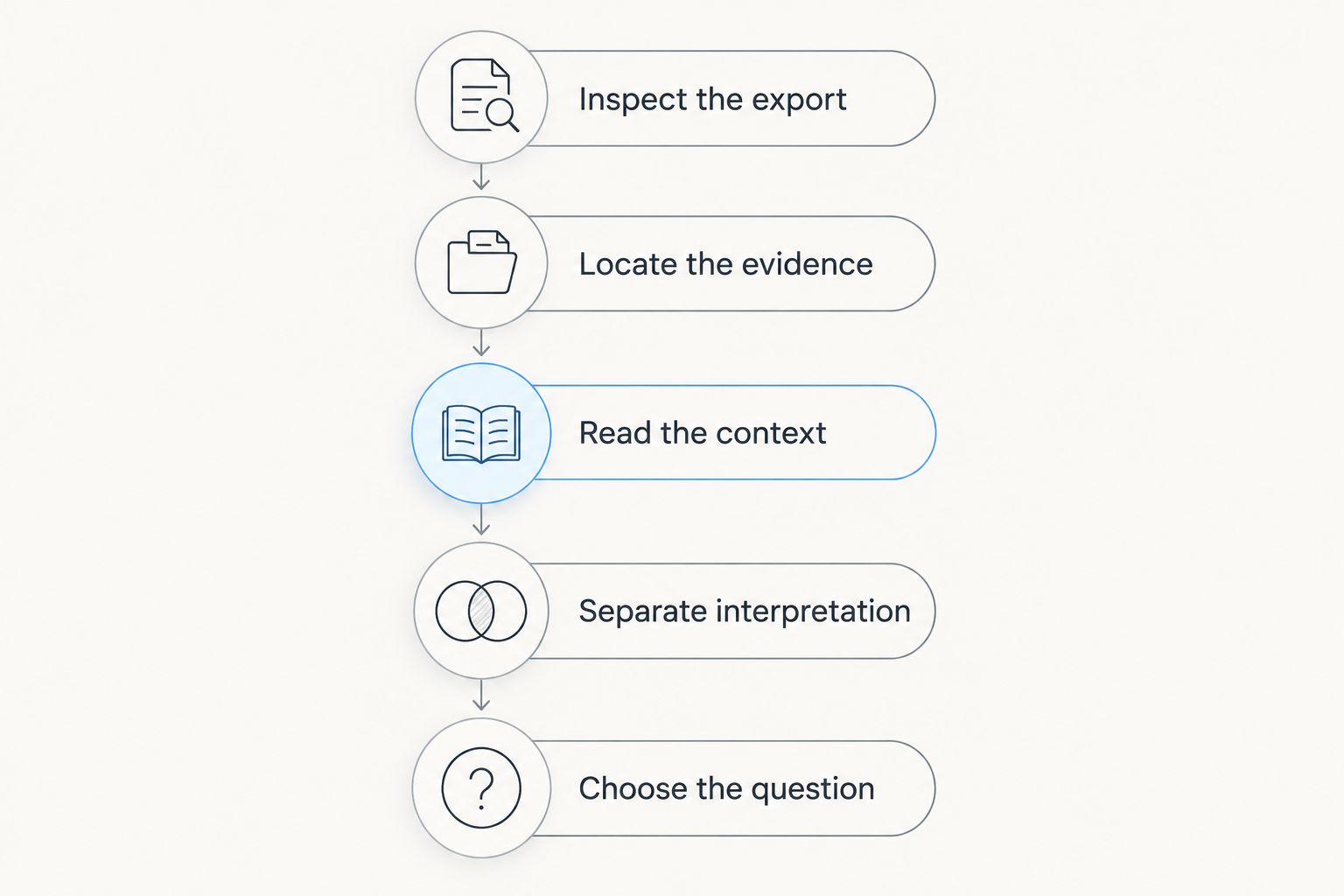
- Inspect the export. Open the relevant message entry in the file you supplied. Check the wording, any visible marker, and the surrounding entries.
- Locate the evidence. Find the exact message or passage supporting the report’s claim. If the claim concerns an earlier version, identify where that version came from.
- Read the context. Review the exchange around the message, including references to missing calls or media. Do not substitute imagined content for those gaps.
- Separate interpretation. Rewrite the finding as an observation followed by a clearly labeled interpretation. Remove any explanation that the supplied messages cannot establish.
- Choose the question. Turn any remaining uncertainty into something you can examine or discuss, rather than a verdict about someone’s character.
A useful observation is that a message contains an apology and the next reply continues the disagreement. Claiming that the apology was added to conceal hostility requires evidence about the earlier wording and still does not establish motive.
Save your corrected summary alongside the finding. That keeps a persuasive interpretation from becoming more certain each time you reread it. If the evidence supports only a narrower conclusion, the narrower conclusion is the useful one.
Should I use Grey Mirror, ChatGPT, or read the export myself?
Choose the workflow that makes its evidence easiest to inspect. A specialized report, an interactive discussion, and direct reading serve different purposes; none can supply a missing edit history simply because you ask for it.
| Option | Best for | Strength | Limitation |
|---|---|---|---|
| Grey Mirror | Examining patterns across a relationship history | Specialized relationship-analysis models, a timeline, evidence-linked findings, charts, and metrics | Its findings still need checking against the supplied conversation |
| ChatGPT | Discussing wording and possible interpretations of a supplied excerpt | You can ask follow-up questions about the material you provide | A plausible explanation is not evidence of unseen wording or intent |
| Reading the export yourself | Verifying a specific message or claim | Direct access to the source material | Keeping a long history organized requires your own notes and review |
Grey Mirror uses specialized relationship-analysis models; it is not presented here as a ChatGPT or Claude wrapper. Its relevant benefit is organizing an existing relationship history into inspectable findings, not reconstructing unavailable message versions.
ChatGPT is useful when your question is narrow and you want to challenge an interpretation. Ask it to identify the exact supporting words, list alternative explanations, and state what the excerpt does not establish. Do not accept confidence or fluent wording as verification.
Direct reading is the final check for either approach. It also lets you reject a finding without replacing it with a competing story: sometimes the correct result is simply that the evidence does not answer the question.
What does trying Grey Mirror involve?
For 2026, the free conversation analysis includes four evidence-linked findings and requires no card. A full relationship report costs $17.99 USD once, or Grey Mirror Plus costs $9.99 USD/month for one full report each paid month.
Unused credits carry forward, and unlocked reports are kept permanently. Choose based on whether you want a single report or recurring monthly report credits—not on an expectation that payment reveals missing message versions.
Can a WhatsApp analyzer recover the original edited message?
A WhatsApp analyzer cannot recover original wording from final text alone. To compare versions, it needs those versions from an actual source, not a prediction about what someone probably wrote.
If a report presents an original sentence, ask where that sentence appears in the supplied material. A suggested reconstruction must not be displayed or treated as a recovered message.
Does an edited WhatsApp message mean someone is hiding something?
An edited WhatsApp message does not establish concealment. It shows a change only when the evidence actually identifies one; it does not establish the reason for that change.
For relationship reflection, focus on documented exchanges and questions you can discuss. Avoid turning an edit into a diagnosis, an accusation, or proof of what someone intended.
Can I tell whether a reply came before or after the edit?
A reply timestamp alone does not establish which message version the recipient read. Resolving that question requires relevant version and timing evidence, not just the order of the final conversation.
When that evidence is unavailable, keep the uncertainty in your notes. Do not label a reply inconsistent merely because it seems mismatched with the final wording.
FAQ
Can a WhatsApp chat analyzer see what an edited message originally said?
A WhatsApp chat analyzer cannot see original wording unless that wording is included in the supplied evidence. Final text is not a record of every previous version.
Does WhatsApp show people an edit history?
WhatsApp shows an edited label rather than an edit history. Its Help Center describes a 15-minute editing window; inspect your export separately to establish what it preserves.
Will my WhatsApp export include an edited label?
Check the actual exported file to determine whether it includes an edited label. A label visible inside WhatsApp does not by itself establish what the exported material contains.
Is ChatGPT better than a relationship-analysis app for edited texts?
Neither approach can recover wording absent from the supplied material. ChatGPT supports follow-up discussion, while a specialized relationship-analysis app can organize a history into structured findings.
Can edited messages prove manipulation in a relationship?
Edited messages alone do not prove manipulation. Separate observable changes from interpretations, and do not use an edit to diagnose a person or establish intent.
Should I upload more messages to explain a confusing edit?
Include relevant surrounding context only when you have permission and are comfortable with the service’s data practices. More context can clarify the visible exchange, but it does not recreate an unavailable original version.
Can I use a chat-analysis report after a breakup?
Use a chat-analysis report after a breakup to organize observations and questions, not to establish what an ex-partner secretly meant. Stop revisiting a particular finding when the source evidence cannot resolve it.
One last thing
Before acting on any edited-message finding in 2026, write down the claim without an explanation of motive. If the claim no longer sounds significant without words such as deliberately or secretly, check whether the evidence supports those additions.
The most useful finding is not the strongest accusation; it is the clearest statement you can trace back to the conversation. An unanswered question can stay unanswered without making the rest of your reflection pointless.