
Analyze the private WhatsApp chat first when your question concerns a relationship between two people; analyze the group history when your question concerns participation, coordination, or interactions involving several people. Keep the histories separate, because a message sent to a group does not establish how someone communicates privately, and neither history proves intentions.
- For whatsapp chat analyzer group vs private decisions, choose the history that matches your relationship question.
- WhatsApp private chats suit direct communication questions; group chats suit questions about shared interactions.
- Keep group and private findings separate before comparing patterns across the same period.
- Justlay offers Grey Mirror for evidence-linked relationship analysis; confirm group-format support before submitting a group export.
WhatsApp group or private chat: which history should you analyze?
Start with the conversation where the behavior you want to understand actually occurred. A private exchange is the better starting point for questions about direct replies, disagreements, and attempts to reconnect. A group history is the better starting point for questions about shared planning, participation, and responses in front of other people.
Justlay offers Grey Mirror, which analyzes exported message histories to produce relationship timelines, evidence-linked findings, charts, and metrics. That describes a relationship-analysis workflow, not confirmation that every group export is supported.
| History | Best for | What you can examine | Main limitation |
|---|---|---|---|
| Private WhatsApp chat | Examining a relationship between two people | Direct exchanges, questions, replies, disagreements, and follow-through within that thread | Excludes group interactions and conversations elsewhere |
| WhatsApp group chat | Examining shared interactions | Who participates, which topics receive responses, and how coordination unfolds | A message is not necessarily addressed to every participant |
| Separate private and group histories | Comparing communication settings | Whether an observed pattern appears in both settings during a matched period | Requires consistent participant identification and careful interpretation |
For a relationship review in 2026, choose one primary question before choosing a file. More messages do not automatically make the evidence more relevant.
Why this matters
A group chat and a private chat answer different questions. Treating them as interchangeable can turn a difference in setting into a judgment about a person.
For example, no reply to a group announcement does not establish that someone ignored a direct request. Before interpreting silence, check whether the message named a recipient, asked a question, or required any response at all.
The same discipline matters after a breakup. Use analysis to identify what happened in the available record, not to obtain certainty about what another person felt. An evidence-linked finding is a starting point for inspection, not a diagnosis or a verdict.
Private chats: best for direct relationship questions
A private chat has two participants. That makes the intended audience clearer than in a group, although it does not resolve every ambiguity about meaning or context.
Start here if you want to examine how you discussed plans, responded to concerns, or returned to a disagreement. Read complete exchanges rather than isolated messages: a short reply after a long conversation means something different from the same reply without that surrounding context.
Useful private-chat questions include:
- Direct requests: Was a question answered in the visible exchange?
- Conflict repair: Did either person acknowledge the disagreement or suggest a next step?
- Follow-through: Did later messages refer back to an earlier commitment?
- Change over time: Did the same observable pattern recur across comparable periods?
The advantage is relevance to the relationship you are examining. The limitation is incomplete coverage: an export cannot stand in for phone calls, in-person conversations, or messages on another platform.
For your 2026 review, describe that boundary explicitly. Write that a subject did not receive a visible reply in the exported thread, rather than claiming the subject was never discussed.
Group chats: best for shared interactions
A group history with three participants already presents a question a private chat does not: who was each message for? Identify the intended recipient before treating a response, or lack of one, as evidence about a particular relationship.
Group analysis suits questions about a shared event, household coordination, or an exchange that took place in front of others. It is less direct evidence for a question about private closeness because the audience and purpose differ.
Useful group-chat questions include:
- Participation: Who contributes to the particular topic you are examining?
- Coordination: Which requests receive a clear acknowledgment or decision?
- Recipient clarity: Does the message name someone or address the whole group?
- Visible disagreement: What was said, who responded, and what happened next in the thread?
The benefit is access to interactions absent from the private history. The limitation is attribution: several conversations can overlap, and a later message might respond to an earlier topic rather than the immediately preceding message.
Do not label someone dismissive because a group question received no reply. First establish whether the question addressed that person and whether another participant answered it.
How should you compare a group chat with a private chat?
Compare the settings separately before drawing a cross-setting conclusion. Combining everything into one undifferentiated history removes the distinction you are trying to investigate.
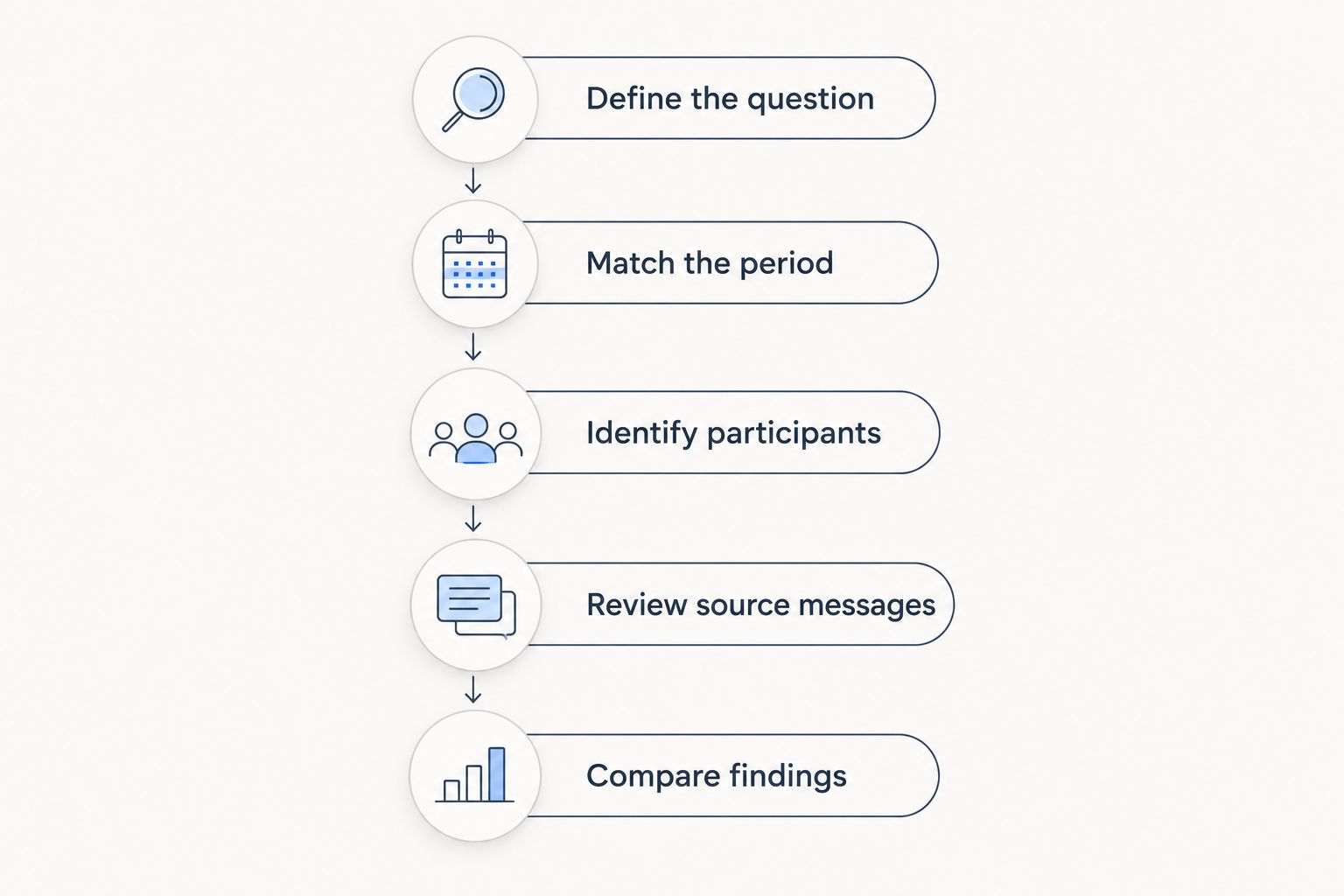
Use this sequence for a 2026 comparison:
- Define the question. Write an observable question, such as whether planning requests receive clear responses. Avoid asking the report to determine whether someone cares.
- Match the period. Select corresponding periods from the private and group histories. Do not compare a private disagreement with an unrelated stretch of group conversation.
- Identify participants. Check how each person appears in each file. Confirm that different display names do not lead you to treat the same person as separate participants.
- Review source messages. Read the evidence around each finding, including messages before and after the cited exchange. Keep the original conversation setting visible.
- Compare findings. Record similarities, differences, and explanations the messages cannot settle. Separate a repeated observation from an interpretation of its cause.
A useful comparison states both the observation and its boundary. You might record that a planning question received an acknowledgment privately but no visible acknowledgment in the group, then note that the messages do not establish why.
That is more precise than declaring that someone behaves differently in public. The narrower statement gives you something concrete to discuss without converting an incomplete record into a character judgment.
Why the right history varies
The right export depends on the question and the available context, not simply the size of the file. Use these factors to decide which history deserves attention first:
- Your question: Private relationship questions belong first with direct exchanges; group coordination questions belong first with the group record.
- Intended audience: A direct request and a general announcement create different expectations. Identify the recipient before evaluating the response.
- Conversation purpose: Keep practical planning separate from emotional discussion when judging whether exchanges changed.
- Coverage: Note when relevant discussion happened through calls, in person, or on another platform. Do not treat absence from the export as absence from the relationship.
- Available context: Missing media, absent messages, and unexplained references limit what you can conclude from the visible text.
- Time period: Compare corresponding stretches of the relationship rather than contrasting unrelated events or stages.
These checks also help you challenge a report. If an interpretation depends on context the export does not contain, retain the observation and set the interpretation aside.
Which analyzer workflow fits your question?
Justlay's Grey Mirror relationship analysis is best for individuals examining patterns across an existing relationship or reflecting on a breakup. Its documented outputs include a relationship timeline, evidence-linked findings, charts, and metrics, using specialized relationship-analysis models rather than a general-purpose chat interface.
The useful distinction is the workflow, not a claim that one system knows another person's mind. Evidence links let you inspect the messages behind a finding; they do not turn an interpretation into proof. Confirm that the intended export format and participant structure are supported before submitting a group history.
| Workflow | Best for | Useful approach | Main limitation |
|---|---|---|---|
| Justlay's Grey Mirror relationship analysis | Reviewing patterns across an exported relationship history | Inspect timeline findings alongside their linked evidence | A report cannot establish intentions or replace missing context |
| ChatGPT-assisted text review | Exploring questions about selected passages | Request separate observations, interpretations, and unresolved questions | Selected passages do not represent the full relationship history |
| Manual review | Checking a specific exchange in its original context | Read the surrounding conversation and record only observable behavior | A narrow review does not establish a broader pattern |
If you use ChatGPT, ask for an observation-only pass before requesting possible interpretations. Require the answer to identify which message supports each observation, and check those references yourself.
Sarcasm deserves particular caution because literal wording and intended meaning can differ. The guide to whether a text message analyzer can understand sarcasm explains a related interpretation problem. This is brand-authored guidance, not an independent endorsement.
For a 2026 evaluation, prioritize inspectable evidence and clear limitations over a confident-sounding summary. Before uploading anyone's messages, review the service's current privacy, retention, and deletion terms, and avoid submitting unrelated group conversations.
Should I analyze both histories after a breakup?
Analyze both only when each history answers a defined question. Start with the private thread if you are reviewing direct communication, then inspect a group exchange only when it provides relevant context.
Set a stopping rule before reopening the messages. Once you have recorded the observable pattern and the questions the record cannot answer, repeated analysis of the same material does not supply the missing conversation.
Can group activity tell me how someone feels about me?
Group activity does not prove how someone feels about you. It shows contributions to a particular conversation, with a particular audience and purpose.
Check the direct relationship evidence separately. A group message can establish what someone wrote there, but it cannot independently establish affection, indifference, or motive.
Should I combine exports into one file?
Keep the exports separate unless your chosen service explicitly documents how it handles that combination. Preserve the distinction between private and group settings so that a finding remains traceable to its source.
Do not remove participant labels or conversation boundaries merely to make a file easier to submit. A cleaner-looking file is not a better record if it obscures who said what and where.
FAQ
What's better to analyze, a WhatsApp group or a private chat?
A private chat is better for direct relationship questions; a group chat is better for shared interactions and coordination. Choose the history where the behavior you want to examine occurred.
Can a WhatsApp group chat prove that someone is ignoring me?
A WhatsApp group chat cannot prove that someone is intentionally ignoring you. Check whether the message addressed that person and required a response before interpreting the silence.
Should I upload both my group chat and private messages?
Upload both only when each history serves a defined question and the service supports the formats involved. Keep the histories separate and compare corresponding periods.
Can a chat analyzer tell me what my ex really meant?
A chat analyzer cannot establish what your ex really meant. Use its findings to inspect observable exchanges and distinguish those observations from possible interpretations.
Is ChatGPT enough for reviewing a WhatsApp conversation?
ChatGPT-assisted review is an option for exploring questions about selected passages, but those passages do not establish a whole-relationship pattern. Check every claimed observation against the original messages.
What does Grey Mirror's free conversation analysis include?
Grey Mirror's free conversation analysis includes four evidence-linked findings and requires no card. Review the linked messages before deciding whether a finding supports your question.
How should I compare private replies with group replies?
Compare private and group replies separately over corresponding periods and for similar kinds of requests. Confirm the intended recipient before treating a missing group response as comparable to an unanswered private question.
One last thing
A clear disagreement can be easier to interpret than an unanswered message. The disagreement contains an explicit response; silence leaves the reason unresolved.
Before treating silence as your main finding, write down the question, its intended recipient, and the surrounding exchange. If those details remain unclear, make uncertainty part of your conclusion rather than asking another report to erase it.